Results by title
51 books match the query 'Arts in Education' and 4 start with h
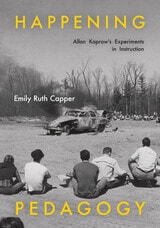
Happening Pedagogy
Allan Kaprow's Experiments in InstructionEmily Ruth Capper
University of Chicago Press, 2026
How Allan Kaprow’s happenings fused modernist pedagogy with an emerging college culture.
In Happening Pedagogy, art historian Emily Ruth Capper argues that Allan Kaprow’s famed invention of the happening brought together experimental traditions of modernist pedagogy with emerging forms of American undergraduate student culture—from hazing rituals to campus protests. Capper traces Kaprow’s trajectory from 1947 to 1968, following him through the classrooms of three of his instructors who were prominent figures in postwar American art—painter Hans Hofmann, art historian Meyer Schapiro, and composer John Cage—and across his own classrooms at institutions including Rutgers and Stony Brook University. Although Kaprow’s teachers were educated in the distinct disciplines of studio art, art history, and music, all three designed their classrooms to cultivate student creativity and critical reflection through forms of social exchange.
Capper shows that Kaprow transformed these modernist classrooms into new pedagogical environments that he developed within the novel context of the suburban state university. Drawing on archival sources, she describes how Kaprow engaged the culture and creative work of middle-class college students, whose rituals he took seriously as an avant-garde vernacular. In this way, Kaprow’s happenings represent a critical extension of modernism as a social practice of sensory attunement, experimentation, and philosophical critique. Through Kaprow’s work, modernist pedagogy became an artistic medium in itself, and his participation-based creative practices helped define the broad resurgence of the American neo-avant-garde after 1960.
Hip-Hop Civics
Connected Learning in the Rap ClassroomJabari M. Evans
University of Michigan Press, 2025
Hope, Heart, and the Humanities
How a Free College Course is Changing LivesJean Cheney and L. Jackson Newell, editors, with Hikmet Sidney Loe, Jeff Metcalf, and Bridget M. Newell
University of Utah Press, 2016
Hope, Heart, and the Humanities tells the story of how Venture, a free, interdisciplinary college humanities course inspired by the national Clemente Course, has helped open doors to improve the lives of people with low incomes who face barriers to attending college. For over a decade, this course has given hundreds of adults, some of them immigrants or refugees, the knowledge, confidence, and power to rechart their lives.
Readers will go inside Venture classrooms to see what occurs when adults enter serious discussions about literature, critical writing, art history, American history, and philosophy. Apparent also are the difficulties nontraditional students, who range in age from 18 to 60, often encounter in a college classroom and the hard choices they and their teachers make. What readers may remember most are the stories and words from people whose views of the world broaden and whose directions in life changed.
Interview with Tom Williams at Access Utah
How to Teach Art?
Wiktoria Furrer, Carla Gabrí, Nastasia Louveau, Maria Ordoñez, and Artur Zmijewski
Diaphanes, 2021
How should art be taught? What kind of knowledge should artists absorb? How might an ordinary person become a creature addicted to the creative process? In other words, how can a non-artist become an artist? Such programmatic questions articulated by acclaimed Polish artist Artur Żmijewski were at the heart of the workshop “How to Teach Art?” Żmijewski invited a group of graduate and doctoral students from three Zurich universities—the Swiss Federal Institute of Technology, the University of Zurich, and the Zurich University of the Arts—to collectively reflect on their artistic practices. Over the course of four months, the group met several times a week for hourlong sessions, following individual and collective exercises induced by Żmijewski himself.
This book retraces the workshop and its process by showing inconclusive, fragmentary results between theory and practice. How to Teach Art? presents drawings, videos, photographs, 16mm films, and accompanying reflections on the central premise, “How to teach art?”