Results by title
72 books match the query 'Being' and 4 start with h
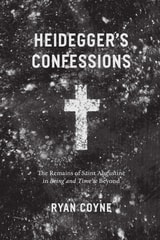
Heidegger's Confessions
The Remains of Saint Augustine in "Being and Time" and BeyondRyan Coyne
University of Chicago Press, 2015
Although Martin Heidegger is nearly as notorious as Friedrich Nietzsche for embracing the death of God, the philosopher himself acknowledged that Christianity accompanied him at every stage of his career. In Heidegger's Confessions, Ryan Coyne isolates a crucially important player in this story: Saint Augustine. Uncovering the significance of Saint Augustine in Heidegger’s philosophy, he details the complex and conflicted ways in which Heidegger paradoxically sought to define himself against the Christian tradition while at the same time making use of its resources.
Coyne first examines the role of Augustine in Heidegger’s early period and the development of his magnum opus, Being and Time. He then goes on to show that Heidegger owed an abiding debt to Augustine even following his own rise as a secular philosopher, tracing his early encounters with theological texts through to his late thoughts and writings. Bringing a fresh and unexpected perspective to bear on Heidegger’s profoundly influential critique of modern metaphysics, Coyne traces a larger lineage between religious and theological discourse and continental philosophy.
Coyne first examines the role of Augustine in Heidegger’s early period and the development of his magnum opus, Being and Time. He then goes on to show that Heidegger owed an abiding debt to Augustine even following his own rise as a secular philosopher, tracing his early encounters with theological texts through to his late thoughts and writings. Bringing a fresh and unexpected perspective to bear on Heidegger’s profoundly influential critique of modern metaphysics, Coyne traces a larger lineage between religious and theological discourse and continental philosophy.
[more]
Heidegger's Question of Being
Holger Zaborowski
Catholic University of America Press, 2017
The number of open and controversial questions in contemporary Heidegger research continues to be a source of scholarly dialogue. There are important questions that concern the development, as it were, of his thought and the differences and similarities between his early main work Being and Time and his later so-called being-historical thought, the thinking of the event, or appropriation, of Being. There are questions that focus on his relation to important figures in the history of ideas such as the pre-Socratics, Plato, Aristotle, Thomas Aquinas, Descartes, Leibniz, Kant, the German idealists, and Nietzsche. Other questions focus on his biography, on his rectorate and on his relation to politics in general and to National Socialism in particular or on his influence on subsequent philosophers.
The contributions to this volume, written by leading scholars in the field of Heidegger research, address many of these questions in close readings of Heidegger’s texts and thus provide sound orientation in the field of contemporary Heidegger research. They show how the different trajectories of Heidegger’s thought—his early interest in the meaning of Being and in Dasein, his discussion of, and involvement with, politics, his understanding of art, poetry, and technology, his concept of truth and the idea of a history of Being—all converge at one point: the question of Being. It thus becomes clear that, all differences notwithstanding, Heidegger followed one very consistent path of thinking.
The contributions to this volume, written by leading scholars in the field of Heidegger research, address many of these questions in close readings of Heidegger’s texts and thus provide sound orientation in the field of contemporary Heidegger research. They show how the different trajectories of Heidegger’s thought—his early interest in the meaning of Being and in Dasein, his discussion of, and involvement with, politics, his understanding of art, poetry, and technology, his concept of truth and the idea of a history of Being—all converge at one point: the question of Being. It thus becomes clear that, all differences notwithstanding, Heidegger followed one very consistent path of thinking.
[more]
Heidegger
The Question of Being and HistoryJacques Derrida
University of Chicago Press, 2016
Few philosophers held greater fascination for Jacques Derrida than Martin Heidegger, and in this book we get an extended look at Derrida’s first real encounters with him. Delivered over nine sessions in 1964 and 1965 at the École Normale Supérieure, these lectures offer a glimpse of the young Derrida first coming to terms with the German philosopher and his magnum opus, Being and Time. They provide not only crucial insight into the gestation of some of Derrida’s primary conceptual concerns—indeed, it is here that he first uses, with some hesitation, the word “deconstruction”—but an analysis of Being and Time that is of extraordinary value to readers of Heidegger or anyone interested in modern philosophy.
Derrida performs an almost surgical reading of the notoriously difficult text, marrying pedagogical clarity with patient rigor and acting as a lucid guide through the thickets of Heidegger’s prose. At this time in intellectual history, Heidegger was still somewhat unfamiliar to French readers, and Being and Time had only been partially translated into French. Here Derrida mostly uses his own translations, giving his own reading of Heidegger that directly challenges the French existential reception initiated earlier by Sartre. He focuses especially on Heidegger’s Destruktion (which Derrida would translate both into “solicitation” and “deconstruction”) of the history of ontology, and indeed of ontology as such, concentrating on passages that call for a rethinking of the place of history in the question of being, and developing a radical account of the place of metaphoricity in Heidegger’s thinking.
This is a rare window onto Derrida’s formative years, and in it we can already see the philosopher we’ve come to recognize—one characterized by a bravura of exegesis and an inventiveness of thought that are particularly and singularly his.
[more]
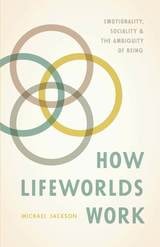
How Lifeworlds Work
Emotionality, Sociality, and the Ambiguity of BeingMichael Jackson
University of Chicago Press, 2017
Michael Jackson has spent much of his career elaborating his rich conception of lifeworlds, mining his ethnographic and personal experience for insights into how our subjective and social lives are mutually constituted.
In How Lifeworlds Work, Jackson draws on years of ethnographic fieldwork in West Africa to highlight the dynamic quality of human relationships and reinvigorate the study of kinship and ritual. How, he asks, do we manage the perpetual process of accommodation between social norms and personal emotions, impulses, and desires? How are these two dimensions of lived reality joined, and how are the dual imperatives of individual expression and collective viability managed? Drawing on the pragmatist tradition, psychology, and phenomenology, Jackson offers an unforgettable, beautifully written account of how we make, unmake, and remake, our lifeworlds.
In How Lifeworlds Work, Jackson draws on years of ethnographic fieldwork in West Africa to highlight the dynamic quality of human relationships and reinvigorate the study of kinship and ritual. How, he asks, do we manage the perpetual process of accommodation between social norms and personal emotions, impulses, and desires? How are these two dimensions of lived reality joined, and how are the dual imperatives of individual expression and collective viability managed? Drawing on the pragmatist tradition, psychology, and phenomenology, Jackson offers an unforgettable, beautifully written account of how we make, unmake, and remake, our lifeworlds.
[more]