Results by title
379 books match the query 'Botany' and 10 start with h
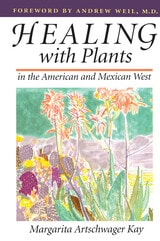
Healing with Plants in the American and Mexican West
Margarita Artschwager Kay
University of Arizona Press, 1996
Acacia (Cassie, Acacia)
Achillea (Yarrow)
Agastache (Giant Hyssop)
Agave (Century Plant)
Allium (Garlic, Onion)
Aloe (Aloe)
Ambrosia (Ragweed)
Anemopsis (Yerba Mansa)
Arctostaphylos (Bearberry, Uva Ursi)
Argemone (Prickly Poppy)
Aristolochia (Bithwort, Snakeroot)
Arracacia (Arracacha)
Artemisia (Wormwood, Mugwort, Western Mugwort, Sagebrush)
Asclepias (Milkweed)
Baccharis (Desert Broom, Seep Willow)
Bocconia (Tree Celandine)
Buddleia (Butterfly Bush)
Bursera (Elephant Tree)
Caesalpinia (Mexican Bird-of-Paradise)
Cannabis (Marijuana)
Capsicum (Chili)
Carnegiea (Saguaro)
Casimiroa (Zapote)
Cassia (Senna)
Cereus (Cactus)
Chenopodium (Goosefoot, Wormseed)
Citrus (Lemon, Lime, Orange)
Datura (Jimson Weed)
Ephedra (Mormon Tea)
Equisetum (Horsetail)
Eryngium (Eryngo, Button Snakeroot)
Eucalyptus (Eucalyptus)
Euphorbia (Spurge)
Eysenhardtia (Kidneywood)
Gnaphalium (Everlasting, Cudweed)
Guaiacum (Lignum Vitae)
Guazuma (Guazuma)
Gutierrezia (Turpentine Bush)
Haematoxylon (Logwood)
Haplopappus (Jimmyweed)
Heterotheca (Telegraph Plant, Falso Arnica)
Hintonia (Copalqu¡n)
Ibervillea (Coyote Melon)
Jacquinia (Jacquinia)
Jatropha (Limberbush)
Juniperus (Juniper)
Karwinskia (Coffeeberry)
Kohleria (Tree Gloxinia)
Krameria (Ratany)
Lantana (Lantana)
Larrea (Creosote Bush, Greasewood)
Ligusticum (Lovage)
Lippia (Oregano)
Lysiloma (Featherbush)
Malva (Mallow)
Mammillaria (Pincushion Cactus)
Mascagnia (Mascagnia)
Matricaria (Chamomile)
Mentha (Mint)
Nicotiana (Tobacco)
Ocimum (Basil)
Opuntia (Cholla, Prickly Pear)
Perezia (Perezia)
Persea (Avocado)
Phaseolus (Bean)
Phoradendron, Stru
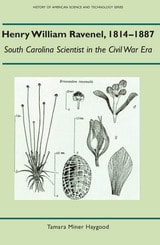
Henry William Ravenel, 1814-1887
South Carolina Scientist in the Civil War EraTamara Miner Haygood
University of Alabama Press, 1987
The life of a pioneering Southern scientist in an era of war, change, and discovery.
Henry William Ravenel, 1814–1887: South Carolina Scientist in the Civil War Era is a compelling biography of one of nineteenth-century America's most accomplished yet largely overlooked natural scientists. Through meticulous archival research, Tamara Miner Haygood brings to life the story of Henry William Ravenel, a South Carolina planter, botanist, and pioneering mycologist whose work earned international recognition while he lived far from the major scientific centers of the United States.
Born into the Lowcountry planter class, Ravenel developed a lifelong fascination with the natural world and became a leading authority on the study of fungi and plants. Despite limited formal scientific training, he built an extensive network of correspondents that included some of the most prominent botanists in America and Europe. His collections, publications, and exchanges of specimens contributed significantly to the advancement of botanical science and established his reputation as one of the foremost naturalists of his generation.
Haygood places Ravenel's scientific achievements within the broader context of Southern society, demonstrating how intellectual pursuits flourished in unexpected ways within a region often overlooked in histories of American science. At the same time, the biography confronts the realities of slavery, plantation life, religion, and regional identity that shaped Ravenel's world. His experience challenges long-held assumptions about the relationship between Southern culture and scientific inquiry.
The Civil War and its aftermath transformed Ravenel's life, disrupting his finances, professional networks, and daily routines. Yet he remained committed to scientific work, continuing to collect, study, and publish despite enormous challenges. More than a biography, this volume offers a fascinating exploration of science, society, and survival during one of the most turbulent periods in American history. Essential reading for historians of science, Civil War scholars, environmental historians, botanists, and students of Southern culture.

Herbarium Handbook Chinese Edition
Yi-jian Yao
Royal Botanic Gardens, Kew, 1998
Hidden Natural Histories
HerbsKim Hurst
University of Chicago Press, 2015
Hidden Natural Histories
TreesNoel Kingsbury
University of Chicago Press, 2015
High Plains Horticulture
A HistoryJohn F. Freeman
University Press of Colorado, 2008
How To Identify Plants
H. D. Harrington
Ohio University Press, 1957
First issued in 1957 by Swallow Press, this classic guide to the art of plant identification is now familiar to an entire generation of students. Harrington who was Professor of Botany and Curator of the Herbarium at Colorado State University, gives step-by-step instructions and definitions to help readers recognize and classify plants. The new printing has been reset and reformatted, and L.W. Durrell’s drawings and glossary—more than 500 images—have been digitally enhanced for clarity.
How the Earth Turned Green
A Brief 3.8-Billion-Year History of PlantsJoseph E. Armstrong
University of Chicago Press, 2014
Using an evolutionary framework, How the Earth Turned Green addresses questions such as: Should all green organisms be considered plants? Why do these organisms look the way they do? How are they related to one another and to other chlorophyll-free organisms? How do they reproduce? How have they changed and diversified over time? And how has the presence of green organisms changed the Earth’s ecosystems? More engaging than a traditional textbook and displaying an astonishing breadth, How the Earth Turned Green will both delight and enlighten embryonic botanists and any student interested in the evolutionary history of plants.

How to Identify Grasses and Grasslike Plants
Sedges and RushesH. D. Harrington
Ohio University Press, 1977
There is no easy way to identify grasses. And no one understands this better than H.D. Harrington, who observed thousands of students struggle and learn. His clear, concise, and well-organized guide will continue to be a basic and essential text for use in the classroom or in the field. The book contains over 500 drawings and an illustrated glossary.
Hybrid
The History and Science of Plant BreedingNoel Kingsbury
University of Chicago Press, 2009
Disheartened by the shrink-wrapped, Styrofoam-packed state of contemporary supermarket fruits and vegetables, many shoppers hark back to a more innocent time, to visions of succulent red tomatoes plucked straight from the vine, gleaming orange carrots pulled from loamy brown soil, swirling heads of green lettuce basking in the sun.
With Hybrid, Noel Kingsbury reveals that even those imaginary perfect foods are themselves far from anything that could properly be called natural; rather, they represent the end of a millennia-long history of selective breeding and hybridization. Starting his story at the birth of agriculture, Kingsbury traces the history of human attempts to make plants more reliable, productive, and nutritious—a story that owes as much to accident and error as to innovation and experiment. Drawing on historical and scientific accounts, as well as a rich trove of anecdotes, Kingsbury shows how scientists, amateur breeders, and countless anonymous farmers and gardeners slowly caused the evolutionary pressures of nature to be supplanted by those of human needs—and thus led us from sparse wild grasses to succulent corn cobs, and from mealy, white wild carrots to the juicy vegetables we enjoy today. At the same time, Kingsbury reminds us that contemporary controversies over the Green Revolution and genetically modified crops are not new; plant breeding has always had a political dimension.
A powerful reminder of the complicated and ever-evolving relationship between humans and the natural world, Hybrid will give readers a thoughtful new perspective on—and a renewed appreciation of—the cereal crops, vegetables, fruits, and flowers that are central to our way of life.