332 books match the query 'Canada' and 7 start with h
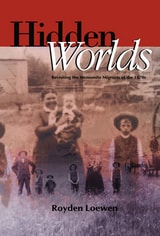
cover of Hidden Worlds: Revisiting the Mennonite Migrants of the 1870s

Hidden Worlds

Revisiting the Mennonite Migrants of the 1870s

Royden Loewen

University of Manitoba Press, 2001
In the 1870s, approximately 18,000 Mennonites migrated from the southern steppes of Imperial Russia (present-day Ukraine) to the North American grasslands. They brought with them an array of cultural and institutional features that indicated they were a "transplanted" people. What is less frequently noted, however, is that they created in their everyday lives a world that ensured their cultural longevity and social cohesiveness in a new land.Their adaptation to the New World required new concepts of social boundary and community, new strategies of land ownership and legacy, new associations, and new ways of interacting with markets. In Hidden Worlds, historian Royden Loewen illuminates some of these adaptations, which have been largely overshadowed by an emphasis on institutional history, or whose sources have only recently been revealed. Through an analysis of diaries, wills, newspaper articles, census and tax records, and other literature, an examination of inheritance practices, household dynamics, and gender relations, and a comparison of several Mennonite communities in the United States and Canada, Loewen uncovers the multi-dimensional and highly resourceful character of the 1870s migrants.
[more]
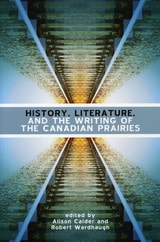
cover of History, Literature and the Writing of the Canadian Prairies

History, Literature and the Writing of the Canadian Prairies

Alison Calder

University of Manitoba Press, 2005
The Canadian Prairie has long been represented as a timeless and unchanging location, defined by settlement and landscape. Now, a new generation of writers and historians challenge that perception and argue, instead, that it is a region with an evolving culture and history. This collection of ten essays explores a more contemporary prairie identity, and reconfigures "the prairie" as a construct that is non-linear and diverse, responding to the impact of geographical, historical, and political currents. These writers explore the connections between document and imagination, between history and culture, and between geography and time.The subjects of the essays range widely: the non-linear structure of Carol Shield's The Stone Diaries; the impact of Aberhart's Social Credit, Marshall McLuhan, and Mesopotamian myth on Robert Kroetsch's prairie postmodernism; the role of document in long prairie poems; the connection between cultural tourism and heritage; the theme of regeneration in Margaret Laurence's Manawaka writing; the influence of imagination on geography in Thomas Wharton's Icefields; and the effects on an alpine climber of pre-WWII ideological concepts of time and individualism.
[more]
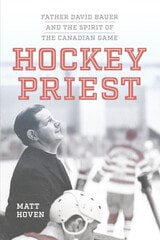
cover of Hockey Priest: Father David Bauer and the Spirit of the Canadian Game

Hockey Priest

Father David Bauer and the Spirit of the Canadian Game

Matt Hoven

Catholic University of America Press, 2024
Born in Waterloo, Ontario, in 1924, to a prominent family, David Bauer attended St. Michael’s College-School run by the Basilian Fathers of Toronto. After serving in World War II, Bauer joined the religious community and coached its St. Michael’s Majors to a national championship in 1961. Influenced by philosophers like Jacques Maritain, Bauer tried to find solutions to problems created within elite hockey and thus founded Canada’s first ever National Team program. This team countered the cutthroat ideals of hockey’s powerbrokers and set out to return Canada to international glory. The team represented the nation at several global tournaments and three Winter Olympic Games. Bauer was posthumously inducted into the Hockey Hall of Fame in 1989. Hockey Priest looks past simply understanding Bauer as a do-gooder or hockey innovator. It shows how he attempted to create a different stream of hockey that could better support youth and so build up the nation. Archival research for the book uncovered Bauer-written hockey reports, speeches, and notes that detail his thinking about the game and his politicking to bring about change in it. Interviews with dozens of associates and family members told the story of his bold efforts to take on the National Hockey League. Despite his work being undermined by some supporters of the corporate game, Bauer offered a vision for Canada’s sport that remains an important counterpoint in the sport’s history and its ongoing challenges.
[more]
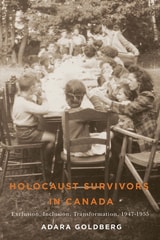
cover of Holocaust Survivors in Canada: Exclusion, Inclusion, Transformation, 1947-1955

Holocaust Survivors in Canada

Exclusion, Inclusion, Transformation, 1947-1955

Adara Goldberg

University of Manitoba Press, 2015

[more]
cover of Honouring the Strength of Indian Women: Plays, Stories, Poetry

Honouring the Strength of Indian Women

Plays, Stories, Poetry

Vera Manuel

University of Manitoba Press, 2019
[more]
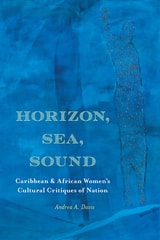
cover of Horizon, Sea, Sound: Caribbean and African Women's Cultural Critiques of Nation

Horizon, Sea, Sound

Caribbean and African Women's Cultural Critiques of Nation

Andrea A. Davis

Northwestern University Press, 2022

Winner of the 2023 Canadian Association of Latin American and Caribbean Studies’ Best Book Prize

In Horizon, Sea, Sound: Caribbean and African Women’s Cultural Critiques of Nation, Andrea Davis imagines new reciprocal relationships beyond the competitive forms of belonging suggested by the nation-state. The book employs the tropes of horizon, sea, and sound as a critique of nation-state discourses and formations, including multicultural citizenship, racial capitalism, settler colonialism, and the hierarchical nuclear family.
 
Drawing on Tina Campt’s discussion of Black feminist futurity, Davis offers the concept future now, which is both central to Black freedom and a joint social justice project that rejects existing structures of white supremacy. Calling for new affiliations of community among Black, Indigenous, and other racialized women, and offering new reflections on the relationship between the Caribbean and Canada, she articulates a diaspora poetics that privileges our shared humanity. In advancing these claims, Davis turns to the expressive cultures (novels, poetry, theater, and music) of Caribbean and African women artists in Canada, including work by Dionne Brand, M. NourbeSe Philip, Esi Edugyan, Ramabai Espinet, Nalo Hopkinson, Amai Kuda, and Djanet Sears. Davis considers the ways in which the diasporic characters these artists create redraw the boundaries of their horizons, invoke the fluid histories of the Caribbean Sea to overcome the brutalization of plantation histories, use sound to enter and reenter archives, and shapeshift to survive in the face of conquest. The book will interest readers of literary and cultural studies, critical race theories, and Black diasporic studies.
[more]
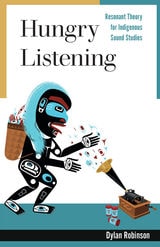
cover of Hungry Listening: Resonant Theory for Indigenous Sound Studies

Hungry Listening

Resonant Theory for Indigenous Sound Studies

Dylan Robinson

University of Minnesota Press, 2020

WInner of the Best First Book from the Native American and Indigenous Studies Association
Winner of the Labriola Center American Indian National Book Award
Winner of the Ann Saddlemyer Award from the Canadian Association for Theatre Research


Reimagining how we understand and write about the Indigenous listening experience​

Hungry Listening is the first book to consider listening from both Indigenous and settler colonial perspectives. A critical response to what has been called the “whiteness of sound studies,” Dylan Robinson evaluates how decolonial practices of listening emerge from increasing awareness of our listening positionality. This, he argues, involves identifying habits of settler colonial perception and contending with settler colonialism’s “tin ear” that renders silent the epistemic foundations of Indigenous song as history, law, and medicine. 

With case studies on Indigenous participation in classical music, musicals, and popular music, Hungry Listening examines structures of inclusion that reinforce Western musical values. Alongside this inquiry on the unmarked terms of inclusion in performing arts organizations and compositional practice, Hungry Listening offers examples of “doing sovereignty” in Indigenous performance art, museum exhibition, and gatherings that support an Indigenous listening resurgence.

Throughout the book, Robinson shows how decolonial and resurgent forms of listening might be affirmed by writing otherwise about musical experience. Through event scores, dialogic improvisation, and forms of poetic response and refusal, he demands a reorientation toward the act of reading as a way of listening. Indigenous relationships to the life of song are here sustained in writing that finds resonance in the intersubjective experience between listener, sound, and space. 

[more]