Results by title
788 books match the query 'Caribbean & Latin American' and 16 start with h
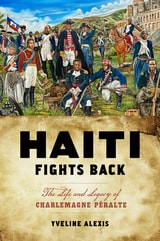
Haiti Fights Back
The Life and Legacy of Charlemagne PéralteYveline Alexis
Rutgers University Press, 2021
Haiti Fights Back: The Life and Legacy of Charlemagne Péralte is the first US scholarly examination of the politician and caco leader (guerrilla fighter) who fought against the US military occupation of Haiti. The occupation lasted close to two decades, from 1915-1934. Alexis argues for the importance of documenting resistance while exploring the occupation’s mechanics and its imperialism. She takes us to Haiti, exploring the sites of what she labels as resistance zones, including Péralte’s hometown of Hinche and the nation’s large port areas--Port-au-Prince and Cap-Haïtien. Alexis offers a new reading of U.S. military archival sources that record Haitian protests as banditry. Haiti Fights Back illuminates how Péralte launched a political movement, and meticulously captures how Haitian women and men resisted occupation through silence, military battles, and writings. She locates and assembles rare, multilingual primary sources from traditional repositories, living archives (oral stories), and artistic representations in Haiti and the United States. The interdisciplinary work draws on legislation, cacos’ letters, newspapers, and murals, offering a unique examination of Péralte’s life (1885-1919) and the significance of his legacy through the twenty-first century. Haiti Fights Back offers a new approach to the study of the U.S. invasion of the Americas by chronicling how Caribbean people fought back.
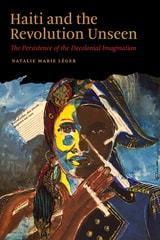
Haiti and the Revolution Unseen
The Persistence of the Decolonial ImaginationNatalie Marie Léger
Vanderbilt University Press, 2025
Léger writes against a Haiti- and Haitians-less idea of the Revolution. She asks scholars and artists of the Revolution to know Haitians as Ginens (African Haitians) and Haiti as Ayiti Ginen (Africa Haiti). This form of knowing demands a decolonial understanding of the Haitian Revolution and a reevaluation of its stories as told by influential twentieth-century Caribbean writers. The story she tells showcases the immense political impact of the African Haitian revolutionist’s philosophies of freedom in Saint Domingue and Haiti thereafter; and she argues that the absence of these philosophies in Caribbean classics of the Revolution demands consideration of why these classics continue to shape how the Revolution and Haiti are discussed in Caribbean Studies, Black Studies, Postcolonial Studies and Haitian Studies. More pressingly, Léger calls on artists and scholars of the Revolution to be mindful of how Haiti and Haitians are figured in narratives of the Revolution. The immense space Haiti holds in Caribbean imaginings of freedom and revolution makes mediating it, its Revolution, and peoples through a prejudiced gaze that serves the West hugely problematic, since a denigrated Haiti yields stunted visions of the Caribbean’s future. These conditions require attention to the pervasive presence of colonial paradigms for being in classic literatures of the Revolution and the way they undermine the generative manner Caribbean writers have used Haiti to think through their past, present, and future.
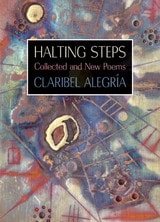
Halting Steps
Collected and New PoemsClaribel Alegria
Northwestern University Press, 2013
Halting Steps represents the most complete single-volume retrospective in English of Claribel Alegría’s seven-decade career. The volume collects all of Alegría’s poems from her fourteen previously published books and debuts several new poems under the title “Otherness.”
Her poetry is not only lyrical and introspective but also politically engaged. Her verse speaks forcefully, specifically, and fearlessly to matters of social justice in her region. She strikes a universal theme, however, in giving a voice to individuals of all classes in their struggle against oppression, but especially women who must contend with a system in which men hold the power and women are excluded. Alegría demonstrates her remarkable range with deeply personal poems, perhaps most notably in the poem cycle “Sorrow,” as she moves steadily through the waves of grief she experiences after her husband’s death.
In Halting Steps, both longtime admirers and those new to her work can appreciate the sustained creative power of Claribel Alegría’s poems.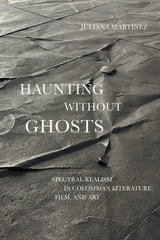
Haunting Without Ghosts
Spectral Realism in Colombian Literature, Film, and ArtBy Juliana Martínez
University of Texas Press, 2020
Winner, William M. LeoGrande Prize, Center for Latin American and Latino Studies at American University, 2022
For half a century, cultural production in Colombia has labored under the weight of magical realism—above all, the works of Gabriel García Márquez—where ghosts told stories about the country’s violent past and warned against a similarly gruesome future.
Decades later, the story of violence in Colombia is no less horrific, but the critical resources of magical realism are depleted. In their wake comes "spectral realism." Juliana Martínez argues that recent Colombian novelists, filmmakers, and artists—from Evelio Rosero and William Vega to Beatriz González and Erika Diettes—share a formal and thematic concern with the spectral but shift the focus from what the ghost is toward what the specter does. These works do not speak of ghosts. Instead, they use the specter to destabilize reality by challenging the authority of human vision and historical chronology.
By introducing the spectral into their work, these artists decommodify well-worn modes of representing violence and create a critical space from which to seek justice for the dead and disappeared. A Colombia-based study, Haunting without Ghosts brings powerful insight to the politics and ethics of spectral aesthetics, relevant for a variety of sociohistorical contexts.

Heaven, Hell, and Everything in Between
Murals of the Colonial AndesBy Ananda Cohen-Aponte
University of Texas Press, 2016
Examining the vivid, often apocalyptic church murals of Peru from the early colonial period through the nineteenth century, Heaven, Hell, and Everything in Between explores the sociopolitical situation represented by the artists who generated these murals for rural parishes. Arguing that the murals were embedded in complex networks of trade, commerce, and the exchange of ideas between the Andes and Europe, Ananda Cohen-Aponte also considers the ways in which artists and viewers worked through difficult questions of envisioning sacredness.
This study brings to light the fact that, unlike the murals of New Spain, the murals of the Andes possess few direct visual connections to a pre-Columbian painting tradition; the Incas’ preference for abstracted motifs created a problem for visually translating Catholic doctrine to indigenous congregations, as the Spaniards were unable to read Inca visual culture. Nevertheless, as Cohen Suarez demonstrates, colonial murals of the Andes can be seen as a reformulation of a long-standing artistic practice of adorning architectural spaces with images that command power and contemplation. Drawing on extensive secondary and archival sources, including account books from the churches, as well as on colonial Spanish texts, Cohen Suarez urges us to see the murals not merely as decoration or as tools of missionaries but as visual archives of the complex negotiations among empire, communities, and individuals.
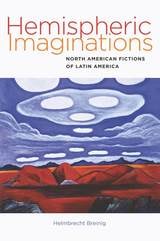
Hemispheric Imaginations
North American Fictions of Latin AmericaHelmbrecht Breinig
Dartmouth College Press, 2016

Hemispheric Waves
Havana's Avant-Garde Theatre, 1965-2000Eric Mayer-García
University of Iowa Press, 2027
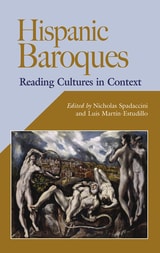
Hispanic Baroques
Reading Cultures in ContextNicholas Spadaccini
Vanderbilt University Press, 2005
History and Memory in the Two Souths
Recent Southern and Spanish American FictionDeborah Cohn
Vanderbilt University Press, 1999
First, Cohn proposes that Faulkner's appeal derives from Spanish American authors' perception of similarities between the South's history and the experiences of their own respective nations. She delineates historical experiences common to the South and Spanish America, including civil wars, defeat and dispossession, regional marginalization, and socio-economic hardship. She also suggests that Spanish American authors found in Faulkner a set of concerns with which they could identify and that, as a result, they were inspired to take up the stylistic innovations characteristic of his writing. The resulting assimilation and adaptation of Euro-American modernism through Faulkner has been an indispensable part of what is known as la nueva narrativa, "the new narrative," as well as of successive movements in Spanish American literature.
From another perspective, Cohn's book shows points of contact between works by other southern and Spanish American novelists without positing relations of influence. Specifically, after identifying common, recurrent themes in modern southern and Spanish American literature in general, Cohn reveals levels of a shared understanding of regional history in Faulkner and Mario Vargas Llosa, in Ralph Ellison and Isabel Allende, as well as in Katherine Anne Porter and Juan Rulfo. Her analyses compare and contrast these authors' shared attempts to provide correctives to official, mainstream historical discourse through alternate, parallel strategies for reconstructing, recording, and reclaiming the past.
In yoking together the South and Spanish America as neighboring spaces with similar personalities, Cohn advances a daring and controversial thesis that both narrows and enhances the frame of comparison between the literatures of the South and Spanish America.

History and Mythology of the Aztecs
The Codex ChimalpopocaJohn Bierhorst
University of Arizona Press, 1992
Of particular interest are the stories of the hero-god Quetzalcoatl, for which the Chimalpopoca is the premier source. John Bierhorst's work is the first major scholarship on the Codex Chimalpopoca in more than forty years. His is the first edition in English and the first in any language to include the complete text of the Legend of the Suns. The precise, readable translation not only contributes to the study of Aztec history and literature but also makes the codex an indispensable reference for Aztec cultural topics, including land tenure, statecraft, the role of women, the tribute system, warfare, and human sacrifice.
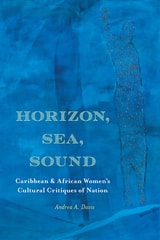
Horizon, Sea, Sound
Caribbean and African Women's Cultural Critiques of NationAndrea A. Davis
Northwestern University Press, 2022
In Horizon, Sea, Sound: Caribbean and African Women’s Cultural Critiques of Nation, Andrea Davis imagines new reciprocal relationships beyond the competitive forms of belonging suggested by the nation-state. The book employs the tropes of horizon, sea, and sound as a critique of nation-state discourses and formations, including multicultural citizenship, racial capitalism, settler colonialism, and the hierarchical nuclear family.
Drawing on Tina Campt’s discussion of Black feminist futurity, Davis offers the concept future now, which is both central to Black freedom and a joint social justice project that rejects existing structures of white supremacy. Calling for new affiliations of community among Black, Indigenous, and other racialized women, and offering new reflections on the relationship between the Caribbean and Canada, she articulates a diaspora poetics that privileges our shared humanity. In advancing these claims, Davis turns to the expressive cultures (novels, poetry, theater, and music) of Caribbean and African women artists in Canada, including work by Dionne Brand, M. NourbeSe Philip, Esi Edugyan, Ramabai Espinet, Nalo Hopkinson, Amai Kuda, and Djanet Sears. Davis considers the ways in which the diasporic characters these artists create redraw the boundaries of their horizons, invoke the fluid histories of the Caribbean Sea to overcome the brutalization of plantation histories, use sound to enter and reenter archives, and shapeshift to survive in the face of conquest. The book will interest readers of literary and cultural studies, critical race theories, and Black diasporic studies.
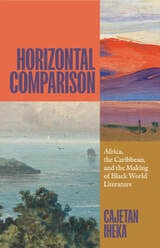
Horizontal Comparison
Africa, the Caribbean, and the Making of Black World LiteratureCajetan Iheka
University of Chicago Press, 2026
By analyzing African and Caribbean texts on their own terms, Horizontal Comparison articulates new forms of transoceanic solidarity.
The fields of comparative literature and Black Atlantic studies have an Africa problem: despite sustained attempts to decenter Western paradigms, they still privilege the United States and Europe as the primary loci of reference. So argues Cajetan Iheka in Horizontal Comparison, which aims to redirect both fields toward a non-hierarchical, South-South orientation focusing on the links between Africa and the Caribbean.
By analyzing the literary work and real-life trajectories of writers such as Peter Abrahams, Chimamanda Adichie, Maryse Condé, Buchi Emecheta, Jamaica Kincaid, Claude McKay, Dinaw Mengestu, Ferdinand Oyono, Taiye Selasi, and Sam Selvon, Iheka draws our attention to the ways in which African and Caribbean texts inform and mutually constitute each other, bypassing the usual comparisons to Western literary canons. The book challenges not only Western cultural hegemony in the study of global Black writing but also the very methodologies of comparative literary studies, offering fresh insights into reading, trauma, character, and the “worlding” of literature.
How Women Win Presidential Elections in Latin America
Catherine Reyes-Housholder
Temple University Press, 2026
Between 1990 and 2020, women candidates won only 6% of the world’s presidential races. How Women Win Presidential Elections in Latin America explains the factors, strategies, and perceptions that help (or hinder) women to democratically access their country’s highest political office. Catherine Reyes-Housholder introduces a theory of gendered incentives and perceived potential to reveal why a political party would break with tradition and nominate a woman. She also shows how citizens respond when women candidates are running in incumbent parties or competing to displace those in power.
Drawing on comparative research on the presidency and gender, How Women Win Presidential Elections in Latin America examines the successful campaigns of Michelle Bachelet in Chile and Dilma Rousseff in Brazil, as well as why Blanca Ovelar lost her presidential race in Paraguay. Reyes-Housholder’s findings indicate that voter sexism is not a major factor; however, women do not triumph in these elections in the same ways that men do. Rather, the central unknown factor behind women’s victories is how they become candidates of major parties—and gender profoundly influences who parties nominate.
How Women Win Presidential Elections in Latin America is a valuable investigation of women and executive politics.
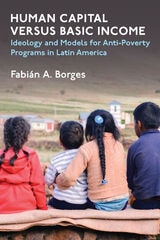
Human Capital versus Basic Income
Ideology and Models for Anti-Poverty Programs in Latin AmericaFabián A. Borges
University of Michigan Press, 2022
There were two distinct models of CCTs: a “human capital” model based on means-tested targeting and strict enforcement of program conditions, exemplified by the program launched by Mexico’s right, and a more universalistic “basic income” model with more permissive enforcement of conditionality, exemplified by Brazil’s program under Lula. These two models then spread across the region. Whereas right and center governments, with assistance from international financial institutions, enacted CCTs based on the human capital model, the left, with assistance from Brazil, enacted CCTs based on the basic income model.
The existence of two distinct types of CCTs and their relation to ideology is supported by quantitative analyses covering the entire region and in-depth case studies based on field research in three countries. Left-wing governments operate CCTs that cover more people and spend more on those programs than their center or right-wing counterparts. Beyond coverage, a subsequent analysis of the 10 national programs adopted after Lula’s embrace of CCTs confirms that program design—evaluated in terms of scope of the target population, strictness of conditionality enforcement, and stipend structure—is shaped by government ideology. This finding is then fleshed out through case studies of the political processes that culminated in the adoption of basic income CCTs by left-wing governments in Argentina and Bolivia and a human capital CCT by a centrist president in Costa Rica.
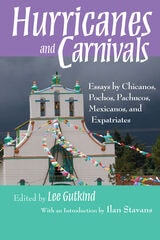
Hurricanes and Carnivals
Essays by Chicanos, Pochos, Pachucos, Mexicanos, and ExpatriatesEdited by Lee Gutkind, with an Introduction by Ilan Stavans
University of Arizona Press, 2007
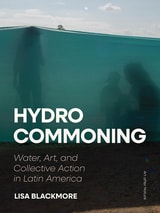
Hydrocommoning
Water, Art, and Collective Action in Latin AmericaLisa Blackmore
University of Minnesota Press, 2027
Reimagining watersheds as living hydrocommons through which artists and communities create more just and sustainable futures
Hydrocommoning explores how artists, activists, and curators coalesce around water in embodied efforts to contest entrenched and enduring forms of harm and degradation. Against the reduction of rivers, streams, and wetlands to mere resources to be managed, Hydrocommoning centers water as a living web of relations through which artists and communities forge creative means of reconnection by moving, weaving, pumping, eating, and listening.
By charting these aesthetic practices, Hydrocommoning shows how artists and organizers across Latin America oppose extractivism, unequal urbanization, ecological degradation, and the erasure of Indigenous water cultures. To cultivate widespread social attunement to vulnerable waters and raise the call for their defense and care, collectives in Brazil, Colombia, Guatemala, and Peru engage in communal meals, sound art, infrastructural interventions, and other practices that Lisa Blackmore theorizes as “hydrocommoning.”
Grounded in five years of experiential fieldwork, archival research, and curatorial projects in Latin America, Blackmore proposes a methodology to work with water as an analytical framework for collective action. Bridging the gap between theory, curating, and community-based practices, Hydrocommoning offers a promising vision of grassroots organizing that actively confronts some of today’s most urgent ecological threats.
Retail e-book files for this title are screen-reader friendly with images accompanied by short alt text and/or extended descriptions.