Results by title
206 books match the query 'City Planning & Urban Development' and 5 start with h
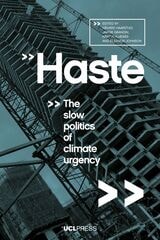
Haste
The Slow Politics of Climate UrgencyEdited by Håvard Haarstad, Jakob Grandin, Kristin Kjærås, and Eleanor Johnson
University College London, 2023
It’s understandable that we tend to present climate change as something urgently requiring action. Every day we fail to act, the potential for catastrophe grows. But is that framing itself a problem? When we hurry, we make more mistakes. We overlook things. We get tunnel vision.
In Haste, a group of distinguished contributors makes the case for a slow politics of urgency. Rather than rushing and speeding up, he argues, the sustainable future is better served by our challenging of the dominant framings through which we understand time and change in society. While recognizing the need for certain types of urgency in climate politics, Haste directs attention to the different and alternative temporalities at play in climate and sustainability politics. Divided into short and accessible chapters, written by both established and emerging scholars from different disciplines, Haste tackles a major problem in contemporary climate change research and offers creative perspectives on pathways out of the climate emergency.
Health Colonialism
Urban Wastelands and Hospital FrontiersShiloh Krupar
University of Minnesota Press, 2023
The role of American hospital expansions in health disparities and medical apartheid
Health Colonialism considers how U.S. urban development policies contribute to the uneven and unjust distribution of health care in this country. Here, Shiloh Krupar investigates the racially inequitable effects of elite U.S. hospitals on their surrounding neighborhoods and their role in consolidating frontiers of land primed for redevelopment.
Naming this frontier “medical brownfields,” Krupar shows how hospitals leverage their domestic real estate empires to underwrite international prospecting for patients and overseas services and specialty clinics. Her pointed analysis reveals that decolonizing health care efforts must scrutinize the land practices of nonprofit medical institutions and the liberal foundations of medical apartheid perpetuated by globalizing American health care.
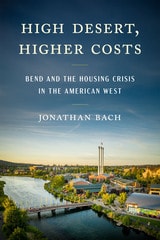
High Desert, Higher Costs
Bend and the Housing Crisis in the American WestJonathan Bach
Oregon State University Press, 2025
Nestled against the Cascade Mountains, former lumber town Bend, Oregon, entices residents who long to live in a wonderland of sagebrush and forests. But like so many other communities across the West, Bend has too few homes for everyone clambering for access. In High Desert, Higher Costs, Jonathan Bach takes a closer look at the housing crisis in this mid-sized city that is both the population center for rural Central Oregon and a major recreation area. Bach uses Bend as a lens into the growing housing crisis in the region, where residents and tourists alike prize access to outdoor recreation, and housing issues have been brewing for decades.
Like other cities in Montana, Idaho, and Colorado, Bend serves as a gateway to popular natural areas while also experiencing a limited amount of new housing, increasing populations, amenity migrants in the age of remote work, depressed or stagnating wages, and a widening gulf between homeowners and renters. High Desert, Higher Costs introduces us to regular people—from the former political candidate evicted during COVID-19 to the nonprofit worker hoping to build apartments for the houseless—who struggle to call Bend home. Bach explores the causes of these issues and the political, legal, economic, and cultural factors influencing them, and also offers potential solutions for current and future residents to build their lives now, and in the years to come, in Bend and throughout the American West.
Homeowners and Neighborhood Reinvestment
George C. Galster
Duke University Press, 1987
Multivariate statistical analyses of models were conducted using household data from Minneapolis and Wooster, Ohio. Three important findings emerged. First, homeowners' sense of solidarity with their neighbors is as significant in determining their efforts at home upkeep as are their income or age. Second, the optimism of homeowners toward increases in property values results in behavior opposite to that produced by optimism about neighborhood quality of life. This implies that different kinds of predictable gaming behavior occur among homeowners, depending on the neighborhoods in which they live. Third, both short-term and extremely long-term plans to move prove damaging to home upkeep.
The results of this study form the basis for a better understanding of such residential phenomena as class succession, racial transition, and gentrification. Galster's findings will also be valuable for analyzing policies that attempt to encourage neighborhood reinvestment.
How Cities Work
Suburbs, Sprawl, and the Roads Not TakenBy Alex Marshall
University of Texas Press, 2001
Do cities work anymore? How did they get to be such sprawling conglomerations of lookalike subdivisions, megafreeways, and "big box" superstores surrounded by acres of parking lots? And why, most of all, don't they feel like real communities? These are the questions that Alex Marshall tackles in this hard-hitting, highly readable look at what makes cities work.
Marshall argues that urban life has broken down because of our basic ignorance of the real forces that shape cities—transportation systems, industry and business, and political decision making. He explores how these forces have built four very different urban environments—the decentralized sprawl of California's Silicon Valley, the crowded streets of New York City's Jackson Heights neighborhood, the controlled growth of Portland, Oregon, and the stage-set facades of Disney's planned community, Celebration, Florida.
To build better cities, Marshall asserts, we must understand and intelligently direct the forces that shape them. Without prescribing any one solution, he defines the key issues facing all concerned citizens who are trying to control urban sprawl and build real communities. His timely book will be important reading for a wide public and professional audience.