Results by title
617 books match the query 'Civil War Period (1850-1877)' and 14 start with h
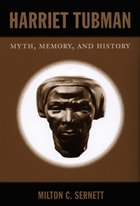
Harriet Tubman
Myth, Memory, and HistoryMilton C. Sernett
Duke University Press, 2007
Three biographies of Harriet Tubman were published within months of each other in 2003–04; they were the first book-length studies of the “Queen of the Underground Railroad” to appear in almost sixty years. Sernett examines the accuracy and reception of these three books as well as two earlier biographies first published in 1869 and 1943. He finds that the three recent studies come closer to capturing the “real” Tubman than did the earlier two. Arguing that the mythical Tubman is most clearly enshrined in stories told to and written for children, Sernett scrutinizes visual and textual representations of “Aunt Harriet” in children’s literature. He looks at how Tubman has been portrayed in film, painting, music, and theater; in her Maryland birthplace; in Auburn, New York, where she lived out her final years; and in the naming of schools, streets, and other public venues. He also investigates how the legendary Tubman was embraced and represented by different groups during her lifetime and at her death in 1913. Ultimately, Sernett contends that Harriet Tubman may be America’s most malleable and resilient icon.
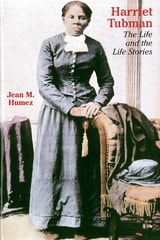
Harriet Tubman
The Life and the Life StoriesJean M. Humez
University of Wisconsin Press, 2005
Harriet Tubman’s name is known world-wide and her exploits as a self-liberated Underground Railroad heroine are celebrated in children’s literature, film, and history books, yet no major biography of Tubman has appeared since 1943. Jean M. Humez’s comprehensive Harriet Tubman is both an important biographical overview based on extensive new research and a complete collection of the stories Tubman told about her life—a virtual autobiography culled by Humez from rare early publications and manuscript sources. This book will become a landmark resource for scholars, historians, and general readers interested in slavery, the Underground Railroad, the Civil War, and African American women.
Born in slavery in Maryland in or around 1820, Tubman drew upon deep spiritual resources and covert antislavery networks when she escaped to the north in 1849. Vowing to liberate her entire family, she made repeated trips south during the 1850s and successfully guided dozens of fugitives to freedom. During the Civil War she was recruited to act as spy and scout with the Union Army. After the war she settled in Auburn, New York, where she worked to support an extended family and in her later years founded a home for the indigent aged. Celebrated by her primarily white antislavery associates in a variety of private and public documents from the 1850s through the 1870s, she was rediscovered as a race heroine by woman suffragists and the African American women’s club movement in the early twentieth century. Her story was used as a key symbolic resource in education, institutional fundraising, and debates about the meaning of "race" throughout the twentieth century.
Humez includes an extended discussion of Tubman’s work as a public performer of her own life history during the nearly sixty years she lived in the north. Drawing upon historiographical and literary discussion of the complex hybrid authorship of slave narrative literature, Humez analyzes the interactive dynamic between Tubman and her interviewers. Humez illustrates how Tubman, though unable to write, made major unrecognized contributions to the shaping of her own heroic myth by early biographers like Sarah Bradford. Selections of key documents illustrate how Tubman appeared to her contemporaries, and a comprehensive list of primary sources represents an important resource for scholars.
Heavy Marching
The Civil War Letters of Lute Moseley, 22nd WisconsinLucius S. Moseley, edited by Sara DeLuca
University of Wisconsin Press, 2023
From 1862 to 1865, Moseley fought in the Civil War as an infantry soldier in Wisconsin’s 22nd Volunteers. Briefly captured and interred in a Confederate POW Camp, he returned to action and participated in Sherman’s Atlanta campaign. He marched in the Washington, D.C., Grand Review before returning to the Beloit area, where he remained for the rest of his life.
Mosely wrote detailed missives to his family in Beloit about his wartime experiences, demonstrating a flair for describing both camp life and battles. Frank and forthright, he was remarkably articulate, insightful, and thoughtful, whether describing mundane activities or the nearly unfathomable death of President Lincoln. These 125 letters, never before made available to scholars or students of the war, became touchstones and sources of pride for the Moseley family—and provide a uniquely candid and vivid view of this tumultuous period in US history.
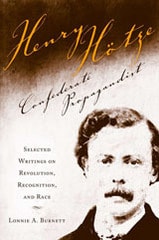
Henry Hotze, Confederate Propagandist
Selected Writings on Revolution, Recognition, and RaceLonnie A. Burnett
University of Alabama Press, 2008
Among the arguments Hotze employed were adaptations of the scientific racism of the period, which attempted to establish a rational basis for assumptions of racial difference. After the collapse of the Confederacy in 1865, Hötze remained in Europe, where he became an active partisan and promoter of the ideas of Arthur de Gobineau (1816–1882) whose work Essai sur L’inégalité des Races Humaines was a founding document in racism’s struggle for intellectual respectability.
This work consists of a biographical essay on Hotze; his contributions to Mobile newspapers during his military service in 1861; his correspondence with Confederate officials during his service in London; articles he published in London to influence British and European opinion; and his correspondence with, and published work in support of, Gobineau.
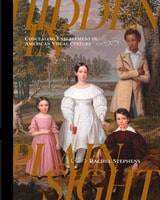
Hidden in Plain Sight
Concealing Enslavement in American Visual CultureRachel Stephens
University of Arkansas Press, 2023
In Hidden in Plain Sight: Concealing Enslavement in American Visual Culture, Rachel Stephens addresses an enormous body of material by tracing themes of concealment and silence through paintings, photographs, and ephemera, connecting long overlooked artworks with both the abolitionist materials to which they were responding and archival research across a range of southern historical narratives.
Stephens begins her fascinating study with an examination of the ways that slavery was visually idealized and defended in antebellum art. She then explores the tyranny—especially that depicted in art—enacted by supporters of enslavement, introduces a range of ways that artwork depicting slavery was tangibly concealed, considers photographs of enslaved female caretakers with the white children they reared, and investigates a printmaker’s confidential work in support of the Confederacy. Finally, she delves into an especially pernicious group of proslavery artists in Richmond, Virginia.
Reading visual culture as a key element of the antebellum battle over slavery, Hidden in Plain Sight complicates the existing narratives of American art and history.
Hinton Rowan Helper
Abolitionist and RacistHugh C. Bailey
University of Alabama Press, 1965
Hinton Rowan Helper—a statistical fanatic, abolitionist, militant racist, Republican propagandist, ardent patriot, international railway projector, and promoter of inter-American co-operation was a man of great paradox and tragedy. Born and reared a Southerner, he became a caustic and potent critic of slavery, who sought to “liberate” his people from its burdens. Unlike many of his Northern abolitionist friends, however, he loathed not only the Negro but most “non-Anglo-Saxon peoples.” It is shocking to read Helper's violent pleas for abolition and to know of his contempt for the Negro.
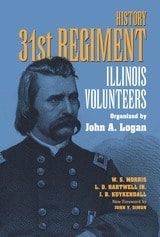
History 31st Regiment
Illinois Volunteers Organized by John A. LoganW. S. Morris, J. B. Kuykendall, and L. D. Hartwell. Foreword by John Y. Simon
Southern Illinois University Press, 1998
The story of John A. Logan’s famed 31st Regiment Illinois Volunteers, told by three veterans, follows the regiment from the battles of Belmont, Fort Donelson, Vicksburg, Kenesaw Mountain, and Atlanta through the March to the Sea and into North Carolina. "Few regiments," notes historian John Y. Simon in the foreword, "fought longer or more fiercely, suffered more casualties, or won more victories."
Logan proved a valiant and valuable Union commander, yet when the Civil War first began, it was far from clear whether he would lead Union or Confederate troops. In dramatic fashion, however, he broke what Simon calls an "ominous silence ... interpreted by many as sympathy for the South." Speaking from a wagon platform in Marion, Illinois, Logan proclaimed: "[The] time has come when a man must be for or against his country." Logan accepted a commission from Illinois governor Richard Yates, recruited heavily in southern Illinois, and formed the 31st Regiment Illinois Volunteers.
The 31st became a prime component in Grant’s western campaigns, fighting for the first time at Belmont, Missouri. In February of 1862, the 31st foiled Confederate general Gideon J. Pillow’s dramatic escape from the Union siege at Fort Donelson. Although this is often listed as one of the proudest moments for the 31st, casualties ran high (fifty-eight killed), with Logan so severely wounded that at first he was reported dead. Logan’s valor at Fort Donelson won him promotion to brigadier general.
History as They Lived It
A Social History of Prairie du Rocher, IllinoisMargaret Kimball Brown, Foreword by Carl J. Ekberg
Southern Illinois University Press, 2005
“History as They Lived It deserves to be placed within the rich context of Illinois Country historiography going back more than a century. . . . It brings together the fully ripened thoughts of a mature scholar at the very moment that students of the Illinois Country need such a book.”—from the foreword by Carl J. Ekberg
Settled in 1722, Prairie du Rocher was at the geographic center of a French colony in the Mississippi Valley, which also included other villages in what is now Illinois and Missouri: Cahokia, Kaskaskia, Fort de Chartres, St. Philippe, Ste. Genevieve, and St. Louis. Located in an alluvial valley near towering limestone bluffs, which inspired the village’s name—French for “prairie of the rock”— Prairie du Rocher is the only one of the seven French colonial villages that still exists today as a small compact community.
The village of Prairie du Rocher endured governance by France, Great Britain, Virginia, and the Illinois territory before Illinois became a state in 1818. Despite these changes, the villagers persisted in maintaining the community and its values. Margaret Kimball Brown looks at one of the oldest towns in the region through the lenses of history and anthropology, utilizing extensive research in archives and public records to give historians, anthropologists, and general readers a lively depiction of this small community and its people.
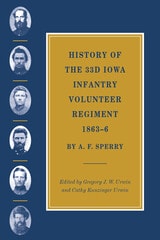
History of the 33d Iowa Infantry Volunteer Regiment, 1863–6
A.F. Sperry
University of Arkansas Press, 2002
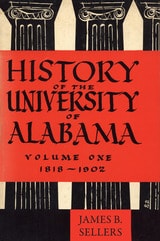
History of the University of Alabama
Volume One, 1818-1902James Benson Sellers
University of Alabama Press, 1953
The definitive and authorized history of the University of Alabama's birth and first century
Step into the rich heritage of one of America’s most storied institutions with the History of the University of Alabama, Volume One 1818 – 1902 by James Sellers. This definitive volume captures the legends, triumphs, and traditions that shaped the Capstone’s first century. From its earliest days on the frontier to its rise as a modern research university, Sellers weaves a narrative that celebrates the people, places, and pivotal moments that define the University of Alabama’s proud legacy.
Among the most dramatic chapters is the interruption of campus life during the closing days of the Civil War, when Union troops burned the university to the ground—a devastating blow that tested resilience and sparked a remarkable rebirth. Through vivid storytelling and meticulous research, Sellers honors the people and milestones that built the Crimson legacy.
Beautifully written and meticulously researched, this book is perfect as a gift for alumni, fans, and collectors. Whether displayed on a coffee table or shared with a fellow member of the Crimson Tide family, this book is more than history. It’s a tribute to the spirit of Alabama. Own the legend. Share the legacy. Celebrate the spirit of the Capstone for generations to come.
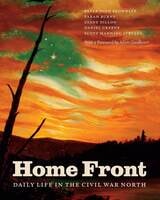
Home Front
Daily Life in the Civil War NorthPeter John Brownlee, Sarah Burns, Diane Dillon, Daniel Greene, and Scott Manning Stevens
University of Chicago Press, 2013
Home Front: Daily Life in the Civil War North reveals this side of the war as it happened, comprehensively examining the visual culture of the Northern home front. Through contributions from leading scholars from across the humanities, we discover how the war influenced household economies and the cotton economy; how the absence of young men from the home changed daily life; how war relief work linked home fronts and battle fronts; why Indians on the frontier were pushed out of the riven nation’s consciousness during the war years; and how wartime landscape paintings illuminated the nation’s past, present, and future.
A companion volume to a collaborative exhibition organized by the Newberry Library and the Terra Foundation for American Art, Home Front is the first book to expose the visual culture of a world far removed from the horror of war yet intimately bound to it.
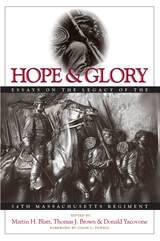
Hope and Glory
Essays on the Legacy of the 54th Massachusetts RegimentMartin H. Blatt
University of Massachusetts Press, 2009
The monument by Augustus Saint-Gaudens to Robert Gould Shaw and the 54th Massachusetts Regiment, located on Boston Common, stands at a symbolic crossroads of American history. A reminder of the nation's ongoing struggle over race, it captures the Civil War's higher purpose—the end of slavery—and memorializes those black soldiers and white officers who made common cause in the service of freedom. The monument and the saga of the 54 th Massachusetts remain powerful touchstones, inspiring enduring meditations such as Robert Lowell's poem “For the Union Dead” and the popular film Glory.
This volume brings together the best scholarship on the history of the 54th, the formation of collective memory and identity, and the ways Americans have responded to the story of the regiment and the Saint-Gaudens monument. Contributors use the historical record and popular remembrance of the 54th as a lens for examining race and community in the United States. The essays range in time from the mid-nineteenth century to the present and encompass history, literature, art, music, and popular culture.
In addition to the editors and Colin Powell, who writes about the memory and example of the 54th in his own career, contributors include Stephen Belyea, David W. Blight, Thomas Cripps, Kathryn Greenthal, James Oliver Horton, Edwin S. Redkey, Marilyn Richardson, Kirk Savage, James Smethurst, Cathy Stanton, Helen Vendler, Denise Von Glahn, and Joan Waugh.

How the North Won
A MILITARY HISTORY OF THE CIVIL WARHerman Hattaway and Archer Jones
University of Illinois Press, 1983
“To those unacquainted with military history, [this book] provides an elementary, instructive, and readable military account of the American Civil War. The basic concepts of war, its conduct, management, and support, are thoroughly explained and explicitly applied throughout in order to make clear what many authors often incorrectly take for granted that readers already know. . . .
We have tried to tell the military history of the war from the viewpoint of the higher commanders on both sides. We therefore emphasize strategy and logistics rather than tactics. . . .Strategy, management, and execution weigh more than superior numbers and resources in dictating the outcomes of wars, and the Civil War is no exception. The weaker side can win; the South almost did.”
Hurrah for Hampton!
Black Red Shirts in South Carolina during ReconstructionEdmund L. Drago
University of Arkansas Press, 1999
This post-revisionist study examines the motives and the concerns of the ex-slaves in South Carolina who supported a movement that eventually led to white supremacy.
Although most freedmen throughout the states of the former Confederacy were Republicans loyal to the party of the Federal government that had emancipated them, they were factions of African-American voters who aligned themselves with local white Democratic leaders. one such group of black conservatives joined the “Red Shirts,” white paramilitary clubs that attempted to restore antebellum values in electing former Confederate general Wade Hampton governor of South Carolina in 1876.
Drago’s fine analysis recovers and explains this lost aspect of Southern black history. Drawing on primary sources that include testimonies of several black Red Shirts before a Congressional investigation of the election and eleven slave narratives, he de-romanticizes the black experience by examining the relationship between black initiative and southern paternalism.