120 books match the query 'Cultural Policy' and 4 start with h
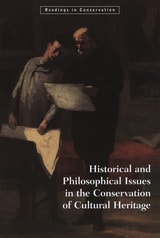
cover of Historical and Philosophical Issues in the Conservation of Cultural Heritage

Historical and Philosophical Issues in the Conservation of Cultural Heritage

Nicholas Price

J. Paul Getty Trust, The, 1996

This volume is the first comprehensive collection of texts on the conservation of art and architecture to be published in the English language. Designed for students of art history as well as conservation, the book consists of forty-six texts, some never before translated into English and many originally published only in obscure or foreign journals.
 
The thirty major art historians and scholars represented raise questions such as when to restore, what to preserve, and how to maintain aesthetic character. Excerpts have been selected from the following books and essays: John Ruskin, The Seven Lamps of Architecture; Bernard Berenson, Aesthetics and History in the Visual Arts; Clive Bell, The Aesthetic Hypothesis; Cesare Brandi, Theory of Restoration; Kenneth Clark, Looking at Pictures; Erwin Panofsky, The History of Art as a Humanistic Discipline; E. H. Gombrich, Art and Illusion; Marie Cl. Berducou, The Conservation of Archaeology; and Paul Philippot, Restoration from the Perspective of the Social Sciences. The fully illustrated book also contains an annotated bibliography and an index.
[more]
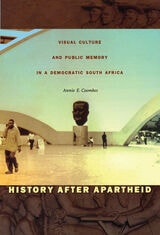
cover of History after Apartheid: Visual Culture and Public Memory in a Democratic South Africa

History after Apartheid

Visual Culture and Public Memory in a Democratic South Africa

Annie E. Coombes

Duke University Press, 2003

The democratic election of Nelson Mandela as president of South Africa in 1994 marked the demise of apartheid and the beginning of a new struggle to define the nation’s past. History after Apartheid analyzes how, in the midst of the momentous shift to an inclusive democracy, South Africa’s visual and material culture represented the past while at the same time contributing to the process of social transformation. Considering attempts to invent and recover historical icons and narratives, art historian Annie E. Coombes examines how strategies for embodying different models of historical knowledge and experience are negotiated in public culture—in monuments, museums, and contemporary fine art.

History after Apartheid explores the dilemmas posed by a wide range of visual and material culture including key South African heritage sites. How prominent should Nelson Mandela and the African National Congress be in the museum at the infamous political prison on Robben Island? How should the postapartheid government deal with the Voortrekker Monument mythologizing the Boer Trek of 1838? Coombes highlights the contradictory investment in these sites among competing constituencies and the tensions involved in the rush to produce new histories for the “new” South Africa.

She reveals how artists and museum officials struggled to adequately represent painful and difficult histories ignored or disavowed under apartheid, including slavery, homelessness, and the attempted destruction of KhoiSan hunter-gatherers. Describing how contemporary South African artists address historical memory and the ambiguities uncovered by the Truth and Reconciliation Commission, Coombes illuminates a body of work dedicated to the struggle to simultaneously remember the past and move forward into the future.
[more]
cover of Hybrid Cultures: Strategies for Entering and Leaving Modernity

Hybrid Cultures

Strategies for Entering and Leaving Modernity

Nestor Garcia Canclini

University of Minnesota Press, 1995
Garcia Canclini questions whether Latin America can compete in a global marketplace without losing its cultural identity. He moves with ease from the ideas of Gramsci and Foucault to economic analysis, from appraisals of the exchanges between Octavio Paz and Jorge Luis Borges to Chicano film and grafitti. Hybrid Cultures at once clarifies the development of democratic institutions in Latin America and reveals that the most destructive ideological trends are still going strong.
[more]
cover of Hybrid Cultures: Strategies for Entering and Leaving Modernity

Hybrid Cultures

Strategies for Entering and Leaving Modernity

Nestor Garcia Canclini

University of Minnesota Press, 2005

When it was originally published, Hybrid Cultures was foundational to Latin American cultural studies. This now-classic work features a new introduction in which Nestor Garcia Canclini calls for a cultural politics to contain the damaging effects of globalization and responds to relevant theoretical developments over the past decade.Garcia Canclini questions whether Latin America can compete in a global marketplace without losing its cultural identity. He moves with ease from the ideas of Gramsci and Foucault to economic analysis, from appraisals of the exchanges between Octavio Paz and Jorge Luis Borges to Chicano film and grafitti. Hybrid Cultures at once clarifies the development of democratic institutions in Latin America and reveals that the most destructive ideological trends are still going strong.
[more]