Results by title
87 books match the query 'Emotions' and 5 start with h
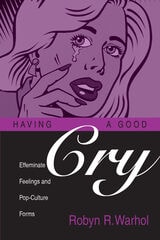
HAVING A GOOD CRY
Effeminate Feelings and Pop-Culture FormsRobyn R. Warhol
The Ohio State University Press, 2003
Robyn R. Warhol’s goal is to investigate the effects of readers’ emotional responses to formulaic fiction of the nineteenth and twentieth centuries on gendered subjectivity. She argues that modern literary and cultural studies have ignored nonsexual affectivity in their inquiries. The book elaborates on Warhol’s theory of affect and then focuses on sentimental stories, marriage plots, serialized novels, and soap operas as distinct genres producing specific feelings among fans.
Popular narrative forms use formulas to bring up familiar patterns of feelings in the audiences who love them. This book looks at the patterns of feelings that some nineteenth- and twentieth-century popular genres evoke, and asks how those patterns are related to gender. Soap operas and sentimentalism are generally derided as “effeminate” forms because their emotional range is seen as hyperfeminine. Having a Good Cry presents a celebration of effeminate feelings and works toward promoting more flexible, less pejorative concepts of gender. Using a psychophysiological rather than a psychoanalytic approach to reading and emotion, Warhol seeks to make readers more conscious of what is happening to the gendered body when we read.
Head and Heart
Perspectives from Religion and PsychologyFraser Watts
Templeton Press, 2013
The fact that this distinction has been so persistent makes it an important area of study. Head and Heart: Perspectives from Religion and Psychology takes an inter-disciplinary approach, linking the thinking of theologians and philosophers with theory and research in present-day psychology. The tradition of using framing questions that have been developed in theology and philosophy can now be brought into dialogue with scientific approaches developed within cognitive psychology and neuroscience. Though these scientific approaches have not generally used the terms “head” and “heart,” they have arrived at a similar distinction in other ways. There is a notable convergence upon the realization that humans have two modes of cognition at their disposal that correspond to “head” and “heart.” The time is therefore ripe to bring the approaches of theology and science in to dialogue—an important dialogue that has been heretofore neglected.
How Emotions Work
Jack Katz
University of Chicago Press, 1999
How Lifeworlds Work
Emotionality, Sociality, and the Ambiguity of BeingMichael Jackson
University of Chicago Press, 2017
In How Lifeworlds Work, Jackson draws on years of ethnographic fieldwork in West Africa to highlight the dynamic quality of human relationships and reinvigorate the study of kinship and ritual. How, he asks, do we manage the perpetual process of accommodation between social norms and personal emotions, impulses, and desires? How are these two dimensions of lived reality joined, and how are the dual imperatives of individual expression and collective viability managed? Drawing on the pragmatist tradition, psychology, and phenomenology, Jackson offers an unforgettable, beautifully written account of how we make, unmake, and remake, our lifeworlds.
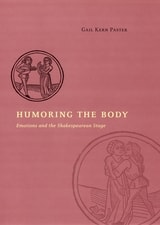
Humoring the Body
Emotions and the Shakespearean StageGail Kern Paster
University of Chicago Press, 2004
Using notions drawn from humoral medical theory to untangle passages from important moral treatises, medical texts, natural histories, and major plays of Shakespeare and his contemporaries, Paster identifies a historical phenomenology in the language of affect by reconciling the significance of the four humors as the language of embodied emotion. She urges modern readers to resist the influence of post-Cartesian abstraction and the disembodiment of human psychology lest they miss the body-mind connection that still existed for Shakespeare and his contemporaries and constrained them to think differently about how their emotions were embodied in a premodern world.