Results by title
271 books match the query 'Employment' and 9 start with h
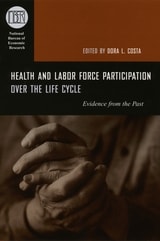
Health and Labor Force Participation over the Life Cycle
Evidence from the PastEdited by Dora L. Costa
University of Chicago Press, 2003
To that end, this book draws on new data-an extensive longitudinal survey of Union Army veterans born between 1820 and 1850-to examine the factors that affected health and labor force participation in nineteenth-century America. Contributors consider the impacts of a variety of conditions-including social class, wealth, occupation, family, and community-on the morbidity and mortality of the group. The papers investigate and address a number of special topics, including the influence of previous exposure to infectious disease, migration, and community factors such as lead in water mains. They also analyze the roles of income, health, and social class in retirement decisions, paying particular attention to the social context of disability.
Economists and historians who specialize in demography or labor, as well as those who study public health, will welcome the unique contributions offered by this book, which offers a clearer view than ever before of the workings and complexities of life, death, and labor during the nineteenth century.
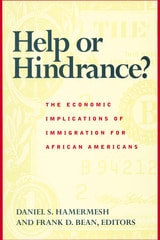
Help or Hindrance?
The Economic Implications of Immigration for African AmericansDaniel S. Hammermesh
Russell Sage Foundation, 1998
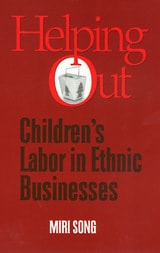
Helping Out
Miri Song
Temple University Press, 1999
Helping Out addresses the centrality of children's labor participation in such family enterprises. Discussing the case of Chinese families running take-out food shops in Britain, Miri Song examines the ways in which children contribute their labor and the context in which children come to understand and believe in "helping out" as part of a "family work contract." Song explores the implications of these children's labor participation for family relationships, cultural identity, and the future of the Chinese community in Britain. While doing so, she argues that the practical importance and the broader meanings of children's work must be understood in the context of immigrant families' experiences of migration and ethnic minority status in Western, white-majority societies.
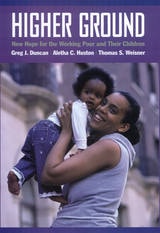
Higher Ground
New Hope for the Working Poor and Their ChildrenGreg J. Duncan
Russell Sage Foundation, 2007
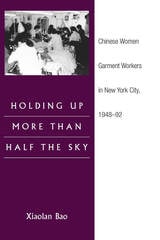
Holding Up More Than Half the Sky
Chinese Women Garment Workers in New York City, 1948-92Xiaolan Bao
University of Illinois Press, 2001
In 1982, 20,000 Chinese-American garment workers—most of them women—went on strike in New York City. Every Chinese garment industry employer in the city soon signed a union contract. The successful action reflected the ways women's changing positions within their families and within the workplace galvanized them to stand up for themselves.
Xiaolan Bao's now-classic study penetrates to the heart of Chinese American society to explain how this militancy and organized protest, seemingly so at odds with traditional Chinese female behavior, came about. Drawing on more than one hundred interviews, Bao blends the poignant personal stories of Chinese immigrant workers with the interwoven history of the garment industry and the city's Chinese community. Bao shows how the high rate of married women employed outside the home profoundly transformed family culture and with it the image and empowerment of Chinese American women. At the same time, she offers a complex and subtle discussion of the interplay of ethnic and class factors within New York's garment industry.
Passionately told and prodigiously documented, Holding Up More Than Half the Sky examines the journey of a community's women through an era of change in the home, on the shop floor, and walking the picket line.

Home Away from Home
Japanese Corporate Wives in the United StatesSawa Kurotani
Duke University Press, 2005
Kurotani interviewed and spent time with more than 120 women in three U.S. locations with sizable expatriate Japanese communities: Centerville, a pseudonymous Midwestern town; the New York metropolitan area; and North Carolina’s Research Triangle area. She highlights the contradictory situations faced by the transient wives. Their husbands’ assignments in the United States typically last from three to five years, and they frequently emphasize the temporariness of their situation, referring to it as a “long vacation.” Yet they are responsible for creating comfortable homes for their families, which necessitates producing a familiar and permanent environment. Kurotani looks at the dynamic friendships that develop among the wives and describes their feelings about returning to Japan. She conveys how their sense of themselves as Japanese women, of home, and of their relationships with family members are altered by their personal experiences of transnational homemaking.
Home and Hegemony
Domestic Service and Identity Politics in South and Southeast AsiaKathleen M. Adams and Sara Dickey, Editors
University of Michigan Press, 2000
This pathbreaking collection builds on recent examinations of identity in the postcolonial states of South and Southeast Asia by investigating the ways in which domestic workers and their employers come to know and depict one another and themselves through their interactions inside and outside of the home. This setting provides a particularly apt arena for examining the daily negotiations of power and hegemony.
Contributors to the volume, all anthropologists, provide rich ethnographic analyses that avoid a narrow focus on either workers or employers. Rather, they examine systems of power through specific topics that range from the notion of "nurture for sale" to the roles of morality and humor in the negotiation of hierarchy and the dilemmas faced by foreign employers who find themselves in life-and-death dependence on their servants.
With its provocative theoretical and ethnographic contributions to current debates, this collection will be of interest to scholars in Asian studies, women's studies, anthropology, sociology, and cultural studies.
Kathleen M. Adams is Associate Professor of Anthropology, Loyola University of Chicago. Sara Dickey is Associate Professor of Anthropology, Bowdoin College.
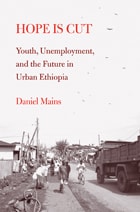
Hope Is Cut
Youth, Unemployment, and the Future in Urban EthiopiaDaniel Mains
Temple University Press, 2013
How do ambitious young men grapple with an unemployment rate in urban Ethiopia hovering around fifty percent? Urban, educated, and unemployed young men have been the primary force behind the recent unrest and revolutions in North Africa and the Middle East. Daniel Mains' detailed and moving ethnographic study, Hope is Cut, examines young men's struggles to retain hope for the future in the midst of economic uncertainty and cultural globalization.
Through a close ethnographic examination of young men's day-to-day lives Hope is Cut explores the construction of optimism through activities like formal schooling, the consumption of international films, and the use of khat, a mild stimulant.
Mains also provides a consideration of social theories concerning space, time, and capitalism. Young men here experience unemployment as a problem of time—they often congregate on street corners, joking that the only change in their lives is the sun rising and setting. Mains addresses these factors and the importance of reciprocity and international migration as a means of overcoming the barriers to attaining aspirations.
Hustles for Humanists
Build a Business with PurposeErica Machulak
Rutgers University Press, 2025
As a humanities professional, your skills are in demand. Despite the challenges of a competitive job market, the unique skill set that you possess is highly transferable to various industries and roles. Knowing how to position your creativity, knowledge and empathy is vital for achieving meaningful employment and professional growth.
Hustles for Humanists provides a detailed roadmap for humanities professionals who want to leverage their valuable skills to find or create meaningful work. Drawing from her experiences as an academic turned entrepreneur, Erica Machulak gives practical advice on how to connect with your core values, market yourself, build relationships with clients, and negotiate fair compensation.
This is an essential field guide for finding work that aligns with the core values of your humanities scholarship and practice. It demonstrates how the professional strengths of the humanities can be drawn upon to create fairer, more just and equitable entrepreneurial approaches – whether you’re launching a business, job hunting, or looking for inspiration. Hustles for Humanists helps you unlock the value of your humanities practice and explore exciting new pathways to achieving economic stability both within and beyond academia.