455 books match the query 'Feminism' and 11 start with h
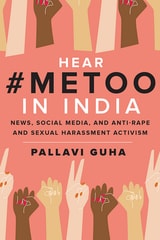
cover of Hear #MeToo in India: News, Social Media,  and Anti-Rape and Sexual Harassment Activism

Hear #MeToo in India

News, Social Media, and Anti-Rape and Sexual Harassment Activism

Pallavi Guha

Rutgers University Press, 2021

This book examines the role media platforms play in anti-rape and sexual harassment activism in India. Including 75 interviews with feminist activists and journalists working across India, it proposes a framework of agenda-building and establishes a theoretical framework to examine media coverage of issues in the digitally emerging Global South.
[more]
cover of Held by Form: Feminism, Poetics, Critical Practice

Held by Form

Feminism, Poetics, Critical Practice

Anna Moser

University of Chicago Press, 2026

How contemporary poetry illuminates the workings—and struggles—of commitment in feminism.

In this lucid and vigorous defense of poetics for feminism, Anna Moser situates the practice of contemporary poetry in an exploratory dialogue with the work of philosophical, critical, and historical thinkers—placing Denise Riley in conversation with Judith Butler, Lyn Hejinian with Hannah Arendt, m. nourbeSe philip with Saidiya Hartman, and Susan Howe with Emily Dickinson. 

Moser’s central theme is these poets’ questioning, agonistic commitment to feminism. What, the book asks, does it mean to be committed? How does such a commitment materialize? What are its consequences? What does it mean not to take for granted an affiliation like “feminist” (or even “woman”), but rather to involve one’s art in probing its historical formations, present conditions, and future trajectories? Moser explores both the risks and possibilities of making art in this equivocal condition. She reveals that the poetry of certain contemporary writers not only unfolds within this space of agonistic commitment, but that, in doing so, it offers an important contribution to feminist thinking. Moser’s book also shows that while form is a constraint that limits these poets’ freedom, it also holds them in a more sustaining sense, allowing something belatedly and imperfectly to be said. 

In dialogue with feminist political theory, philosophy, historiography, and aesthetics, Held by Form reveals poetics as a unique mode of critical practice: one that models relations of care and collectivity, refigures inherited forms in ways that contest their hierarchies of value, and responds with generosity and openness to the complexities of living in gender.

[more]
cover of High-Risk Feminism in Colombia: Women's Mobilization in Violent Contexts

High-Risk Feminism in Colombia

Women's Mobilization in Violent Contexts

Julia Margaret Zulver

Rutgers University Press, 2022

High-Risk Feminism in Colombia documents the experiences of grassroots women’s organizations that united to demand gender justice during and in the aftermath of Colombia’s armed conflict. In doing so, it illustrates a little-studied phenomenon: women whose experiences with violence catalyze them to mobilize and resist as feminists, even in the face of grave danger. Despite a well-established tradition of studying women in war, we tend to focus on their roles as mothers or carers, as peacemakers, or sometimes as revolutionaries. This book explains the gendered underpinnings of why women engage in feminist mobilization, even when this takes place in a ‘domain of losses’ that exposes them to high levels of risk. It follows four women’s organizations who break with traditional gender norms and defy armed groups’ social and territorial control, exposing them to retributive punishment. It provides rich evidence to document how women are able to surmount the barriers to mobilization when they frame their actions in terms of resistance, rather than fear.

 
[more]
cover of Higher Ground: From Utopianism to Realism in American Feminist Thought and Theory

Higher Ground

From Utopianism to Realism in American Feminist Thought and Theory

Sally L. Kitch

University of Chicago Press, 2000

Many feminists love a utopia—the idea of restarting humanity from scratch or transforming human nature in order to achieve a prescribed future based on feminist visions. Some scholars argue that feminist utopian fiction can be used as a template for creating such a future. However, Sally L. Kitch argues that associating feminist thought with utopianism is a mistake.

Drawing on the history of utopian thought, as well as on her own research on utopian communities, Kitch defines utopian thinking, explores the pitfalls of pursuing social change based on utopian ideas, and argues for a "higher ground" —a contrasting approach she calls realism. Replacing utopianism with realism helps to eliminate self-defeating notions in feminist theory, such as false generalization, idealization, and unnecessary dichotomies. Realistic thought, however, allows feminist theory to respond to changing circumstances, acknowledge sameness as well as difference, value the past and the present, and respect ideological give-and-take.

An important critique of feminist thought, Kitch concludes with a clear, exciting vision for a feminist future without utopia.
[more]
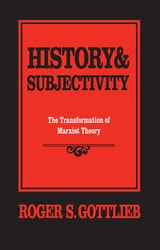
cover of History & Subjectivity

History & Subjectivity

Roger Gottlieb

Temple University Press, 1987

"...rescues the probing spirit of Marx from the dead hand of Marx-ism. In this bold and argumentative book, Gottlieb joins other contemporary theorists in challenging the primacy of class and relations of production as keys to understanding our collective predicament. The result is an important contribution to left theory- both for its summation of the insights drawn from recent movements and for its provocative confrontation with the wisdom of the past." --Barbara Ehrenreich Can Marxism still serve the American left? History and Subjectivity answers this question by synthesizing the conflicting perspectives of traditional Marxism, Western and neo-Marxism, socialist-feminism, and various minority political movements into a comprehensive and original social theory. In the last seventy years, social change and the failure of leftist movements have made it necessary to transform Marxist theory. Undermined by its own theoretical success, traditional Marxism mistakenly assumed that Marx's understanding of competitive capitalism could be the model for theories of any society. Roger Gottlieb argues convincingly that the transformation of Marxist theory requires a fundamentally new understanding of social primacy. Gottlieb draws on resources from virtually all areas of contemporary radical social theory. This interdisciplinary approach results in a sweeping synthesis of existing Marxist thought and an original and compelling social theory. "Roger Gottlieb has written a very rich and often brilliant book.... [His] general thesis is developed, argued, and tested in the course of an impressive series of reconsiderations of debates in the Marxist tradition--impressive for the sheer breadth of the material mastered, as well as the critical acumen with which Gottlieb finds his way through the thicket of arguments and counter arguments. The result is an always lively, frequently exciting journey through the Marxist tradition, as well as a major contribution to the transformation which Marxism is currently undergoing." --Richard Schmitt "This is a serious and ambitious book. Its attempt to incorporate socialist feminism, and its interesting discussion of the American left are major strengths. It is a distinctive argument, framed within a personal sensibility, which should encourage wide response." --Marx W. Wartofsky
[more]
cover of Holy Rebellion: Religious Feminism and the Transformation of Judaism and Women's Rights in Israel

Holy Rebellion

Religious Feminism and the Transformation of Judaism and Women's Rights in Israel

Ronit Irshai and Tanya Zion-Waldoks

Brandeis University Press, 2024

An in-depth study of Jewish religion and law in Israel from a gendered perspective.
 
In Holy Rebellion, Ronit Irshai and Tanya Zion-Waldoks examine social change in Israel through a rigorous analysis of the shifting entanglements of religion, gender, and law in times of cultural transformation. They explore theological, halakhic, political, and sociological processes and show how they interact with one another in ways that advance women’s rights, as well as how they are met with a conservative backlash in the discourses and actions of the rabbinic establishment. Irshai and Zion-Waldoks build on legal philosopher Robert Cover’s 1982 paper “Nomos and Narrative,” which explained how cultural narratives and legal norms are reciprocally enforced or transformed. Expanding on this notion, Irshai and Zion-Waldoks propose a “narrative ripeness test,” an analytic tool that evaluates the relationship between culture and law to assess how and when change within a minority cultural community may be accelerated or hindered by state intervention. 
 
Religious feminisms are emerging around the world, not solely in Israel, and this book helps elucidate how they create enduring and radical change. Many liberal states are also confronting an illiberal backlash and question the multicultural framework’s ability to serve the needs of minorities within minorities. Therefore, the theoretical framework offered by Irshai and Zion-Waldoks is applicable beyond the Israeli case, even as it offers deeper insights into an Israeli society in turmoil.
[more]
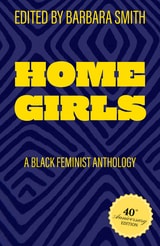
cover of Home Girls, 40th Anniversary Edition: A Black Feminist Anthology

Home Girls, 40th Anniversary Edition

A Black Feminist Anthology

Barbara Smith

Rutgers University Press, 2024

Home Girls, the pioneering anthology of Black feminist thought, features writing by Black feminist and lesbian activists on topics both provocative and profound. Since its initial publication in 1983, it has become an essential text on Black women's lives and contains work by many of feminism's foremost thinkers. This edition features an updated list of contributor biographies and an all-new preface that provides Barbara Smith the opportunity to look back on forty years of the struggle, as well as the influence the work in this book has had on generations of feminists. The preface from the previous Rutgers edition remains, as well as all of the original pieces, set in a fresh new package. 

Contributors: Tania Abdulahad, Donna Allegra, Barbara A. Banks, Becky Birtha, Cenen, Cheryl Clarke, Michelle Cliff, Michelle T. Clinton, Willi (Willie) M. Coleman, Toi Derricotte, Alexis De Veaux, Jewelle L. Gomez, Akasha (Gloria) Hull, Patricia Spears Jones, June Jordan, Audre Lorde, Raymina Y. Mays, Deidre McCalla, Chirlane McCray, Pat Parker, Linda C. Powell, Bernice Johnson Reagon, Spring Redd, Gwendolyn Rogers, Kate Rushin, Ann Allen Shockley, Barbara Smith, Beverly Smith, Shirley O. Steele, Luisah Teish, Jameelah Waheed, Alice Walker, and Renita J. Weems.
[more]
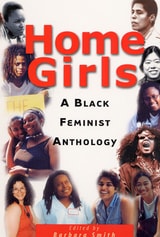
cover of Home Girls: A Black Feminist Anthology

Home Girls

A Black Feminist Anthology

Smith, Barbara

Rutgers University Press, 2000

The pioneering anthology Home Girls features writings by Black feminist and lesbian activists on topics both provocative and profound. Since its initial publication in 1983, it has become an essential text on Black women's lives and writings. This edition features an updated list of contributor biographies and an all-new preface that provides a fresh assessment of how Black women's lives have changed-or not-since the book was first published.

Contributors are Tania Abdulahad, Donna Allegra, Barbara A. Banks, Becky Birtha, Julie Carter, Cenen, Cheryl Clarke, Michelle Cliff, Michelle T. Clinton, Willie M. Coleman, Toi Derricotte, Alexis De Veaux, Jewelle L. Gomez, Akasha (Gloria) Hull, Patricia Jones, June Jordan, Audre Lorde, Raymina Y. Mays, Deidre McCalla, Chirlane McCray, Pat Parker, Linda C. Powell, Bernice Johnson Reagon, Spring Redd, Gwendolyn Rogers, Kate Rushin, Ann Allen Shockley, Barbara Smith, Beverly Smith, Shirley O. Steele, Luisah Teish, Jameelah Waheed, Alice Walker, and Renita Weems.
[more]
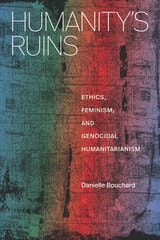
cover of Humanity's Ruins: Ethics, Feminism, and Genocidal Humanitarianism

Humanity's Ruins

Ethics, Feminism, and Genocidal Humanitarianism

Danielle Bouchard

Duke University Press, 2025
In Humanity’s Ruins, Danielle Bouchard examines how genocidal aspirations animate contemporary Western humanitarian projects and discourses. Drawing on anticolonial and antiracist feminist critique, Bouchard argues that humanitarianism has functioned in the Cold War and post-Cold War eras to perpetuate longer-lived, fundamentally racist conceptualizations of humanity’s defining characteristics. She examines the aesthetics of humanitarian texts, which are filled with figures of the wounded, dead, and disappeared—the atomic bomb victim whose only remainder is a shadow imprinted on concrete, the grievously injured Muslim woman, the vanished members of Amazonian “uncontacted” tribes, the dying African—to elucidate how the appearance of these figures reaffirms a genocidal view of humanity that aligns with the continuation of Western imperial warfare. Humanitarian discourses conceive of humanity as a community which, by definition, is under existential threat from some humans who are explicitly or implicitly understood as needing to be eliminated. Bouchard invokes “humanity’s ruins” to expose the genocidal fantasy of a human world in which such threat has been eliminated in the interest of supposedly ensuring humanity’s survival.
[more]
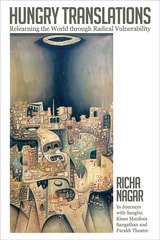
cover of Hungry Translations: Relearning the World through Radical Vulnerability

Hungry Translations

Relearning the World through Radical Vulnerability

Richa Nagar

University of Illinois Press, 2019
Experts often assume that the poor, hungry, rural, and/or precarious need external interventions. They frequently fail to recognize how the same people create politics and knowledge by living and honing their own dynamic visions. How might scholars and teachers working in the Global North ethically participate in producing knowledge in ways that connect across different meanings of struggle, hunger, hope, and the good life?Informed by over twenty years of experiences in India and the United States, Hungry Translations bridges these divides with a fresh approach to academic theorizing. Through in-depth reflections on her collaborations with activists, theatre artists, writers, and students, Richa Nagar discusses the ongoing work of building embodied alliances among those who occupy different locations in predominant hierarchies. She argues that such alliances can sensitively engage difference through a kind of full-bodied immersion and translation that refuses comfortable closures or transparent renderings of meanings. While the shared and unending labor of politics makes perfect translation--or retelling--impossible, hungry translations strive to make our knowledges more humble, more tentative, and more alive to the creativity of struggle.
[more]
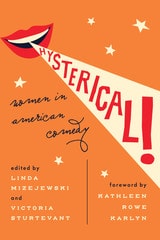
cover of Hysterical!: Women in American Comedy

Hysterical!

Women in American Comedy

Edited by Linda Mizejewski and Victoria Sturtevant; foreword by Kathleen Rowe Karlyn

University of Texas Press, 2017

Ideal for classroom use, this anthology of original essays by the leading authorities on women’s comedy surveys the disorderly, subversive, and unruly performances of women comics from silent film to contemporary multimedia

Winner, Susan Koppleman Award for Best Anthology, Multi-Authored, or Edited Book in Feminist Studies, Popular and American Culture Associations (PACA), 2017

Amy Schumer, Samantha Bee, Mindy Kaling, Melissa McCarthy, Tig Notaro, Leslie Jones, and a host of hilarious peers are killing it nightly on American stages and screens large and small, smashing the tired stereotype that women aren’t funny. But today’s funny women aren’t a new phenomenon—they have generations of hysterically funny foremothers. Fay Tincher’s daredevil stunts, Mae West’s linebacker walk, Lucille Ball’s manic slapstick, Carol Burnett’s athletic pratfalls, Ellen DeGeneres’s tomboy pranks, Whoopi Goldberg’s sly twinkle, and Tina Fey’s acerbic wit all paved the way for contemporary unruly women, whose comedy upends the norms and ideals of women’s bodies and behaviors.

Hysterical! Women in American Comedy delivers a lively survey of women comics from the stars of the silent cinema up through the multimedia presences of Tina Fey and Lena Dunham. This anthology of original essays includes contributions by the field’s leading authorities, introducing a new framework for women’s comedy that analyzes the implications of hysterical laughter and hysterically funny performances. Expanding on previous studies of comedians such as Mae West, Moms Mabley, and Margaret Cho, and offering the first scholarly work on comedy pioneers Mabel Normand, Fay Tincher, and Carol Burnett, the contributors explore such topics as racial/ethnic/sexual identity, celebrity, stardom, censorship, auteurism, cuteness, and postfeminism across multiple media. Situated within the main currents of gender and queer studies, as well as American studies and feminist media scholarship, Hysterical! masterfully demonstrates that hysteria—women acting out and acting up—is a provocative, empowering model for women’s comedy.

[more]