Results by title
208 books match the query 'Finance' and 7 start with h

HIV Exceptionalism
Development through Disease in Sierra LeoneAdia Benton
University of Minnesota Press, 2015
WINNER, 2017 RACHEL CARSON PRIZE, SOCIETY FOR THE SOCIAL STUDIES OF SCIENCE
In 2002, Sierra Leone emerged from a decadelong civil war. Seeking international attention and development aid, its government faced a dilemma. Though devastated by conflict, Sierra Leone had a low prevalence of HIV. However, like most African countries, it stood to benefit from a large influx of foreign funds specifically targeted at HIV/AIDS prevention and care.
What Adia Benton chronicles in this ethnographically rich and often moving book is how one war-ravaged nation reoriented itself as a country suffering from HIV at the expense of other, more pressing health concerns. During her fieldwork in the capital, Freetown, a city of one million people, at least thirty NGOs administered internationally funded programs that included HIV/AIDS prevention and care. Benton probes why HIV exceptionalism—the idea that HIV is an exceptional disease requiring an exceptional response—continues to guide approaches to the epidemic worldwide and especially in Africa, even in low-prevalence settings.
In the fourth decade since the emergence of HIV/AIDS, many today are questioning whether the effort and money spent on this health crisis has in fact helped or exacerbated the problem. HIV Exceptionalism does this and more, asking, what are the unanticipated consequences that HIV/AIDS development programs engender?

Healthy Markets?
The New Competition in Medical CareMark A. Peterson, ed.
Duke University Press, 1999
With original contributions from leading social science health policy analysts, this volume addresses the full context of health system change. Believing that the analysis of health care change is too important to be left to economists alone, Mark A. Peterson has collected a mulitdisciplinary group of experts who revisit the contentious debate over the market approaches to health care and consider the disparate effects of these approaches on cost, quality, and coverage of both managed care and Medicaid and Medicare. While market enthusiasts applaud the enhanced efficiency, reduced excess capacity, and abatement of the decades-long health care cost explosion, a backlash has emerged among many providers and the public against the perceived excesses of the market: diminished access to care, commercialization of the physician-patient relationship, and exacerbated inequality. Contributors assess these varied responses while examining the impact that market-based applications are likely to have for future health policy making, the significance of the U.S. experience for policy makers abroad, and the lessons that these changes might provide for thinking sensibly about the future of our health care system.
This volume will be useful for public policy analysts, economists, social scientists, health care providers and administrators, and others interested in the future—and in understanding the past—of American health care.
Contributors. Gary S. Belkin, Lawrence D. Brown, Robert G. Evans, Martin Gaynor, Paul B. Ginsburg, Marsha Gold, Theodore R. Marmor, Cathie Jo Martin, Jonathan B. Oberlander, Mark V. Pauly, Mark A. Peterson, Thomas Rice, Deborah A. Stone, William B. Vogt, Kenneth E. Thorpe
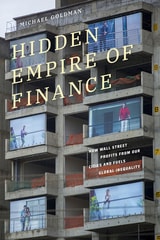
Hidden Empire of Finance
How Wall Street Profits from Our Cities and Fuels Global InequalityMichael Goldman
Duke University Press, 2026
Hidden Tuition
An Insider's Guide to College Pricing and Financial AidPhillip B. Levine
University of Chicago Press, 2026
The secret economics of maximizing college financial aid (and why it’s not as miserable as you think).
In the college admissions process, a terrifying unknown looms large: How much is this really going to cost? For prospective students and their families, there’s no easy answer. While college prices continue to rise, so do their promises of financial aid for qualified students. But who qualifies? And for how much? How can this monumental life decision be so utterly impossible to understand?
Hidden Tuition is an insider’s guide for navigating college financial aid to maximum effect and with (relatively) minimal pain. Economist and financial-aid expert Phillip B. Levine draws on his unique experience—including years of research in higher-education finance and work alongside admissions and financial-aid departments—to help readers first identify, then minimize, what they’ll actually pay for different types of colleges based on their circumstances. With expertise, clarity, and the warmth of someone who’s been through it, Levine details how students can find the hidden tuition costs in the opaque landscape of college pricing and financial aid. He explores topics that include:
- Why college’s “sticker prices” are rarely what students pay—and how some actual prices are even going down
- The best, worst, and most surprising deals for students with different financial resources
- How to navigate financial aid for divorced and multi-residence households
- Who really benefits from early decision
- How the nature of scholarships and merit-based aid is often framed in misleading ways
- The pros and cons of college savings accounts
- When and how to get started on college financing
- Why all student loans aren't the same (or aren't all that bad)
Debunking common myths and offering practical guidance for both families and individual students, Hidden Tuition makes a maddeningly imperfect process more manageable—and gives students a clearer path through one of life’s biggest financial decisions towards collegiate success.

Housing and the Financial Crisis
Edited by Edward L. Glaeser and Todd Sinai
University of Chicago Press, 2013
Housing and the Financial Crisis looks at what happened to prices and construction both during and after the housing boom in different parts of the American housing market, accounting for why certain areas experienced less volatility than others. It then examines the causes of the boom and bust, including the availability of credit, the perceived risk reduction due to the securitization of mortgages, and the increase in lending from foreign sources. Finally, it examines a range of policies that might address some of the sources of recent instability.
How Noise Matters to Finance
N. Adriana Knouf
University of Minnesota Press, 2016
As scores of crises over the past century have shown, the stock market is manipulable and manipulated. The market is composed of human-made machines, which are affected by a lack of predictability more fundamental than the human: the noise of the material world. N. Adriana Knouf draws on historical and contemporary documents to show how noise—sonic, informatic, or otherwise—affects the ways in which financial markets function. How Noise Matters to Finance draws on different forms of financial noise, paying attention to how materiality and the interference of humans and machines causes the meanings of noise to shift over space and time.
Forerunners is a thought-in-process series of breakthrough digital works. Written between fresh ideas and finished books, Forerunners draws on scholarly work initiated in notable blogs, social media, conference plenaries, journal articles, and the synergy of academic exchange. This is gray literature publishing: where intense thinking, change, and speculation take place in scholarship.
How the Financial Crisis and Great Recession Affected Higher Education
Edited by Jeffrey R. Brown and Caroline M. Hoxby
University of Chicago Press, 2014
The studies in this volume explore how various practices at institutions of higher education, such as the drawdown of endowment resources, the awarding of financial aid, and spending on research, responded to the financial crisis. The studies examine universities as economic organizations that operate in a complex institutional and financial environment. The authors examine the role of endowments in university finances and the interaction of spending policies, asset allocation strategies, and investment opportunities. They demonstrate that universities’ behavior can be modeled using economic principles.