156 books match the query 'Geology' and 4 start with h

cover of Happenstance

Happenstance

Robert Root

University of Iowa Press, 2013
Reflecting on how a student’s parents met because of a fly ball to center field in a summer softball game, author Robert Root wondered how the lives of that student’s parents and of the student himself would have changed had the batter bunted or struck out. Haunted by this pure example of happenstance, he began to ponder his own existence, dependent in part on geology (the Niagara Escarpment) and history (the Erie Canal). He wondered how happenstance had influenced the course of his parents’ lives, in particular their marriages (they married and divorced each other twice), and consequently the shaping of his identity. Happenstance investigates the effects of that phenomenon and choice on one man’s life.
Root explores this theme in interwoven strands of narrative, interpretation, and reflection. One strand, “The Hundred Days,” follows his attempt to write one hundred journal entries, each about a different day in his life, to recover memories of specific moments or collections of moments. In the strand headed “Album,” he examines and interprets old family photographs in light of the way he reads them in the present, as someone now privy to a family secret that directed his and his siblings’ lives without their knowledge. Interspersed among these brief interpretations and narratives are reflections on happenstance and choice, a sequence contemplating their effect on his life and perhaps on all our lives. Through juxtaposition and accumulation, the book’s incremental unraveling of meaning imitates the process of unexpected epiphanies and gradual self-discovery in anyone’s life.
By revisiting individual days, giving voice to photographs that mutely preserve family moments, and reflecting on the way happenstance and choice determine the directions lives take, Robert Root generates a meditation on identity anchored in an album in words and images of a mid-twentieth-century life.
 
[more]
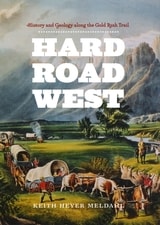
cover of Hard Road West: History and Geology along the Gold Rush Trail

Hard Road West

History and Geology along the Gold Rush Trail

Keith Heyer Meldahl

University of Chicago Press, 2007

In 1848 news of the discovery of gold in California triggered an enormous wave of emigration toward the Pacific. Lured by the promise of riches, thousands of settlers left behind the forests, rain, and fertile soil of the eastern United States in favor of the rough-hewn lands of the American West. The dramatic terrain they struggled to cross is so familiar to us now that it is hard to imagine how frightening—even godforsaken—its sheer rock faces and barren deserts seemed to our forebears.
       
Hard Road West brings their perspective vividly to life, weaving together the epic overland journey of the covered wagon trains and the compelling story of the landscape they encountered. Taking readers along the 2,000-mile California Trail, Keith Meldahl uses the diaries and letters of the settlers themselves—as well as the countless hours he has spent following the trail—to reveal how the geology and geography of the West directly affected our nation’s westward expansion. He guides us through a corrugated landscape of sawtooth mountains, following the meager streams that served as lifelines through an arid land, all the way to California itself, where colliding tectonic plates created breathtaking scenery and planted the gold that lured travelers west in the first place.
 
“Alternates seamlessly between vivid accounts of the 19th-century journey and lucid explanations of the geological events that shaped the landscape traveled. . . . The reader comes away with both an appreciation for the arduous cross-continental wagon journey and an understanding of the events that created such a vast and difficult landscape.”—Library Journal
 
“[Meldahl] draws on his professional knowledge to explain the geology of the West, showing how centuries of geological activity had a direct effect on the routes taken by the travelers. . . . Meldahl provides a novel account of the largest overland migration since the Crusades.”—Science News
[more]
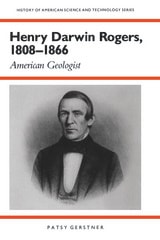
cover of Henry Darwin Rogers, 1808–1866: American Geologist

Henry Darwin Rogers, 1808–1866

American Geologist

Patsy Gerstner

University of Alabama Press, 1994

The life and legacy of a pioneer who helped shape American geology.

Henry Darwin Rogers, 1808–1866: American Geologist is the first comprehensive biography of Henry Darwin Rogers, one of the pioneering figures who helped establish geology as a professional scientific discipline in the United States. Written by historian Patsy Gerstner, this meticulously researched study traces Rogers's life from his early education and scientific interests to his leadership of the groundbreaking geological surveys of New Jersey and Pennsylvania.

At a time when American science was still in its formative stages, Rogers distinguished himself through extensive fieldwork, influential publications, and innovative theories about the formation of mountain systems. His investigations of Pennsylvania's Appalachian region led to one of the first distinctly American theories of mountain elevation and helped advance understanding of the earth's geological structure. Gerstner places these achievements within the broader context of nineteenth-century scientific institutions, professional rivalries, and the growing importance of state-sponsored research

More than a scientific biography, the book offers a compelling account of the emergence of American geology and the individuals who transformed natural history into a rigorous scientific enterprise. It is an indispensable resource for understanding the history of science, the development of geological thought, and the evolution of scientific professionalism in the United States.
[more]
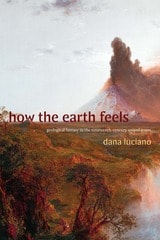
cover of How the Earth Feels: Geological Fantasy in the Nineteenth-Century United States

How the Earth Feels

Geological Fantasy in the Nineteenth-Century United States

Dana Luciano

Duke University Press, 2024

In How the Earth Feels Dana Luciano examines the impacts of the new science of geology on nineteenth-century US culture. Drawing on early geological writings, Indigenous and settler accounts of earthquakes, African American antislavery literature, and other works, Luciano reveals how geology catalyzed transformative conversations regarding the intersections between humans and the nonhuman world. She shows that understanding the earth’s history geologically involved confronting the dynamic nature of inorganic matter over vast spans of time, challenging preconceived notions of human agency. Nineteenth-century Americans came to terms with these changes through a fusion of fact and imagination that Luciano calls geological fantasy. Geological fantasy transformed the science into a sensory experience, sponsoring affective and even erotic connections to the matter of the earth. At the same time, it was often used to justify accounts of evolution that posited a modern, civilized, and Anglo-American whiteness as the pinnacle of human development. By tracing geology’s relationship with biopower, Luciano illuminates how imagined connections with the earth shaped American dynamics of power, race, and colonization.
[more]