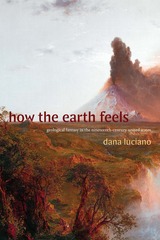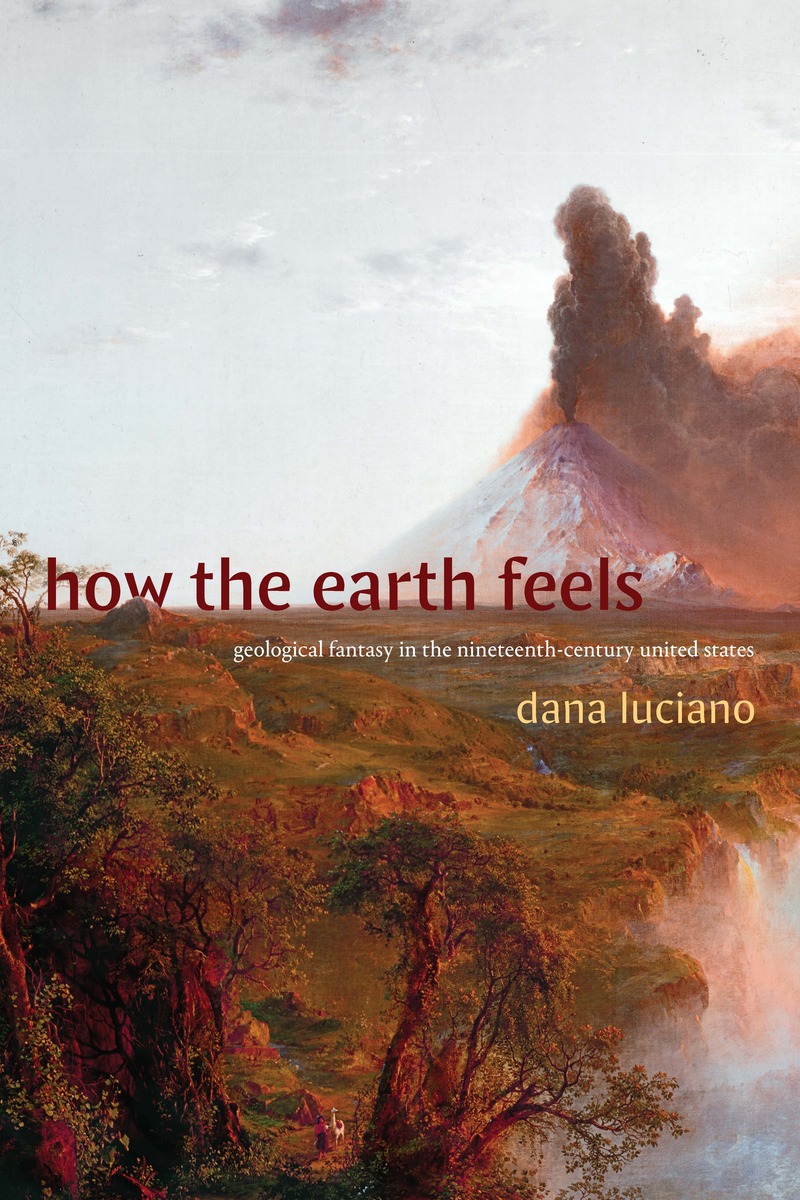
How the Earth Feels: Geological Fantasy in the Nineteenth-Century United States
Duke University Press, 2024
eISBN: 978-1-4780-2784-3 | Paper: 978-1-4780-2570-2 | Cloth: 978-1-4780-2096-7
Library of Congress Classification PS217.G56L835 2024
See other books on: Geology | Geology in literature | How | Luciano, Dana | Nineteenth - Century United States
See other titles from Duke University Press
eISBN: 978-1-4780-2784-3 | Paper: 978-1-4780-2570-2 | Cloth: 978-1-4780-2096-7
Library of Congress Classification PS217.G56L835 2024
ABOUT THIS BOOK | AUTHOR BIOGRAPHY | REVIEWS | TOC | REQUEST ACCESSIBLE FILE
ABOUT THIS BOOK
In How the Earth Feels Dana Luciano examines the impacts of the new science of geology on nineteenth-century US culture. Drawing on early geological writings, Indigenous and settler accounts of earthquakes, African American antislavery literature, and other works, Luciano reveals how geology catalyzed transformative conversations regarding the intersections between humans and the nonhuman world. She shows that understanding the earth’s history geologically involved confronting the dynamic nature of inorganic matter over vast spans of time, challenging preconceived notions of human agency. Nineteenth-century Americans came to terms with these changes through a fusion of fact and imagination that Luciano calls geological fantasy. Geological fantasy transformed the science into a sensory experience, sponsoring affective and even erotic connections to the matter of the earth. At the same time, it was often used to justify accounts of evolution that posited a modern, civilized, and Anglo-American whiteness as the pinnacle of human development. By tracing geology’s relationship with biopower, Luciano illuminates how imagined connections with the earth shaped American dynamics of power, race, and colonization.
See other books on: Geology | Geology in literature | How | Luciano, Dana | Nineteenth - Century United States
See other titles from Duke University Press