Results by title
212 books match the query 'German' and 5 start with h
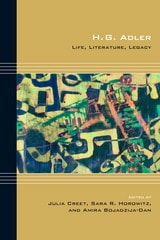
H. G. Adler
Life, Literature, LegacyEdited by Julia Creet, Sara R. Horowitz, and Amira Bojadzija-Dan
Northwestern University Press, 2016
H. G. Adler: Life, Literature, Legacy is the first collection of essays in English dedicated to the life and work of German-language author H. G. Adler. Among the international scholars of German, Jewish, and Holocaust literature and history who reveal the range of Adler’s legacy across genres are Adler’s son, Jeremy Adler, and Peter Filkins, translator of Adler’s trilogy, Panorama, (The Journey). Together, the essays examine Adler’s writing in relation to his life, especially his memory as a survivor of the Nazi death camps and his posthumous recognition for having produced a Gesamtkunstwerk, an aesthetic synthesis of the Shoah. The book carries the moral charge of Adler’s work, moving beyond testimony to a complex dialectic between fact and fiction, exploring Adler’s experiments with voice and the ethical work of literary engagement with the Shoah.
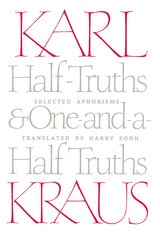
Half-Truths and One-and-a-Half Truths
Selected AphorismsKarl Kraus
University of Chicago Press, 1990
"Kraus is a superb aphorist."—D. J. Enright, New York Review of Books
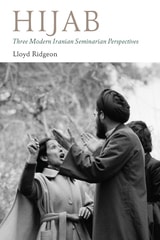
Hijab
Three Modern Iranian Seminarian PerspectivesLloyd Ridgeon
Gingko, 2021
Ḥijāb addresses the differences of opinion among seminarians on the hijab in the Islamic Republic of Iran, focusing on three representative thinkers: Murtaza Mutahhari who held veiling to be compulsory, Ahmad Qabil who argued for the desirability of the hijab, and Muhsin Kadivar who considers it neither necessary nor desirable. In the first chapter, the views of these three scholars are contextualized within the framework known as ‘new religious thinking’ among the seminarians. Comprehending the hermeneutics of this new religious thinking is key to appreciating how and why the younger generation of scholars have offered divergent judgements about the hijab. Following the first chapter, the book is divided into three parallel sections, each devoted to one of the three seminarians. These present a chronological approach, and each scholar’s position on the hijab is assessed with reference to historical specificity and their own general jurisprudential perspective. Extensive examples of the writings of the three scholars on the hijab are also provided.
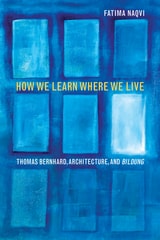
How We Learn Where We Live
Thomas Bernhard, Architecture, and BildungFatima Naqvi
Northwestern University Press, 2015
How We Learn Where We Live opens new avenues into thinking about one of the most provocative writers of the twentieth century, Thomas Bernhard. In one of the first English studies of his work, Fatima Naqvi focuses on the Austrian author’s critique of education (Bildung) through the edifices in which it takes place. She demonstrates that both literature and architecture are implicated in the concept of Bildung. His writings insist that learning has always been a life-long process that is helped—or hindered—by the particular buildings in which Bildung occurs. Naqvi offers close readings of Bernhard’s major prose works, from Amras (1964) to Old Masters (1985) and brings them into dialogue with major architectural debates of the times. She examines Bernard’s interrogation of the theoretical foundations underpinning the educational system and its actual sites.
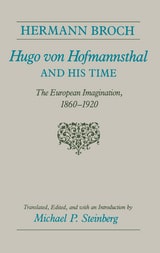
Hugo von Hofmannsthal and His Time
The European Imagination, 1860-1920Hermann Broch
University of Chicago Press, 1984
Through an analysis of the changing thought and career of the Austrian poet, librettist, and essaist Hugo von Hofmannsthal (1874-1929), Broch attempts to define and analyze the major intellectual issues of the European fin de siècle, a period that he characterizes according to the Nietzschean concepts of the breakdown of rationality and the loss of a central value system. The result is a major examination of European thought as well as a comparative study of political systems and artistic styles.