230 books match the query 'Government relations' and 4 start with h

cover of High Stakes: Florida Seminole Gaming and Sovereignty

High Stakes

Florida Seminole Gaming and Sovereignty

Jessica R. Cattelino

Duke University Press, 2008

In 1979, Florida Seminoles opened the first tribally operated high-stakes bingo hall in North America. At the time, their annual budget stood at less than $2 million. By 2006, net income from gaming had surpassed $600 million. This dramatic shift from poverty to relative economic security has created tangible benefits for tribal citizens, including employment, universal health insurance, and social services. Renewed political self-governance and economic strength have reversed decades of U.S. settler-state control. At the same time, gaming has brought new dilemmas to reservation communities and triggered outside accusations that Seminoles are sacrificing their culture by embracing capitalism. In High Stakes, Jessica R. Cattelino tells the story of Seminoles’ complex efforts to maintain politically and culturally distinct values in a time of new prosperity.

Cattelino presents a vivid ethnographic account of the history and consequences of Seminole gaming. Drawing on research conducted with tribal permission, she describes casino operations, chronicles the everyday life and history of the Seminole Tribe, and shares the insights of individual Seminoles. At the same time, she unravels the complex connections among cultural difference, economic power, and political rights. Through analyses of Seminole housing, museum and language programs, legal disputes, and everyday activities, she shows how Seminoles use gaming revenue to enact their sovereignty. They do so in part, she argues, through relations of interdependency with others. High Stakes compels rethinking of the conditions of indigeneity, the power of money, and the meaning of sovereignty.
[more]
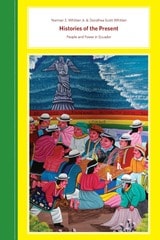
cover of Histories of the Present: People and Power in Ecuador

Histories of the Present

People and Power in Ecuador

Norman E. Whitten Jr. and Dorothea Scott Whitten

University of Illinois Press, 2011
The wellspring of critical analysis in this book emerges from Ecuador's major Indigenous Uprising of 1990 and its ongoing aftermath in which indigenous and Afro-Ecuadorian action transformed the nation-state and established new dimensions of human relationships. The authors weave anthropological theory with longitudinal Ecuadorian ethnography to produce a unique contribution to Latin American studies.
[more]
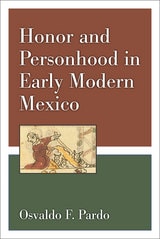
cover of Honor and Personhood in Early Modern Mexico

Honor and Personhood in Early Modern Mexico

Osvaldo F. Pardo

University of Michigan Press, 2015
Osvaldo F. Pardo examines the early dissemination of European views on law and justice among Mexico’s native peoples. Newly arrived from Spain in the sixteenth and seventeenth centuries, mendicant friars brought not only their faith in the authority of the Catholic Church but also their reverence of the monarchy. Drawing on a rich range of documents dating from this era—including secular and ecclesiastical legislation, legal and religious treatises, bilingual catechisms, grammars on indigenous languages, historical accounts, and official reports and correspondence—Pardo finds that honor, as well as related notions such as reputation, came to play a central role in shaping the lives and social relations of colonists and indigenous Mexicans alike. Following the application and adaptation of European ideas of justice and royal and religious power as they took hold in the New World, Pardo sheds light on the formation of colonial legalities and long-lasting views, both secular and sacred, that still inform attitudes toward authority in contemporary Mexican society.
[more]
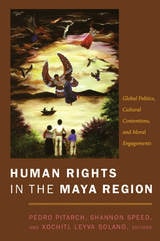
cover of Human Rights in the Maya Region: Global Politics, Cultural Contentions, and Moral Engagements

Human Rights in the Maya Region

Global Politics, Cultural Contentions, and Moral Engagements

Pedro Pitarch, Shannon Speed, and Xochitl Leyva Solano, eds.

Duke University Press, 2008

In recent years Latin American indigenous groups have regularly deployed the discourse of human rights to legitimate their positions and pursue their goals. Perhaps nowhere is this more evident than in the Maya region of Chiapas and Guatemala, where in the last two decades indigenous social movements have been engaged in ongoing negotiations with the state, and the presence of multinational actors has brought human rights to increased prominence. In this volume, scholars and activists examine the role of human rights in the ways that states relate to their populations, analyze conceptualizations and appropriations of human rights by Mayans in specific localities, and explore the relationship between the individualist and “universal” tenets of Western-derived concepts of human rights and various Mayan cultural understandings and political subjectivities.

The collection includes a reflection on the effects of truth-finding and documenting particular human rights abuses, a look at how Catholic social teaching validates the human rights claims advanced by indigenous members of a diocese in Chiapas, and several analyses of the limitations of human rights frameworks. A Mayan intellectual seeks to bring Mayan culture into dialogue with western feminist notions of women’s rights, while another contributor critiques the translation of the United Nations Declaration of Human Rights into Tzeltal, an indigenous language in Chiapas. Taken together, the essays reveal a broad array of rights-related practices and interpretations among the Mayan population, demonstrating that global-local-state interactions are complex and diverse even within a geographically limited area. So too are the goals of indigenous groups, which vary from social reconstruction and healing following years of violence to the creation of an indigenous autonomy that challenges the tenets of neoliberalism.

Contributors: Robert M. Carmack, Stener Ekern, Christine Kovic, Xochitl Leyva Solano, Julián López García, Irma Otzoy, Pedro Pitarch, Álvaro Reyes, Victoria Sanford, Rachel Sieder, Shannon Speed, Rodolfo Stavenhagen, David Stoll, Richard Ashby Wilson

[more]