Results by title
438 books match the query 'Hispanic & Latino' and 14 start with h
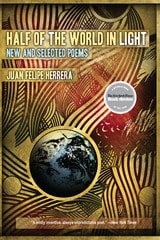
Half of the World in Light
New and Selected PoemsJuan Felipe Herrera
University of Arizona Press, 2008
For nearly four decades, Juan Felipe Herrera has documented his experience as a Chicano in the United States and Latin America through stunning, memorable poetry that is both personal and universal in its impact, themes, and approach. Often political, never fainthearted, his career has been marked by tremendous virtuosity and a unique sensibility for uncovering the unknown and the unexpected. Through a variety of stages and transformations, Herrera has evolved more than almost any other Chicano poet, always re-inventing himself into a more mature and seasoned voice.
Now, in this unprecedented collection, we encounter the trajectory of this highly innovative and original writer, bringing the full scope of his singular vision into view. Beginning with early material from A Certain Man, the volume moves through thirteen of Herrera’s collections into new, previously unpublished work. Serious scholars and readers alike will now have available to them a representative set of glimpses into his production as well as his origins and personal development. The ultimate value of bringing together such a collection, however, is that it will allow us to better understand and appreciate the complexity of what this major American poet is all about.
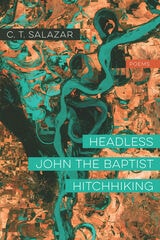
Headless John the Baptist Hitchhiking
PoemsC. T. Salazar
Acre Books, 2022
In C. T. Salazar’s striking debut poetry collection, the speaker is situated in the tradition of Southern literature but reimagines its terrain with an eye on the South’s historic and ongoing violence. His restless relationship with religion (“a child told me there was a god / and because he was smiling, I believed him”) eventually includes a reclamation of the language of belief in the name of desire. “I felt myself become gospel in your hands,” the speaker tells his beloved. And, as the title poem asserts, a headless body “leaves more room for salvation.”
Though Salazar’s South is not a tender place, the book is a petition for tenderness, revealing in both place and people the possibilities for mercy, vulnerability, and wonder. The lyric I, as it creates an archive of experience, is not distanced from the poems’ subjects or settings, but deeply enmeshed in a tangled world. In poems with lush diction, ranging from a sonnet crown to those that explore the full field of the page, Headless John the Baptist Hitchhiking seeks—and finds—where the divine resides: “Praise our hollow-bell bodies still ringing.”

Heart of the Stone / El corazón de la piedra / Uk'u'x ri ab'aj
By Rosa Chávez, translated by Gabriela Ramirez-Chavez and Wel Raxulew
Amherst College Press, 2027
In Heart of the Stone, Rosa Chávez celebrates a Maya spirituality that recognizes all things—stones included—as part of the web of life. At the center of the collection is tijax, the poet's nawal represented by obsidian, the volcanic stone. Her verses cut through grief and fear to address colonization, injustices, and environmental abuse, while carving out a space for tenderness and deep healing.
Originally written in Spanish and translated into Maya K'iche' by Wel Raxulew, this stunning trilingual edition brings the poems into English for the first time in Gabriela Ramirez-Chavez's translation. The volume is framed by an introduction from Ramirez-Chavez, photography by Carlos Bernardo Euler Coy, and illustrations by Erick Boror.
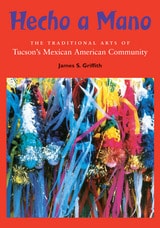
Hecho a Mano
The Traditional Arts of Tucson's Mexican American CommunityJames S. Griffith; Foreword by Patricia Preciado Martin
University of Arizona Press, 2000
Arts as intimate as a piece of needlework or a home altar. Arts as visible as decorative iron, murals, and low riders. Through such arts, members of Tucson's Mexican American community contribute much of the cultural flavor that defines the city to its residents and to the outside world. Now Tucson folklorist Jim Griffith celebrates these public and private artistic expressions and invites us to meet the people who create them.
- Josefina Lizárraga learned to make paper flowers as a girl in her native state of Nayarit, Mexico, and ensures that this delicate art is not lost.
- Ornamental blacksmith William Flores runs the oldest blacksmithing business in town, a living link with an earlier Tucson.
- Ramona Franco's family has maintained an elaborate altar to Our Lady of Guadalupe for three generations.
- Signmaker Paul Lira, responsible for many of Tucson's most interesting signs, brings to his work a thoroughly mexicano sense of aesthetics and humor.
- Muralists David Tineo and Luis Mena proclaim Mexican cultural identity in their work and carry on a tradition that has blossomed in the last twenty years.
Featuring a foreword by Tucson author Patricia Preciado Martin and a spectacular gallery of photographs, many by Pulitzer prize-winning photographer José Galvez, this remarkable book offers a close-up view of a community rich with tradition and diverse artistic expression. Hecho a Mano is a piñata bursting with unexpected treasures that will inspire and inform anyone with an interest in folk art or Mexican American culture.
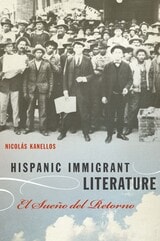
Hispanic Immigrant Literature
El Sueño del RetornoBy Nicolás Kanellos
University of Texas Press, 2011
Immigration has been one of the basic realities of life for Latino communities in the United States since the nineteenth century. It is one of the most important themes in Hispanic literature, and it has given rise to a specific type of literature while also defining what it means to be Hispanic in the United States. Immigrant literature uses predominantly the language of the homeland; it serves a population united by that language, irrespective of national origin; and it solidifies and furthers national identity. The literature of immigration reflects the reasons for emigrating, records—both orally and in writing—the trials and tribulations of immigration, and facilitates adjustment to the new society while maintaining links with the old society.
Based on an archive assembled over the past two decades by author Nicolás Kanellos's Recovering the U. S. Hispanic Literary Heritage project, this comprehensive study is one of the first to define this body of work. Written and recorded by people from Mexico, Cuba, Puerto Rico, the Caribbean, and Central and South America, the texts presented here reflect the dualities that have characterized the Hispanic immigrant experience in the United States since the mid-nineteenth century, set always against a longing for homeland.
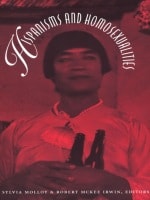
Hispanisms and Homosexualities
Sylvia Molloy and Robert Irwin, eds.
Duke University Press, 1998
In Hispanisms and Homosexualities, editors Sylvia Molloy and Robert Irwin bring together a group of essays that advance Hispanic studies and gay and lesbian studies by calling into question what is meant by the words Hispanic and homosexual. The fourteen contributors to this volume not only offer queer readings of Spanish and Latin American texts and performances, they also undermine a univocal sense of homosexual identities and practices. Taking on formations of national identity and sexuality; the politics of visibility and outing; the intersections of race, sexuality, and imperial discourse; the status of transvestism and posing; and a postmodern aesthetic of camp and kitsch, these essays from both established and emerging scholars provide a more complex and nuanced view of related issues involving nationality, ethnicity, and sexuality in the Hispanic world.
Hispanisms and Homosexualities offers the most sophisticated critical and theoretical work to date in Hispanic and queer studies. It will be an essential text for all those engaged with the complexities of ethnic, cultural, and sexual subjectivities.
Contributors. Daniel Balderston, Emilie Bergmann, Israel Burshatin, Brad Epps, Mary S. Gossy, Robert Irwin, Agnes I. Lugo-Ortiz, Sylvia Molloy, Oscar Montero, José Esteban Muñoz, José Quiroga, Rubén Ríos Avila, B. Sifuentes Jáuregui, Paul Julian Smith
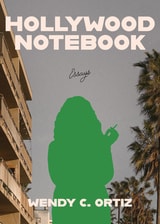
Hollywood Notebook
EssaysWendy C. Ortiz
Northwestern University Press, 2025
A daylight traipse through early-aughts Los Angeles, Hollywood Notebook encapsulates the powerful feelings and hopeful futures of twentysomething Wendy C. Ortiz. In this boundary-defying sister memoir to Bruja, Ortiz navigates internal maps as she traverses external palm-treed streets, moving through her youthful twenties and into the pensiveness of her thirties. Peering at what lies ahead while dipping her toes into the past, Ortiz shows us that there is no place like Hollywood to unearth the joys of success and the blows of mistakes—both realized and denied. An innovative and bold examination of the daytime roaming mind, Hollywood Notebook is a cartography of love, loss, and transformation in the face of a brilliant psyche in a vibrant city.
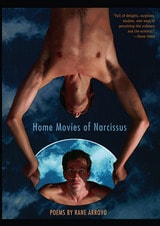
Home Movies of Narcissus
Rane Arroyo
University of Arizona Press, 2002
Using sophisticated language to inspect life from barrio childhood to cosmopolitan manhood, Arroyo explores themes of gay strength and alienation, linked to his experiences as both a Puerto Rican and an intellectual. Through a variety of approaches, he examines a major recurrent Latino paradox: the need to write about Latino issues while being criticized for being too self-centered.
Sometimes reserved, sometimes passionate, Arroyo writes with humor and a remarkable quickness of association, moving with a grace that makes seamless use of speech ranging from the formal to the vernacular. Taking in love and sexuality, world literature and history, and the exile's heritage of a shifting geography of identity, he invokes remarkable imagery with language that is economical, fresh, and mischievous. Some of Arroyo's poems take an autobiographical approach and show how poets have both the luxury and necessity of speaking for those in their lives.
Others create personas that take in the American experience from a variety of viewpoints—including gays, who are often marginalized by the larger Latino community. "The Ponce de León Poems" pit the poet against a ghost who seeks to direct his writing, while a final section, "The Black Moon Poems," deals with the many sleepless nights that Arroyo has spent struggling with questions over the worth of his art and whether he has betrayed those he loves by writing-or not writing-about them. "In his home movies," he writes, "Narcissus is both the seen and the seer." As Arroyo's insightful words demonstrate, the writer must come to value his own image but not fall in love with it, for it will change, age, and, if he is fortunate, finally grow wise. As readers will discover in Home Movies of Narcissus, Rane Arroyo has seen past the mirror and charted a new territory of self-discovery.
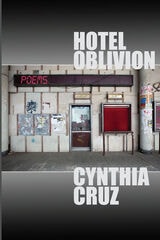
Hotel Oblivion
Cynthia Cruz
Four Way Books, 2022
A specter, haunting the edges of society: because neoliberalism insists there are no social classes, thus, there is no working class, the main subject of Hotel Oblivion, a working class subject, does not exist. With no access to a past, she has no home, no history, no memory. And yet, despite all this, she will not assimilate. Instead, this book chronicles the subject’s repeated attempts at locating an exit from capitalist society via acts of negative freedom and through engagement with the death drive, whose aim is complete destruction in order to begin all over again. In the end, of course, the only true exit and only possibility for emancipation for the working class subject is through a return to one’s self. In Hotel Oblivion, through a series of fragments and interrelated poems, Cruz resists invisibilizing forces, undergoing numerous attempts at transfiguration in a concerted effort to escape her fate.
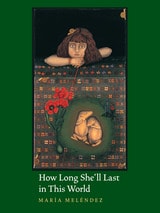
How Long She'll Last in This World
Maria Melendez
University of Arizona Press, 2006
With this invocation, María Meléndez beckons us on a journey—an exotic expedition through life’s mysteries in search of the finer strands of experience. In a Latina voice laced with a naturalist’s sense of wonder, she weaves bold images reflecting a world threaded by unseen wounds, now laid before us with an unflinching love of life and an exquisite precision of language. Adopting multiple guises—field researcher, laboring mother, grief-stricken lover—Meléndez casts aside stereotypes and expectations to forge a new language steeped in life and landscape. Whether meditating on a controlled prairie burn or contemplating the turquoise cheek of a fathead minnow, she weaves words and memories into a rich tapestry that resonates with sensual detail and magnifies her sense of maternal wildness, urging us to “Love as much as you / can, don’t throw your heart / away to just one god.” In her paean to the Aztec deity Tonacacihuatl, mother of the gods, Meléndez muses that “How many spirits she’s twin to, and how long she’ll last in this world, / are secrets stashed in the rattle / of corn ears, in the coils / of venomous snakes.”
Through stunning images and stark realism, her poems embrace motherhood and vocation, love and grief, land and life, to bring new meaning to the natural world and how we experience it.
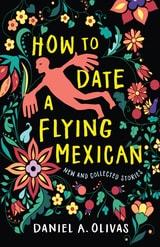
How to Date a Flying Mexican
New and Collected StoriesDaniel A. Olivas
University of Nevada Press, 2022
The collection is made up of Olivas’s favorite previously published stories, along with two new stories—one dystopian and the other magical— that challenge the Trump administration’s anti-immigration rhetoric and policies. How to Date a Flying Mexican draws together some of Olivas’s most unforgettable and strange tales, allowing readers to experience his very distinct, and very Chicano, fiction.
How to Kill a Goat and Other Monsters
Saúl Hernández
University of Wisconsin Press, 2024
These pages are infused with comfort, with desire, with heartache. Never absent is love, family. Hernández—hyperaware of American society’s dismissal or hatred of people who look like him—writes with a refreshing confidence, a sure knowledge of who he is and where he comes from. Transcending any particular experience, this volume will continue to resonate with multiple readings.
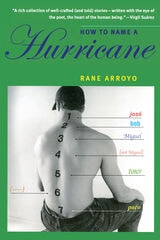
How to Name a Hurricane
Rane Arroyo
University of Arizona Press, 2005
How to Name a Hurricane collects short stories and other fictions depicting Latino drag queens and leather men, religious sinners and happy atheists, working class heroes and cyberspace vaqueros—a parade of characters that invites readers to consider whether one is more authentic a gay Latino than another. Whereas actual hurricanes are given names, the gays given voice in this collection must name themselves—and these narratives in turn reveal something of the "I" of Hurricane Rane. Whether portraying a family gathering as Brideshead Revisited with a mambo soundtrack, recounting the relationship of transvestite Louie/Lois and her bisexual Superman, or bemoaning "feeling as unsexy as an old bean burrito in a 7-11 microwave," Arroyo tracks the heartbeat of his characters through a shimmering palette of styles. Here are monologues, a story in verse, and other experimental forms appropriate to experimental lives—all affirming the basic human rights to dignity, equality, love, and even silliness.
When the AIDS epidemic first hit, many Latino families destroyed any remembrances of their gay and bisexual sons that might betray their pasts to la familia or el pueblo. Arroyo’s writings return the ghosts of those sons to the families, bars, dance clubs, and neighborhoods where they belong. By penetrating to the I’s of narrative hurricanes, these stories honor the survivors of our ongoing cultural storms.
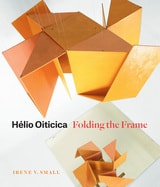
Hélio Oiticica
Folding the FrameIrene V. Small
University of Chicago Press, 2016
From Oiticica’s late 1950s experiments with painting and color to his mid-1960s wearable Parangolés, Small traces a series of artistic procedures that foreground the activation of the spectator. Analyzing works, propositions, and a wealth of archival material, she shows how Oiticica’s practice recast—in a sense “folded”—Brazil’s utopian vision of progress as well as the legacy of European constructive art. Ultimately, the book argues that the effectiveness of Oiticica’s participatory works stems not from a renunciation of art, but rather from their ability to produce epistemological models that reimagine the traditional boundaries between art and life.