Results by title
783 books match the query 'History & Theory' and 22 start with h
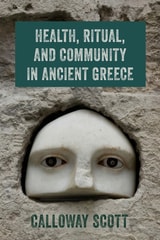
Health, Ritual, and Community in Ancient Greece
Calloway Scott
University of Wisconsin Press, 2027
At the heart of this book is a deceptively simple question: What does “health” mean? The answer, historian Calloway B. Scott shows, is culturally contingent, and in ancient Greece the concept went well beyond the proper functioning of an individual’s body. Rather, “health” (Greek hygieia) furnished a key discursive and ritual tool for civic cohesion, religious praxis, and even cultural identity. The all-important polis, central to ancient Greek social and political life, fundamentally depended on this conception of good health as a communal and religious phenomenon, and its ritualization informed relationships not just between individuals but also between communities of humans and between the human and divine realms.
Scott employs an impressive array of sources, from technical medical treatises to poetry to material remains and sanctuary sites, to explore the “body politic” of the ancient Greek world—and to query exactly what keeping that body healthy meant. Health, political identity, social relationships, and religious praxis were all deeply entwined; thus rites, rituals, and healing spaces were public, bringing people together in cohesive, coherent, and, ideally, healthy communities.
Hegemony And Power
On the Relation between Gramsci and MachiavelliBenedetto Fontana
University of Minnesota Press, 1993
Presents a comparative and textual exploration of Gramsci's interpretation of Machiavelli's political analyses. This valuable contribution to our understanding of Gramsci includes a comparison of the major Machiavellian ideas such as the nature of political knowledge, the new principality, the concept of the people, and the relation between thought and action, to Gramsci's concepts of hegemony, moral and intellectual reform, and the collective will.
Heidegger and the Myth of a Jewish World Conspiracy
Peter Trawny
University of Chicago Press, 2015
While Heidegger’s affiliation with National Socialism is well known, the anti-Semitic dimension of that engagement could not be fully told until now. Trawny traces Heidegger’s development of a grand “narrative” of the history of being, the “being-historical thinking” at the center of Heidegger’s work after Being and Time. Two of the protagonists of this narrative are well known to Heidegger’s readers: the Greeks and the Germans. The world-historical antagonist of this narrative, however, has remained hitherto undisclosed: the Jews, or, more specifically, “world Judaism.” As Trawny shows, world Judaism emerges as a racialized, destructive, and technological threat to the German homeland, indeed, to any homeland whatsoever. Trawny pinpoints recurrent, anti-Semitic themes in the Notebooks, including Heidegger’s adoption of crude cultural stereotypes, his assigning of racial reasons to philosophical decisions (even undermining his Jewish teacher, Edmund Husserl), his endorsement of a Jewish “world conspiracy,” and his first published remarks on the extermination camps and gas chambers (under the troubling aegis of a Jewish “self-annihilation”). Trawny concludes with a thoughtful meditation on how Heidegger’s achievements might still be valued despite these horrifying facets. Unflinching and systematic, this is one of the most important assessments of one of the most important philosophers in our history.
Herodotus in the Anthropocene
Joel Alden Schlosser
University of Chicago Press, 2020
Schlosser shows that the Histories, which chronicle the interactions among the Greek city-states and their neighbors that culminated in the Persian Wars, illuminate a telling paradox: at those times when humans appear capable of exerting more influence than ever before, they must also assert collective agency to avoid their own downfall. Here, success depends on nomoi, or the culture, customs, and laws that organize human communities and make them adaptable through cooperation. Nomoi arise through sustained contact between humans and their surroundings and function best when practiced willingly and with the support of strong commitments to the equality of all participants. Thus, nomoi are the very substance of political agency and, ultimately, the key to freedom and ecological survival because they guide communities to work together to respond to challenges. An ingenious contribution to political theory, political philosophy, and ecology, Herodotus in the Anthropocene reminds us that the best perspective on the present can often be gained through the lens of the past.
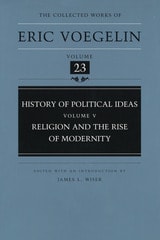
History of Political Ideas, Volume 5 (CW23)
Religion and the Rise of ModernityEric Voegelin, Edited by James L. Wiser
University of Missouri Press, 1998
Examining the emergence of modernity within the philosophical and political debates of the sixteenth century, Religion and the Rise of Modernity resumes the analysis of the "great confusion" introduced in Volume IV of History of Political Ideas. Encompassing a vast range of events ignited by Luther's Ninety-Five Theses, this period is one of controversy, revolution, and partiality.
Despite the era's fragmentation and complexity, Voegelin's insightful analysis clarifies its significance and suggests the lines of change converging at a point in the future: the medieval Christian understanding of a divinely created closed cosmos was being replaced by a distinctly modern form of human consciousness that posits man as the proper origin of meaning in the universe.
Analyzing the most significant features of the great confusion, Voegelin examines a vast range of thought and issues of the age. From the more obvious thinkers to those less frequently studied, this volume features such figures as Calvin, Althusius, Hooker, Bracciolini, Savonarola, Copernicus, Tycho de Brahe, and Giordano Bruno. Devoting a considerable amount of attention to Jean Bodin, Voegelin presents him as a prophet of a new, true religion amid the civilizational disorder of the post-Christian era. Focusing on such traditional themes as monarchy, just war theory, and the philosophy of law, this volume also investigates issues within astrology, cosmology, and mathematics.
Religion and the Rise of Modernity is a valuable work of scholarship not only because of its treatment of individual thinkers and doctrines influential in the sixteenth century and beyond but also because of its close examination of those experiences that formed the modern outlook.
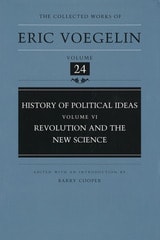
History of Political Ideas, Volume 6 (CW24)
Revolution and the New ScienceEric Voegelin, Edited & Intro by Barry Cooper
University of Missouri Press, 1999
Volume VI of Voegelin's account of the history of Western political ideas continues from the point reached in the previous volume with the study of the mystic-philosopher Jean Bodin. Voegelin begins with a discussion of the conflict between Bishop Bossuet and Voltaire concerning the relationship between what is conventionally identified as sacred history and profane history. Bossuet maintained the traditional Christian position, the origin of which may be traced to Saint Augustine's City of God. Voegelin shows, however, that while Bossuet may have been heir to an adequate understanding of human existence, Voltaire drew attention to a series of historical facts, such as the comparative size of the Russian and Roman empires, the existence of Chinese civilization, and the discovery of the New World, that could be incorporated into Bossuet's account only with great difficulty or not at all.
For the first time, the theoretical problem of the historicity of evocative symbols of political order becomes the focus of Voegelin's analysis. This major problem, which found a provisional solution in the New Science of Vico, was intertwined with several additional ones that may be summarized in terms of an increasing closure toward what Voegelin calls the world- transcendent ground of reality. Voegelin traces the consequences of the new attitudes and sentiments in terms of an increasing disorientation in personal, social, and political life, a disorientation that was expressed in increasingly impoverished experiences and accounts of history and of nature.
Vico represents the great exception to this decline in the intellectual adequacy of modern political ideas and modern self- understanding. Readers familiar with Voegelin's New Science of Politics will find in the long, challenging, and brilliant chapter on Vico and his New Science one of the major textual analyses that sustained Voegelin's entire intellectual enterprise. Indeed, the chapter on Vico, along with similarly provocative and insightful chapters on Bodin and on Schelling in other volumes, may almost be read as an element of Voegelin's own spiritual autobiography.
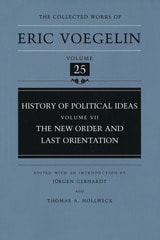
History of Political Ideas, Volume 7 (CW25)
The New Order and Last OrientationEric Voegelin, Edited & Intro by Jurgen Gebhardt & Thomas A. Hollweck
University of Missouri Press, 1999
In The New Order and Last Orientation, Eric Voegelin explores two distinctly different yet equally important aspects of modernity. He begins by offering a vivid account of the political situation in seventeenth-century Europe after the decline of the church and the passing of the empire. Voegelin shows how the intellectual and political disorder of the period was met by such seemingly disparate responses as Grotius's theory of natural right, Hobbes's Leviathan, the role of the Fronde in the formation of the French national state, Spinoza's Tractatus Theologico-Politicus, and Locke's Second Treatise, the blueprint of a modern middle-class society. By putting these responses and the thought of Montesquieu, Hume, and others in the context of the birth pains of the national state and the emergence of a new self-understanding of man, Voegelin achieves a brilliant mixture of political history and profound philosophical analysis.
Voegelin's verdict of modernity is pronounced most powerfully in the opening part of "Last Orientation," in the chapter entitled "Phenomenalism." His discussion of the intellectual confusion underlying the modern project of scientistic phenomenalism is the most original criticism leveled against modernity to date. It is at the same time the first step toward a recovery of reality through philosophy conceived as a science of substance in the spirit of Giordano Bruno. Voegelin's first example of such an effort at recovering reality is the chapter on Schelling, one of the spiritual realists who has not been affected by the prevailing rationalist or reductionist creeds that are part of the modern disorder. Schelling's indirect yet powerful influence on Schopenhauer, Nietzsche, and Freud more than justifies Voegelin's interest in his philosophy and character, even though Voegelin would later distance himself from some of Schelling's positions.
The volume's concluding chapter, "Nietzsche and Pascal," applies the understanding gained from the study of Schelling to the thought of the most powerful critic of the age, Nietzsche. Nietzsche's self-avowed affinity with Pascal provides the key to an analysis of the strengths and weaknesses of his thought and reaffirms the connection that links the beginning of modernity with its most recent crises and the efforts to overcome them.
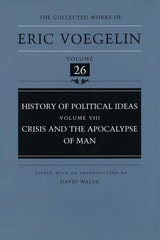
History of Political Ideas, Volume 8 (CW26)
Crisis and the Apocalypse of ManEric Voegelin, Edited & Intro by David Walsh.
University of Missouri Press, 1999
Reaching into our own time, Crisis and the Apocalypse of Man confronts the disintegration of traditional sources of meaning and the correlative attempt to generate new sources of order from within the self. Voegelin allows us to contemplate the crisis in its starkest terms as the apocalypse of man that now seeks to replace the apocalypse of God. The totalitarian upheaval that convulsed Voegelin's world, and whose aftermath still defines ours, is only the external manifestation of an inner spiritual turmoil. Its roots have been probed throughout the eight volumes of History of Political Ideas, but its emergence is marked by the age of Enlightenment.
In our postmodern era, discussions of the collapse of the "enlightenment project" have become commonplace. Voegelin compels us to follow the great-souled individuals who sought to go from disintegration of the present toward evocations of order for the future. Such thinkers as Comte, Bakunin, and Marx suffered through the crisis and fully understood the need for a new outpouring of the spirit. They resolved to supply the deficiency themselves. As a consequence they launched us irrevocably on the path of the apocalypse of man.
One of the great merits of Voegelin's analysis is his exposition of the pervasive character of this crisis. It is not confined to the megalomaniacal dreamers of a revolutionary apocalypse; rather, echoes of it are found in the more moderate Enlightenment preoccupation with progress to be attained through application of the scientific method. Faith in the capacity of instrumental reason to answer the ultimate questions of human existence defined men such as Voltaire, Helvétius, Diderot, D'Alembert, and Condorcet. It remains the authoritative faith of our world today, Voegelin argues, demonstrated by our continuing inability to step outside the parameters of the Enlightenment. Are we condemned, then, to oscillate between the rational incoherence of a science that never delivers on its promises and a now discredited revolutionary idealism that wreaks havoc in practice? This is the question toward which Voegelin's final volume points. While not direct, his response is evident everywhere. Crisis and the Apocalypse of Man could have been written only by a man who had reached his own resolution of the crisis.
History of Political Philosophy
Edited by Leo Strauss and Joseph Cropsey
University of Chicago Press, 2001
History, the Human, and the World Between
R. Radhakrishnan
Duke University Press, 2008
Radhakrishnan develops his rationale of the “between” through three linked essays where he locates the terms “world,” “history,” “human,” and “subject” between phenomenology and poststructuralism, and in the process sets forth a nuanced reading of the politics of a gendered postcolonial humanism. Critically juxtaposing the works of thinkers such as Friedrich Nietzsche, Adrienne Rich, Frantz Fanon, Edward Said, Michel Foucault, Maurice Merleau-Ponty, Martin Heidegger, David Harvey, and Ranajit Guha, Radhakrishnan examines the relationship between systems of thought and their worldly situations. History, the Human, and the World Between is a powerful argument for a theoretical perspective that combines the existential urgency of phenomenology with the discursive rigor of poststructuralist practices.

Hizbu'llah
Politics and ReligionAmal Saad-Ghorayeb
Pluto Press, 2001
Hizbu’llah is the largest and most prominent political party in Lebanon, and one of the most renowned Islamist movements in the world. In this book, Amal Saad-Ghorayeb examines the organisation’s understanding of jihad and how this, together with its belief in martyrdom, brought about the withdrawal of Israeli occupation forces from Lebanon in May 2000.
Saad-Ghorayeb explores the nature of the party’s struggle against the West by studying its views on the use of violence against Westerners. Crucially, she also addresses the question of whether Hizbu’llah depicts this struggle in purely political or civilisational terms. The existential nature of the movement’s conflict with Israel is analysed and the Islamic roots of its anti-Judaism is unearthed.
The author explores the mechanics and rationale behind the party’s integration into the Lebanese political system, and sheds light on how it has reconciled its national idenitity with its solidarity with the Muslim umma.
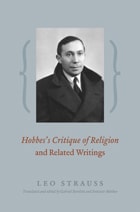
Hobbes's Critique of Religion and Related Writings
Leo Strauss
University of Chicago Press, 2011
Leo Strauss’s The Political Philosophy of Hobbes deservedly ranks among his most widely acclaimed works. In it Strauss argues that the basis for Hobbes’s natural and political science is his interest in “self-knowledge of man as he really is.” The writings collected in this book, each written prior to that classic volume, complement that account. Thus at long last, this book allows us to have a complete picture of Strauss’s interpretation of Hobbes, the thinker pivotal to the fundamental theme of his life’s work: the conflicting demands of philosophy and revelation, or as he termed it, “the theologico-political problem.”
It is no exaggeration to say that Strauss’s work on Hobbes’s critique of religion is essential to his analysis of Hobbes’s political philosophy, and vice versa. This volume will spark new interest in Hobbes’s explication of the Bible and in his understanding of religion by revealing previously neglected dimensions and motives of Hobbes’s “theology.” At the same time, scholars interested in the intellectual development of Leo Strauss will find in these writings the missing link, as it were, between his two early books,Spinoza’s Critique of Religion and The Political Philosophy of Hobbes.
In addition, this volume makes available for the first time in English a letter, a book outline, an extended review, an engagement with legal positivism, and an account of Strauss’s work on Hobbes by Heinrich Meier, all of which shed light on Strauss’s concerns and his approach to Hobbes in particular, as well as to modern political thought and life.
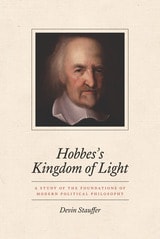
Hobbes's Kingdom of Light
A Study of the Foundations of Modern Political PhilosophyDevin Stauffer
University of Chicago Press, 2018
In Hobbes’s Kingdom of Light, Stauffer argues that Hobbes was engaged in a struggle on multiple fronts against forces, both philosophic and religious, that he thought had long distorted philosophy and destroyed the prospects of a lasting peace in politics. By exploring the twists and turns of Hobbes’s arguments, not only in his famous Leviathan but throughout his corpus, Stauffer uncovers the details of Hobbes’s critique of an older outlook, rooted in classical philosophy and Christian theology, and reveals the complexity of Hobbes’s war against the “Kingdom of Darkness.” He also describes the key features of the new outlook—the “Kingdom of Light”—that Hobbes sought to put in its place. Hobbes’s venture helped to prepare the way for the later emergence of modern liberalism and modern secularism. Hobbes’s Kingdom of Light is a wide-ranging and ambitious exploration of Hobbes’s thought.

Hollywood in Havana
US Cinema and Revolutionary Nationalism in Cuba before 1959Megan Feeney
University of Chicago Press, 2018
Megan Feeney argues that the freedom fighting extolled in American World War II dramas and the rebellious values and behaviors seen in postwar film noir helped condition Cuban audiences to expect and even demand purer forms of Cuban democracy and national sovereignty. At the same time, influential Cuban intellectuals worked to translate Hollywood ethics into revolutionary rhetoric—which, ironically, led to pointed critiques and subversions of the US presence in Cuba. Hollywood in Havana not only expands our notions of how American cinema was internalized around the world—it also broadens our view of the ongoing history of US-Cuban interactions, both cultural and political.
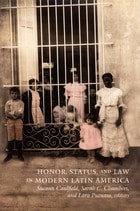
Honor, Status, and Law in Modern Latin America
Sueann Caulfield, Sarah C. Chambers, and Lara Putnam, eds.
Duke University Press, 2005
Each essay examines honor in the context of specific historical processes, including early republican nation-building in Peru; the transformation in Mexican villages of the cargo system, by which men rose in rank through service to the community; the abolition of slavery in Rio de Janeiro; the growth of local commerce and shifts in women’s status in highland Bolivia; the formation of a multiethnic society on Costa Rica’s Caribbean coast; and the development of nationalist cultural responses to U.S. colonialism in Puerto Rico. By connecting liberal projects that aimed to modernize law and society with popular understandings of honor and status, this volume sheds new light on broad changes and continuities in Latin America over the course of the long nineteenth century.
Contributors. José Amador de Jesus, Rossana Barragán, Sueann Caulfield, Sidney Chalhoub, Sarah C. Chambers, Eileen J. Findley, Brodwyn Fischer, Olívia Maria Gomes da Cunha, Laura Gotkowitz, Keila Grinberg, Peter Guardino, Cristiana Schettini Pereira, Lara Elizabeth Putnam
Hope and Scorn
Eggheads, Experts, and Elites in American PoliticsMichael J. Brown
University of Chicago Press, 2020
Intellectuals “have been both rallying points and railed against in American politics, vessels of hope and targets of scorn,” writes Michael J. Brown as he invigorates a recurrent debate in American life: Are intellectual public figures essential voices of knowledge and wisdom, or out-of-touch elites? Hope and Scorn investigates the role of high-profile experts and thinkers in American life and their ever-fluctuating relationship with the political and public spheres.
From Eisenhower’s era to Obama’s, the intellectual’s role in modern democracy has been up for debate. What makes an intellectual, and who can claim that privileged title? What are intellectuals’ obligations to society, and how, if at all, are their contributions compatible with democracy? For some, intellectuals were models of civic engagement. For others, the rise of the intellectual signaled the fall of the citizen. Carrying us through six key moments in this debate, Brown expertly untangles the shifting anxieties and aspirations for democracy in America in the second half of the twentieth century and beyond. Hope and Scorn begins with “egghead” politicians like Adlai Stevenson; profiles scholars like Richard Hofstadter and scholars-turned-politicians like H. Stuart Hughes; and ends with the rise of public intellectuals such as bell hooks and Cornel West. In clear and unburdened prose, Brown explicates issues of power, authority, political backlash, and more. Hope and Scorn is an essential guide to American concerns about intellectuals, their myriad shortcomings, and their formidable abilities.
How Democracies Live
Power, Statecraft, and Freedom in Modern SocietiesStein Ringen
University of Chicago Press, 2022
In the new century, the triumph of democracy at the end of the Cold War turned to retrenchment. The core democracies, in America and Britain, succumbed to polarization and misrule. Dictatorships, such as China, made themselves assertive. New democracies in Central Europe turned to muddled ideologies of “illiberal democracy.” In this book, Stein Ringen offers a meditation on what democracy is, the challenges it faces, and how it can be defended. Ringen argues that democracy must be rooted in a culture that supports the ability of citizens to exchange views and information among themselves and with their rulers.
Drawing on the ideas of Machiavelli, Aristotle, Tocqueville, Max Weber, and others, Ringen shows how power is the fuel of government, and statecraft turns power into effective rule. Democracy should prize freedom and minimizing unfairness, especially poverty. Altogether, Ringen offers powerful insight on the meaning of democracy, including a new definition, and how countries can improve upon it and make it function more effectively. Timely and thought-provoking, How Democracies Live is a sober reminder of the majesty of the democratic enterprise.
How Philosophy Became Socratic
A Study of Plato's "Protagoras," "Charmides," and "Republic"Laurence Lampert
University of Chicago Press, 2010

How Revolutions Happen
Konstantin Sonin
University of Chicago Press, 0
From the Russian intellectual-in-exile Konstantin Sonin, a grand theory of when and how rapid political change happens—or doesn’t.
In 2015, economist Konstantin Sonin solidified his status as an enemy of the Russian state when he published an article predicting that Vladimir Putin’s presidency would produce the country’s third revolution by the middle of this century. Forced to flee the country, Sonin settled in Chicago. In the decade that followed, the Russian government continued to pursue him—placing him on their state wanted list, tracking his movements, and sentencing him in absentia to eight years in prison. Sonin’s research and political advocacy continued unabated. So did his writing.
Now, Sonin has completed his masterpiece: a revelatory and sweeping investigation of a timeless question—what makes a revolution? How Revolutions Happen pinpoints why they arise, why they don’t, and where they’re likely to occur next. Tracing examples of successful and failed examples from history—in China, France, Haiti, Ukraine—Sonin shows that revolutions don’t grow out of mere popular unrest; they happen when states cease to evolve. This argument extends well beyond why nations fail, considering also why nations almost fail and why other nations fail repeatedly. Drawing on both empirical evidence and his firsthand experience, he also argues that although revolutions are an important part of human societies, they are not inherently good or bad—or quick to end.
Wry, sweeping, and erudite, How Revolutions Happen recasts everything we think about political change. From one of the world’s foremost political economists, this book is a momentous cumulation of knowledge that allows us to fully understand what a revolution is, why they occurred in the past—and how to measure where they might be coming.
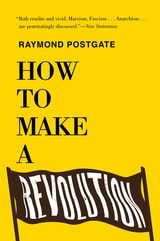
How to Make a Revolution
Raymond Postgate
Westholme Publishing, 2018
The first third of the twentieth century saw a seismic upheaval in global politics and society that still reverberates today. Communism and fascism toppled both traditional monarchies and representative democracies, while trade unions and other factions effectively challenged existing governments to adopt reforms or face crippling economic or social upheaval. Given these extraordinary events, Raymond Postgate set forth in How to Make a Revolution to objectively discuss revolutionary methods, and which tactics or strategies are the most effective. Drawing on his own idealistic experience as a young labor agitator and editor of a communist newspaper and more than fifteen years of close study of past revolutionary history and theories, the author dispassionately discusses Marxism, fascism, anarchism, and Blanquism (a doctrine within socialism), as well as syndicalism and industrial unionism. He then reviews revolutionary practice, including general strikes, financial pressure, armed revolution, and communist tactics, and ends with a prescient and frightening conclusion: without general consensus and determination, a peaceful revolution is impossible, and “if no action is taken, action of another kind will be taken for us. . . . The continuance of uncertainty will mean that the disillusioned will drift steadily across to a Fascist organization. Fascism means war; the character of a Fascist State is fairly well known. Once it is established, those who read, who write, who publish or who print, books like this are likely to be dead or in concentration camps.” Originally published in 1934, Postgate’s book was heralded for its clarity and scholarship.
Human Nature and History
A Study of the Development of Liberal Political ThoughtRobert Denoon Cumming
University of Chicago Press, 1969
Human Nature and History, a monumental work in two volumes, is an attempt to analyze these relations. It is a work in meta-theory or the theory of political theory.
At the most general level, Cumming is concerned with the question of what is involved in the enterprise of political theory or political philosophy and how different conceptions of that enterprise have developed historically. More specifically, he is concerned with the format imposed on the historical development of political thought by Anglo-American liberalism, especially as represented by John Stuart Mill.
Since Cumming traces the development of political theory by reference to the relation between its subject-matter and other subject-matters, his study should be of interest to historians of thought and culture, as well as to political theorists and philosophers.
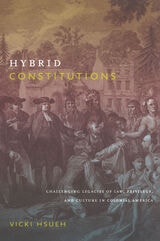
Hybrid Constitutions
Challenging Legacies of Law, Privilege, and Culture in Colonial AmericaVicki Hsueh
Duke University Press, 2010
Hsueh traces the historical development and theoretical implications of proprietary constitutionalism by examining the founding of the colonies of Maryland, Carolina, and Pennsylvania. She provides close readings of colonial proclamations, executive orders, and assembly statutes, as well as the charter granting Cecilius Calvert the colony of Maryland in 1632; the Fundamental Constitutions of Carolina, adopted in 1669; and the treaties brokered by William Penn and various Lenni Lenape and Susquehannock tribes during the 1680s and 1690s. These founding documents were shaped by ambition, contingency, and limited resources; they reflected an ambiguous and unwieldy colonialism rather than a purposeful, uniform march to modernity. Hsueh concludes by reflecting on hybridity as a rubric for analyzing the historical origins of colonialism and reconsidering contemporary indigenous claims in former settler colonies such as Australia, New Zealand, and the United States.