260 books match the query 'Holocaust' and 15 start with h
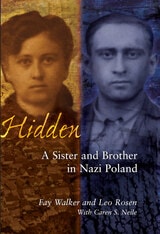
cover of Hidden: A Sister and Brother in Nazi Poland

Hidden

A Sister and Brother in Nazi Poland

Fay Walker

University of Wisconsin Press, 2002

Of the Rosenbluth family, only the older children, Faiga and Luzer, had gone into hiding before the SS rounded up the Jews of Kanczuga, Poland. Hidden is Faiga and Luzer’s story, a memoir whose intimate and quiet particularity makes the incomprehensible enormity of the Holocaust immediate, human, and devastatingly real.
In alternating first-person narratives, Faiga (Fay) and Luzer (Leo) take readers into their very different but inextricably linked experiences in Nazi-occupied Poland. Faiga, the once-dignified young lady from a good home with servants and a seat by the eastern wall of the synagogue, spends two years wandering the perilous countryside, hoping to be taken for a peasant. Mere miles away, knowing nothing of his sister’s fate, Luzer, the leather wholesaler’s only son, lies silent all day in the stifling dark corner of a barn, where the smell of the cows’ warm hides are a piquant reminder of his lost world. Hidden deftly summons that world, as the familiar comforts and squabbles of life in a well-to-do, religious Jewish family are slowly overwhelmed by the grim news coming out of Germany. We follow Faiga and Luzer through the early forebodings and deprivations of the war, into hiding among righteous Poles and erstwhile neighbors-turned-betrayers, and finally, at war’s end, back once more into the world—but not necessarily into safety. Told in a confident, clear, and unsentimental prose, this is a story of heroism and tragedy writ large and small, of two young people coming of age in a world in chaos and then trying to return to "normal" after experiences as unimaginable as they are unforgettable.
[more]
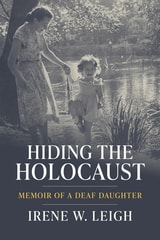
cover of Hiding the Holocaust: Memoir of a Deaf Daughter

Hiding the Holocaust

Memoir of a Deaf Daughter

Irene W. Leigh

Gallaudet University Press, 2026
From her parents, deaf psychologist Irene W. Leigh learned how quickly safety could be yanked away. Her parents, Jews who barely escaped Nazi Germany on the eve of World War II, tried to shield Leigh from harm, never talking about the horrors they endured, and it was not until recently that she began to discover the truth by uncovering a shocking document. Having rebuilt their lives from scratch, first in England and then in America, Leigh’s parents passed down a legacy of ambition, persistence, and achievement, shaping her resilience in response to bias and discrimination. In this deeply personal memoir, Hiding the Holocaust, Leigh explores how this unspoken history and inherited trauma has informed her personal, familial, academic, and career experiences. Using a lifespan narrative structure focusing on memories, reflections, and recreated dialogue, Leigh narrates the subtle ways in which Holocaust trauma and loss affected not only her parents but also herself as a deaf child, teen, adult, and parent.
[more]
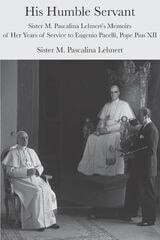
cover of His Humble Servant: Sister M. Pascalina Lehnert's Memoirs of Her Years of Service to Eugenio Pacelli, Pope Pius XII

His Humble Servant

Sister M. Pascalina Lehnert's Memoirs of Her Years of Service to Eugenio Pacelli, Pope Pius XII

M. Pascalina Lehnert

St. Augustine's Press, 2012

This is a personal and insightful portrait of Pope Pius XII, the memories of Sister M. Pascalina Lehnert, who served as his housekeeper for forty years. Her book, most of it written just a few months after the Pope’s death, shares insights into the person, the life, and the thinking of Pius XII, from his time as Nuncio in Munich until his death. Much of Sister’s motivation in writing this work was to correct the many distortions of fact and interpretation regarding this great pope.
   This book was a best seller in the original German, as well as in the Italian and French translations. This is the first edition in English.
   These reminiscences were written down at the instructions of Sister’s Superior General, but were not made known to the public until 1982, when it was published in German at the express wishes of Pope John Paul II to publish the work without any changes. So the work remained a lively, flowing account of memories and anecdotes in a simple, spontaneous style. It is a powerful and insightful account of Pius’s daily life, his treatment of those around him, and his concern for the upholding of the traditional teaching of the Church in the face of his awesome burden to lead the Church during World War II.
[more]
cover of Historical Distance and the Holocaust: Interactions Between Historians and Middle-Class Western Europeans in Memory Education

Historical Distance and the Holocaust

Interactions Between Historians and Middle-Class Western Europeans in Memory Education

Thomas Van de Putte

Central European University Press, 2026

What happens when Holocaust historians leave their academic bubble and start interacting with laypeople? This book investigates practices and discourses of historical distance and their effects on vernacular understandings of the Holocaust among white, middle-class Europeans. In five chapters, Historical Distance and the Holocaust describes and explains how historians, in interactions with laypeople, strip the Holocaust of its moral meaning and emotional load, narrate it as a ‘system’, and use sick Holocaust humour as distancing strategy.
A detailed interactional analysis and thick ethnographic description demonstrate how the temporal, moral and emotional distancing practices reenforce the lay moralities and political subjectivities of the white middle-class. This comes with (mostly unintended) consequences. Distanced approaches to the Holocaust in non-academic environments reduce empathy for victims and survivors, normalize violence, disconnect the meaning of the Holocaust from contemporary conflict, and re-activate stereotypes about groups who employ more ‘close’ approaches to the Holocaust.
[more]
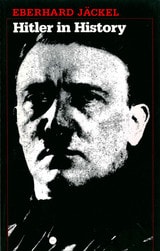
cover of Hitler in History

Hitler in History

Eberhard Jäckel

Brandeis University Press, 2000
A leading interpreter of the Nazi period addresses crucial issues in modern European and contemporary history.
[more]
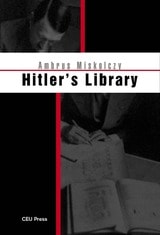
cover of Hitler's Library

Hitler's Library

Ambrus Miskolczy

Central European University Press, 2003

The first book to present the so-called Hitler Library. It sheds new light on the readings of Hitler and on his techniques how to read a book. Hitler presented himself as an ideal reader of Schopenhauer, nevertheless his remarks destroy that image, particularly if we see how he read Ernst Jünger, Richard Wagner, or Paul de Lagarde, and how he reread Mein Kampf.The book describes the gnostic character of the phenomenon as an explication of the success of nazism and that of the Hitler myth and challenges the static views of traditional historiography.
[more]
cover of Holocaust And Memory In The Global Age

Holocaust And Memory In The Global Age

Daniel Levy

Temple University Press, 2005

Can collective memories of the past shape the future? If one of the fears about a globalized society is the homogenization of culture, can it nevertheless be true that the homogenization of memory might have a positive impact on political and cultural norms?

Originally published in Germany, The Holocaust and Memory in the Global Age examines the nature of collective memory in a globalized world, and how the memory of one particular event—the Holocaust—helped give rise to an emerging global consensus on human rights.

Daniel Levy and Natan Sznaider show how memories of the Holocaust have been de-contextualized from the original event and offer a framework for interpreting contemporary acts of injustice such as ethnic cleansing and genocide. Representations of mass atrocities in Bosnia and Kosovo during the 1990s resonated with iconographies of the Holocaust and played a significant role in the political and military interventions in the Balkans. Subsequently, these representations have had a crucial impact on the consolidation of international human rights and related issues of transitional justice, reparations, and restitution.
[more]
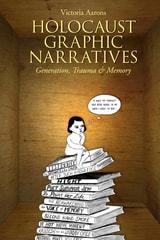
cover of Holocaust Graphic Narratives: Generation, Trauma, and Memory

Holocaust Graphic Narratives

Generation, Trauma, and Memory

Victoria Aarons

Rutgers University Press, 2020
In Holocaust Graphic Narratives, Victoria Aarons demonstrates the range and fluidity of this richly figured genre. Employing memory as her controlling trope, Aarons analyzes the work of the graphic novelists and illustrators, making clear how they extend the traumatic narrative of the Holocaust into the present and, in doing so, give voice to survival in the wake of unrecoverable loss. In recreating moments of traumatic rupture, dislocation, and disequilibrium, these graphic narratives contribute to the evolving field of Holocaust representation and establish a new canon of visual memory. The intergenerational dialogue established by Aarons’ reading of these narratives speaks to the on-going obligation to bear witness to the Holocaust. Examined together, these intergenerational works bridge the erosions created by time and distance. As a genre of witnessing, these graphic stories, in retracing the traumatic tracks of memory, inscribe the weight of history on generations that follow.
 
[more]
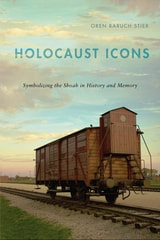
cover of Holocaust Icons: Symbolizing the Shoah in History and Memory

Holocaust Icons

Symbolizing the Shoah in History and Memory

Oren Baruch Stier

Rutgers University Press, 2015

The Holocaust has bequeathed to contemporary society a cultural lexicon of intensely powerful symbols, a vocabulary of remembrance that we draw on to comprehend the otherwise incomprehensible horror of the Shoah. Engagingly written and illustrated with more than forty black-and-white images, Holocaust Icons probes the history and memory of four of these symbolic relics left in the Holocaust’s wake.
 
Jewish studies scholar Oren Stier offers in this volume new insight into symbols and the symbol-making process, as he traces the lives and afterlives of certain remnants of the Holocaust and their ongoing impact. Stier focuses in particular on four icons: the railway cars that carried Jews to their deaths, symbolizing the mechanics of murder; the Arbeit Macht Frei (“work makes you free”) sign over the entrance to Auschwitz, pointing to the insidious logic of the camp system; the number six million that represents an approximation of the number of Jews killed as well as mass murder more generally; and the persona of Anne Frank, associated with victimization. Stier shows how and why these icons—an object, a phrase, a number, and a person—have come to stand in for the Holocaust: where they came from and how they have been used and reproduced; how they are presently at risk from a variety of threats such as commodification; and what the future holds for the memory of the Shoah.
 
In illuminating these icons of the Holocaust, Stier offers valuable new perspective on one of the defining events of the twentieth century. He helps readers understand not only the Holocaust but also the profound nature of historical memory itself.
[more]
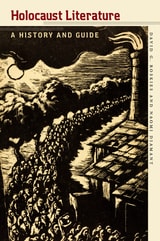
cover of Holocaust Literature: A History and Guide

Holocaust Literature

A History and Guide

David G. Roskies and Naomi Diamant

Brandeis University Press, 2013
What is Holocaust literature? When does it begin and how is it changing? Is there an essential core that consists of diaries, eyewitness accounts of the concentration camps, and tales of individual survival? Is it the same everywhere: West and East, in Australia as in the Americas, in poetry as in prose? Is this literature sacred and separate, or can it be studied alongside other responses to catastrophe? What works of Holocaust literature will be read a hundred years from now—and why? Here, for the first time, is a historical survey of Holocaust literature in all genres, countries, and major languages. Beginning in wartime, it proceeds from the literature of mobilization and mourning in the Free World to the vast literature produced in Nazi-occupied ghettos, bunkers and places of hiding, transit and concentration camps. No less remarkable is the new memorial literature that begins to take shape within weeks and months of the liberation. Moving from Europe to Israel, the United States, and beyond, the authors situate the writings by real and proxy witnesses within three distinct postwar periods: “communal memory,” still internal and internecine; “provisional memory” in the 1960s and 1970s, when a self-conscious Holocaust genre is born; and “authorized memory,” in which we live today. Twenty book covers—first editions in their original languages—and a guide to the “first hundred books” show the multilingual scope, historical depth, and artistic range of this extraordinary body of writing.
[more]
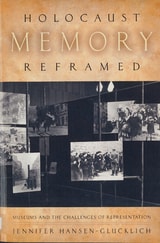
cover of Holocaust Memory Reframed: Museums and the Challenges of Representation

Holocaust Memory Reframed

Museums and the Challenges of Representation

Hansen-Glucklich, Jennifer

Rutgers University Press, 2014

Holocaust memorials and museums face a difficult task as their staffs strive to commemorate and document horror. On the one hand, the events museums represent are beyond most people’s experiences.  At the same time they are often portrayed by theologians, artists, and philosophers in ways that are already known by the public. Museum administrators and curators have the challenging role of finding a creative way to present Holocaust exhibits to avoid clichéd or dehumanizing portrayals of victims and their suffering.

In Holocaust Memory Reframed, Jennifer Hansen-Glucklich examines representations in three museums: Israel’s Yad Vashem in Jerusalem, Germany’s Jewish Museum in Berlin, and the United States Holocaust Memorial Museum in Washington, D.C. She describes a variety of visually striking media, including architecture, photography exhibits, artifact displays, and video installations in order to explain the aesthetic techniques that the museums employ. As she interprets the exhibits, Hansen-Glucklich clarifies how museums communicate Holocaust narratives within the historical and cultural contexts specific to Germany, Israel, and the United States. In Yad Vashem, architect Moshe Safdie developed a narrative suited for Israel, rooted in a redemptive, Zionist story of homecoming to a place of mythic geography and renewal, in contrast to death and suffering in exile. In the Jewish Museum in Berlin, Daniel Libeskind’s architecture, broken lines, and voids emphasize absence. Here exhibits communicate a conflicted ideology, torn between the loss of a Jewish past and the country’s current multicultural ethos. The United States Holocaust Memorial Museum presents yet another lens, conveying through its exhibits a sense of sacrifice that is part of the civil values of American democracy, and trying to overcome geographic and temporal distance. One well-know example, the pile of thousands of shoes plundered from concentration camp victims encourages the visitor to bridge the gap between viewer and victim.  

Hansen-Glucklich explores how each museum’s concept of the sacred shapes the design and choreography of visitors’ experiences within museum spaces. These spaces are sites of pilgrimage that can in turn lead to rites of passage.
[more]
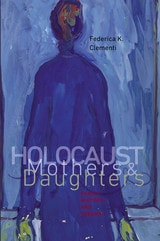
cover of Holocaust Mothers and Daughters: Family, History, and Trauma

Holocaust Mothers and Daughters

Family, History, and Trauma

Federica K. Clementi

Brandeis University Press, 2013
In this brave and original work, Federica Clementi focuses on the mother-daughter bond as depicted in six works by women who experienced the Holocaust, sometimes with their mothers, sometimes not. The daughters’ memoirs, which record the “all-too-human” qualities of those who were persecuted and murdered by the Nazis, show that the Holocaust cannot be used to neatly segregate lives into the categories of before and after. Clementi’s discussions of differences in social status, along with the persistence of antisemitism and patriarchal structures, support this point strongly, demonstrating the tenacity of trauma—individual, familial, and collective—among Jews in twentieth-century Europe.
[more]
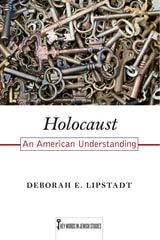
cover of Holocaust: An American Understanding

Holocaust

An American Understanding

Lipstadt, Deborah E

Rutgers University Press, 2016
Immediately after World War II, there was little discussion of the Holocaust, but today the word has grown into a potent political and moral symbol, recognized by all.  In Holocaust: An American Understanding, renowned historian Deborah E. Lipstadt explores this striking evolution in Holocaust consciousness, revealing how a broad array of Americans—from students in middle schools to presidents of the United States—tried to make sense of this inexplicable disaster, and how they came to use the Holocaust as a lens to interpret their own history.
 
Lipstadt weaves a powerful narrative that touches on events as varied as the civil rights movement, Vietnam, Stonewall, and the women’s movement, as well as controversies over Bitburg, the Rwandan genocide, and the bombing of Kosovo. Drawing upon extensive research on politics, popular culture, student protests, religious debates and various strains of Zionist ideologies, Lipstadt traces how the Holocaust became integral to the fabric of American life. Even popular culture, including such films as Dr. Strangelove and such books as John Hershey’s The Wall, was influenced by and in turn influenced thinking about the Holocaust. Equally important, the book shows how Americans used the Holocaust to make sense of what was happening in the United States. Many Americans saw the civil rights movement in light of Nazi oppression, for example, while others feared that American soldiers in Vietnam were destroying a people identified by the government as the enemy.   
 
Lipstadt demonstrates that the Holocaust became not just a tragedy to be understood but also a tool for interpreting America and its place in the world. Ultimately Holocaust: An American Understanding tells us as much about America in the years since the end of World War II as it does about the Holocaust itself.
 
[more]
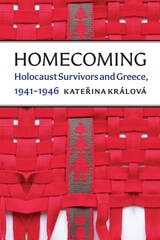
cover of Homecoming: Holocaust Survivors and Greece, 1941–1946

Homecoming

Holocaust Survivors and Greece, 1941–1946

Katerina Králová

Brandeis University Press, 2025

Documents the lives of Greek Jews who returned after surviving persecution, combat, and exile during World War II.
 
Homecoming records the experiences of Greek Jews who returned to their native country after World War II, when many went into hiding, fought in combat, became refugees, or were deported, some to Nazi death camps. Though they wanted more than anything to survive and come home, those who returned to postwar Greece faced isolation, anguish, deprivation, and hostility in the midst of a civil war. Their stories, which rarely feature in discussions of the Holocaust, raise important questions about its aftermath across Europe. Based on exhaustive archival research and new interviews with Holocaust survivors across several continents, Kateřina Králová’s new book adds to our understanding of the genocide and its impact.
[more]
cover of How Green Were the Nazis?: Nature, Environment, and Nation in the Third Reich

How Green Were the Nazis?

Nature, Environment, and Nation in the Third Reich

Franz-Josef Brüggemeier

Ohio University Press, 2005

The Nazis created nature preserves, championed sustainable forestry, curbed air pollution, and designed the autobahn highway network as a way of bringing Germans closer to nature. How Green Were the Nazis?:Nature, Environment, and Nation in the Third Reich is the first book to examine the Third Reich’s environmental policies and to offer an in-depth exploration of the intersections between brown ideologies and green practices. Environmentalists and conservationists in Germany welcomed the rise of the Nazi regime with open arms and hoped that it would bring about legal and institutional changes. However, environmentalists soon realized that the rhetorical attention they received from the regime did not always translate into action. By the late 1930s, nature and the environment had become less pressing concerns as Nazi Germany prepared for and executed a global conflagration. Based on prodigious archival research, and written by some of the most important scholars in the field of twentieth-century German history, How Green Were the Nazis? examines the overlap between Nazi ideology and conservationist agendas. This landmark book underscores the fact that the “green” policies of the Nazis were more than a mere episode or aberration in environmental history. Contributors: Franz-Josef Brüggemeier, Mark Cioc, Thomas Zeller, Charles Closmann, Michael Imort, Thomas Lekan, Frank Uekötter, Gesine Gerhard, Thomas Rohkrämer, Mark Bassin, and Joachim Wolschke-Bulmahn.
[more]