Results by title
69 books match the query 'Homosexuality and literature' and 5 start with h
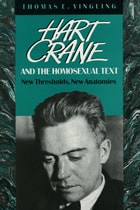
Hart Crane and the Homosexual Text
New Thresholds, New AnatomiesThomas E. Yingling
University of Chicago Press, 1990
"Canonized for being insufficiently American although he took America as his subject, chastised for obscurity by readers who would not allow or would not read homosexual meanings, Crane embodies many understandings of America, and of the predicament of the gay writer."—Voice Literary Supplement
"A brilliant critical model for understanding how textuality and sexuality can produce pervasive effects on each other in the writing of a figure like Crane."—Michael Moon, Duke University
"A brilliant critical model for understanding how textuality and sexuality can produce pervasive effects on each other in the writing of a figure like Crane."—Michael Moon, Duke University
[more]
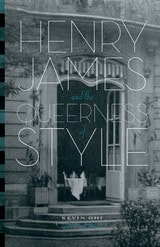
Henry James and the Queerness of Style
Kevin Ohi
University of Minnesota Press, 2010
Kevin Ohi begins this energetic book with the proposition that to read Henry James—particularly the late texts—is to confront the queer potential of style and the traces it leaves on the literary life. In contrast to other recent critics, Ohi asserts that James’s queerness is to be found neither in the homoerotic thematics of the texts, however startlingly explicit, nor in the suggestions of same-sex desire in the author’s biography, however undeniable, but in his style.
For Ohi, there are many elements in the style that make James’s writing queer. But if there is a thematic marker, Ohi shows through his careful engagements with these texts, it is belatedness. The recurrent concern with belatedness, Ohi explains, should be understood not psychologically but stylistically, not as confessing the sad predicament of being out of sync with one’s life but as revealing the consequences of style’s refashioning of experience. Belatedness marks life’s encounter with style, and it describes an experience not of deprivation but of the rich potentiality of the literary work that James calls “freedom.” In Ohi’s reading, belatedness is the indicator not of sublimation or repression, nor of authorial self-sacrifice, but of the potentiality of the literary—and hence of the queerness of style.
Presenting original readings of a series of late Jamesian texts, the book also represents an exciting possibility for queer theory and literary studies in the future: a renewed attention to literary form and a new sounding—energized by literary questions of style and form—of the theoretical implications of queerness.
[more]
Hispanisms and Homosexualities
Sylvia Molloy and Robert Irwin, eds.
Duke University Press, 1998
A man masquerading as a lesbian in Spain’s Golden Age fiction. A hermaphrodite’s encounters with the Spanish Inquisition. Debates about virility in the national literature of postrevolutionary Mexico. The work of contemporary artists Reinaldo Arenas, Severo Sarduy, and María Luisa Bemberg. The public persona of Pedro Zamora, former star of MTV’s The Real World. Despite an enduring queer presence in Hispanic literatures and cultures, most scholars have avoided the specter of sexual dissidence in the Spanish-speaking world.
In Hispanisms and Homosexualities, editors Sylvia Molloy and Robert Irwin bring together a group of essays that advance Hispanic studies and gay and lesbian studies by calling into question what is meant by the words Hispanic and homosexual. The fourteen contributors to this volume not only offer queer readings of Spanish and Latin American texts and performances, they also undermine a univocal sense of homosexual identities and practices. Taking on formations of national identity and sexuality; the politics of visibility and outing; the intersections of race, sexuality, and imperial discourse; the status of transvestism and posing; and a postmodern aesthetic of camp and kitsch, these essays from both established and emerging scholars provide a more complex and nuanced view of related issues involving nationality, ethnicity, and sexuality in the Hispanic world.
Hispanisms and Homosexualities offers the most sophisticated critical and theoretical work to date in Hispanic and queer studies. It will be an essential text for all those engaged with the complexities of ethnic, cultural, and sexual subjectivities.
Contributors. Daniel Balderston, Emilie Bergmann, Israel Burshatin, Brad Epps, Mary S. Gossy, Robert Irwin, Agnes I. Lugo-Ortiz, Sylvia Molloy, Oscar Montero, José Esteban Muñoz, José Quiroga, Rubén Ríos Avila, B. Sifuentes Jáuregui, Paul Julian Smith
[more]
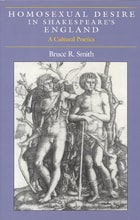
Homosexual Desire in Shakespeare's England
A Cultural PoeticsBruce R. Smith
University of Chicago Press, 1994
In the most comprehensive study yet of homosexuality in the English Renaissance, Bruce R. Smith examines and rejects the assessments of homosexual acts in moral philosophy, laws, and medical books in favor of a poetics of homosexual desire. Smith isolates six different "myths" from classical literature and discusses each in relation to a particular Renaissance literary genre and to a particular part of the social structure of early modern England. Smith's new Preface places his work in the context of the continuing controversies in gay, lesbian, and bisexual studies.
"The best single analysis of the homoerotic element in Renaissance English literature."—Keith Thomas, New York Review of Books
"Smith's lucid and subtle book offer[s] a poetics of homosexual desire. . . . Its scholarship, impressively broad and deftly deployed, aims to further a serious social purpose: the redemptive location of homosexual desire in history and the recuperation for our own time, through an understanding of its discursive embodiments, of that desire's changing imperatives and parameters."—Terence Hawkes, Times Literary Supplement
"The great strength of Bruce Smith's book is that it does not sidestep the complex challenge of engaging in the sexual politics of the present while attending to the resistant discourses and practices of Renaissance England. Homosexual Desire in Shakespeare's England demonstrates how a commitment to the present opens up our understanding of the past."—Peter Stallybrass, Shakespeare Quarterly
"A major contribution to the understanding of homosexuality in Renaissance England and by far the best and most comprehensive account yet offered of the homoeroticism that suffuses Renaissance literature."—Claude J. Summers, Journal of Homosexuality
[more]
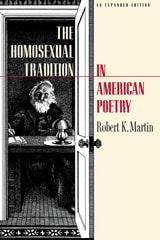
Homosexual Tradition in American Poetry
Robert K. Martin
University of Iowa Press, 1998
In this expanded edition, Robert Martin sketches an account of American gay male poetry since the 1970s, including an overview of works by Rafael Campo, Mark Doty, Marlon Riggs, and Reginald Shepherd.
[more]