Results by title
260 books match the query 'Human ecology' and 12 start with h
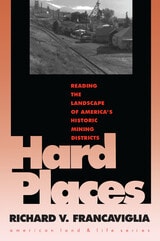
Hard Places
Reading the Landscape of America's Historic Mining DistrictsRichard V. Francaviglia
University of Iowa Press, 1997
Working with the premise that there are much meaning and value in the "repelling beauty" of mining landscapes, Richard Francaviglia identifies the visual clues that indicate an area has been mined and tells us how to read them, showing the interconnections among all of America's major mining districts. With a style as bold as the landscape he reads and with photographs to match, he interprets the major forces that have shaped the architecture, design, and topography of mining areas. Covering many different types of mining and mining locations, he concludes that mining landscapes have come to symbolize the turmoil between what our society elects to view as two opposing forces: culture and nature.
Haunted by Waters
A Journey through Race and Place in the American WestRobert T. Hayashi
University of Iowa Press, 2007
Even though race influenced how Americans envisioned, represented, and shaped the American West, discussions of its history devalue the experiences of racial and ethnic minorities. In this lyrical history of marginalized peoples in Idaho, Robert T. Hayashi views the West from a different perspective by detailing the ways in which they shaped the western landscape and its meaning.
As an easterner, researcher, angler, and third-generation Japanese American traveling across the contemporary Idaho landscape—where his grandfather died during internment during World War II—Hayashi reconstructs a landscape that lured emigrants of all races at the same time its ruling forces were developing cultured processes that excluded nonwhites. Throughout each convincing and compelling chapter, he searches for the stories of dispossessed minorities as patiently as he searches for trout.
Using a wide range of materials that include memoirs, oral interviews, poetry, legal cases, letters, government documents, and even road signs, Hayashi illustrates how Thomas Jefferson’s vision of an agrarian, all-white, and democratic West affected the Gem State’s Nez Perce, Chinese, Shoshone, Mormon, and particularly Japanese residents. Starting at the site of the Corps of Discovery’s journey into Idaho, he details the ideological, aesthetic, and material manifestations of these intertwined notions of race and place. As he ?y-?shes Idaho’s fabled rivers and visits its historical sites and museums, Hayashi reads the contemporary landscape in light of this evolution.
Herodotus in the Anthropocene
Joel Alden Schlosser
University of Chicago Press, 2020
Schlosser shows that the Histories, which chronicle the interactions among the Greek city-states and their neighbors that culminated in the Persian Wars, illuminate a telling paradox: at those times when humans appear capable of exerting more influence than ever before, they must also assert collective agency to avoid their own downfall. Here, success depends on nomoi, or the culture, customs, and laws that organize human communities and make them adaptable through cooperation. Nomoi arise through sustained contact between humans and their surroundings and function best when practiced willingly and with the support of strong commitments to the equality of all participants. Thus, nomoi are the very substance of political agency and, ultimately, the key to freedom and ecological survival because they guide communities to work together to respond to challenges. An ingenious contribution to political theory, political philosophy, and ecology, Herodotus in the Anthropocene reminds us that the best perspective on the present can often be gained through the lens of the past.
Highland Sanctuary
Environmental History in Tanzania’s Usambara MountainsChristopher A. Conte
Ohio University Press, 2004
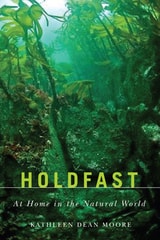
Holdfast
At Home in the Natural WorldKathleen Dean Moore
Oregon State University Press, 2013
Naturalist and philosopher Kathleen Dean Moore meditates on connection and separation in these twenty-one elegant, probing essays. Using the metaphor of holdfasts—the structures that attach seaweed to rocks with a grip strong enough to withstand winter gales—she examines our connections to our own bedrock.
“When people lock themselves in their houses at night and seal the windows shut to keep out storms, it is possible to forget, sometimes for years and years, that human beings are part of the natural world,” she writes. Holdfast passionately reclaims an awareness of the natural world, exploring the sense of belonging fostered by the communal howls of wolves; the inevitability of losing children to their own lives; the fear of bears and love of storms; the sublimity of life and longing in the creatures of the sea; her agonizing decision when facing her father’s bone-deep pain. As Moore travels philosophically and geographically—from Oregon’s shores to Alaska’s islands—she leaves no doubt of her virtuosity and range.
The new afterword is an important statement on the new responsibilities of nature writers as the world faces the consequences of climate change.
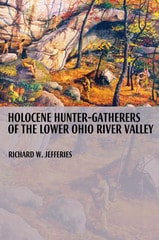
Holocene Hunter-Gatherers of the Lower Ohio River Valley
Richard Jefferies
University of Alabama Press, 2009
How Nature Speaks
The Dynamics of the Human Ecological ConditionYrjö Haila and Chuck Dyke, eds.
Duke University Press, 2006
Exploring ways of conceiving the complexity and multiplicity of humans’ many interactive relationships with the environment, the contributors provide in-depth case studies of the interweaving of culture and nature in socio-historical processes. The case studies focus on the origin of environmental movements, the politicization of environmental issues in city politics, the development of a local energy production system, and the convergence of forest management practices toward a dominant scheme. They are supported by explorations of big-picture issues: recurring themes in studies of social and environmental dynamics, the difficulties of deliberative democracy, and the potential gains for socio-ecological research offered by developmental systems theory and Pierre Bourdieu’s theory of intentionality.
How Nature Speaks includes a helpful primer, “On Thinking Dynamically about the Human Ecological Condition,” which explains the basic principles of complexity and nonlinear thinking.
Contributors. Chuck Dyke, Yrjö Haila, Ari Jokinen, Ville Lähde, Markus Laine, Iordanis Marcoulatos, John O’Neill, Susan Oyama, Taru Peltola, Lasse Peltonen, John Shotter, Peter Taylor
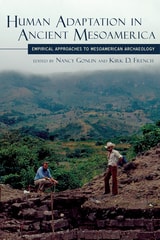
Human Adaptation in Ancient Mesoamerica
Empirical Approaches to Mesoamerican ArchaeologyNancy Gonlin
University Press of Colorado, 2016
This volume explores the dynamics of human adaptation to social, political, ideological, economic, and environmental factors in Mesoamerica and includes a wide array of topics, such as the hydrological engineering behind Teotihuacan’s layout, the complexities of agriculture and sustainability in the Maya lowlands, and the nuanced history of abandonment among different lineages and households in Maya centers.
The authors aptly demonstrate how culture is the mechanism that allows people to adapt to a changing world, and they address how ecological factors, particularly land and water, intersect with nonmaterial and material manifestations of cultural complexity. Contributors further illustrate the continuing utility of the cultural ecological perspective in framing research on adaptations of ancient civilizations.
This book celebrates the work of Dr. David Webster, an influential Penn State archaeologist and anthropologist of the Maya region, and highlights human adaptation in Mesoamerica through the scientific lenses of anthropological archaeology and cultural ecology.
Contributors include Elliot M. Abrams, Christopher J. Duffy, Susan Toby Evans, Kirk D. French, AnnCorinne Freter, Nancy Gonlin, George R. Milner, Zachary Nelson, Deborah L. Nichols, David M. Reed, Don S. Rice, Prudence M. Rice, Rebecca Storey, Kirk Damon Straight, David Webster, Stephen L. Whittington, Randolph J. Widmer, John D. Wingard, and W. Scott Zeleznik.
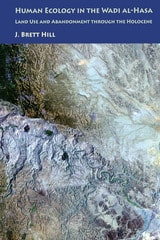
Human Ecology in the Wadi al-Hasa
Land Use and Abandonment through the HoloceneJ. Brett Hill
University of Arizona Press, 2006
This book focuses on changing land-use patterns and their relationship to socio-political organization. Using a combination of archaeological and environmental data, Brett Hill examines the human ecology of agriculture and pastoralism from the beginnings of domestication through the rise and collapse of complex societies. Models of land use often consider political complexity as an important factor affecting mismanagement. Together with GIS erosion modeling and settlement pattern analysis, Hill evaluates the archaeological, historical, and environmental record spanning the Holocene to show how land use was affected by the rise of centralized authority. Yet populations in the Hasa maintained the ability to resist authority and return to a nomadic life when it became advantageous. This process emphasizes the power of local groups to pursue alternative strategies when their interests diverged from those of elites, creating a dynamic that reshapes the landscape each generation.
Hill’s analysis contributes significantly to our understanding of the history of human ecology in the southern Levant, wherein current debates are complicated by research at different scales and by a lack of consensus on the importance of localized phenomena. It not only complements existing research but also seeks to refine models of processes in human ecology to demonstrate the effect of political organization on land mismanagement.
Human Ecology
A Theoretical EssayAmos H. Hawley
University of Chicago Press, 1986
Focused on the interaction between society and environment, human ecology is an attempt to deal holistically with the phenomenon of human organization. Beginning in the first quarter of the century, sociologists such as Park, Burgess, and McKenzie developed the study of human ecology to account for the dynamics of change in American cities. Over time, theorists have reached beyond the boundaries of sociology, drawing on the findings of economics, political science, anthropology, and bioecology, to understand the relationship of human beings to their environment. Hawley has successfully integrated the scattered theses of this wide-ranging discipline into a schematic whole.
The early human ecologists seized on the analogy of plant communities as a way of understanding urban communities. Hawley here maintains that the most important contribution to human ecology of the lexicons of plant and animal ecologies is the perspective of collective life as an adaptive process consisting in an interaction of environment, population, and organization. From the adaptive profess, he argues, emerges the ecosystem, a concept that serves as a common denominator for bioecology and human ecology.
Hawley has codified the theory of human ecology by a set of deductive hypotheses that establish its claims to coherence and comprehensiveness. His model charts a synthesis of ecological concepts ranging from adaptation and equilibrium through growth in temporal and spatial dimensions to convergence and openness. The essay underscores the critical importance of transportation and communication technology to the shaping of the human ecological system.
Human Ecology brings concision and elegance to this holistic perspective and will serve as a point of reference and orientation for anyone interested in the powers and scope of the ecological approach.
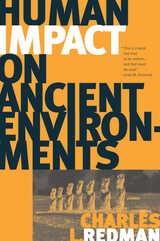
Human Impact on Ancient Environments
Charles L. Redman
University of Arizona Press, 1999

Humans and Other Animals
Cross-Cultural Perspectives on Human-Animal InteractionsSamantha Hurn
Pluto Press, 2012
Humans and Other Animals is about the myriad and evolving ways in which humans and animals interact, the divergent cultural constructions of humanity and animality found around the world, and individual experiences of other animals.
Samantha Hurn explores the work of anthropologists and scholars from related disciplines concerned with the growing field of anthrozoology. Case studies from a wide range of cultural contexts are discussed, and readers are invited to engage with a diverse range of human-animal interactions including blood sports (such as hunting, fishing and bull fighting), pet keeping and ‘petishism’, eco-tourism and wildlife conservation, working animals and animals as food. The idea of animal exploitation raised by the animal rights movements is considered, as well as the anthropological implications of changing attitudes towards animal personhood, and the rise of a posthumanist philosophy in the social sciences more generally.
Key debates surrounding these issues are raised and assessed and, in the process, readers are encouraged to consider their own attitudes towards other animals and, by extension, what it means to be human.