Results by title
78 books match the query 'Humanism' and 13 start with h
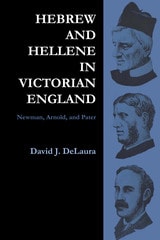
Hebrew and Hellene in Victorian England
Newman, Arnold, and PaterBy David DeLaura
University of Texas Press, 1969
Hebrew and Hellene explores the intellectual and personal relations among John Henry Newman, Matthew Arnold, and Walter Pater, three figures important in the development of nineteenth-century English thought and culture. Fundamentally concerned with the humanistic vision of Arnold and Pater, especially as they adapted the traditional religious culture to the needs of their generation, David DeLaura also recognizes Newman's central role. To a far greater degree than has been realized, Newman assumed a commanding position in the thought of the two younger men.
DeLaura seeks to define the mechanics of the process by which the conservative religious humanism of Newman could be exploited in the fluid, relativistic, and "aesthetic" humanism of Pater. The careers of Arnold and Pater are viewed as a continuing effort to reconcile the opposing forces of one of the central modern myths, the great cultural struggle between religious and secular values—Arnold's Hebraism and Hellenism.
DeLaura traces this important movement in nineteenth-century culture by studying the development of key phrases and ideas in the writings of the three men: the secularization of Newman's ideal of "inwardness" in Arnold's "criticism" and "culture" and in Pater's "impassioned contemplation"; the shared emphasis on an elite culture; the growing tendency to identify culture with the functions of traditional religion.
Newman, as the supreme apologist of both religious orthodoxy and the older Oxonian tradition, offered a rich arsenal to the defenders of a literary culture increasingly threatened by the utilitarian spirit (!nd by a rising scientific naturalism. Moreover, with the appearance of his Apologia in 1864, the "mystery" and the "miracle" of Newman's personality intrigued a new literary generation.
In Hebrew and Hellene DeLaura looks beyond the debates of the Late Victorians, the immediate inheritors of this legacy, to the continuing twentieth-century discussion of the nature of literature, its place in the humanizing process, and its role in a science-dominated civilization. He finds the problems faced by Pater, Arnold, and Newman—and some of their solutions—surprisingly relevant to unfinished contemporary debate.
Heidegger and Marx
A Productive Dialogue over the Language of HumanismLaurence Paul Hemming
Northwestern University Press, 2013
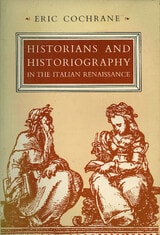
Historians and Historiography in the Italian Renaissance
Eric Cochrane
University of Chicago Press, 1981
History, the Human, and the World Between
R. Radhakrishnan
Duke University Press, 2008
Radhakrishnan develops his rationale of the “between” through three linked essays where he locates the terms “world,” “history,” “human,” and “subject” between phenomenology and poststructuralism, and in the process sets forth a nuanced reading of the politics of a gendered postcolonial humanism. Critically juxtaposing the works of thinkers such as Friedrich Nietzsche, Adrienne Rich, Frantz Fanon, Edward Said, Michel Foucault, Maurice Merleau-Ponty, Martin Heidegger, David Harvey, and Ranajit Guha, Radhakrishnan examines the relationship between systems of thought and their worldly situations. History, the Human, and the World Between is a powerful argument for a theoretical perspective that combines the existential urgency of phenomenology with the discursive rigor of poststructuralist practices.
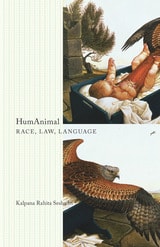
HumAnimal
Race, Law, LanguageKalpana Rahita Seshadri
University of Minnesota Press, 2012
HumAnimal explores the experience of dehumanization as the privation of speech. Taking up the figure of silence as the space between human and animal, it traces the potential for an alternate political and ethical way of life beyond law. Employing the resources offered by deconstruction as well as an ontological critique of biopower, Kalpana Rahita Seshadri suggests that humAnimal, as the site of impropriety opened by racism and manifested by silence, can be political and hazardous to power.
Through the lens of such works as Coetzee’s Foe, Chesnutt’s “The Dumb Witness,” Dr. Itard’s “wild child,” and aerialist Philippe Petit’s Man on Wire, Seshadri lucidly brings Derrida’s concept of the trace and his theory of sovereignty into conversation with Agamben’s investigation of the analytics of power. The task is twofold: on the one hand, to question the logocentric presumption that determines the separation between human and animal, and on the other to examine the conflation of this separation as an instrument of power in the practice of racism. Thus HumAnimal details the differences and intersections between Derrida and Agamben in their respective approaches to power, claiming that to think simultaneously within the registers of deconstruction (which conceives of power as a symptom of the metaphysics of presence) and biopolitics (which conceives of power as the operation of difference) entails a specification of the political and ethical consequences that attends the two perspectives.
When considered as the potential of language to refuse the law of signification and semantics, silence can neutralize the exercise of power through language, and Seshadri’s inquiry discloses a counterpower that does not so much oppose or destroy the politics of the subject but rather neutralizes it and renders it ineffective.

Human Rights and the Care of the Self
Alexandre Lefebvre
Duke University Press, 2018
Humanesis
Sound and Technological PosthumanismDavid Cecchetto
University of Minnesota Press, 2013
Humanesis critically examines central strains of posthumanism, searching out biases in the ways that human–technology coupling is explained. Specifically, it interrogates three approaches taken by posthumanist discourse: scientific, humanist, and organismic. David Cecchetto’s investigations reveal how each perspective continues to hold on to elements of the humanist tradition that it is ostensibly mobilized against. His study frontally desublimates the previously unseen presumptions that underlie each of the three thought lines and offers incisive appraisals of the work of three prominent thinkers: Ollivier Dyens, Katherine Hayles, and Mark Hansen.
To materially ground the problematic of posthumanism, Humanesis interweaves its theoretical chapters with discussions of artworks. These highlight the topos of sound, demonstrating how aurality might produce new insights in a field that has been dominated by visualization. Cecchetto, a media artist, scrutinizes his own collaborative artistic practice in which he elucidates the variegated causal chains that compose human–technological coupling.
Humanesis advances the posthumanist conversation in several important ways. It proposes the term “technological posthumanism” to focus on the discourse as it relates to technology without neglecting its other disciplinary histories. It suggests that deconstruction remains relevant to the enterprise, especially with respect to the performative dimension of language. It analyzes artworks not yet considered in the light of posthumanism, with a particular emphasis on the role of aurality. And the form of the text introduces a reflexive component that exemplifies how the dialogue of posthumanism might progress without resorting to the types of unilateral narratives that the book critiques.
Humanism Challenges Materialism in Economics and Economic History
Edited by Roderick Floud, Santhi Hejeebu, and David Mitch
University of Chicago Press, 2016
With Humanism Challenges Materialism in Economics and Economic History, Roderick Floud, Santhi Hejeebu, and David Mitch have brought together a distinguished group of scholars in economics, economic history, political science, philosophy, gender studies, and communications who synthesize and build on McCloskey’s work. The essays in this volume illustrate the ways in which the humanistic approach to economics that McCloskey pioneered can open up new vistas for the study of economic history and cultivate rich synergies with a wide range of disciplines. The contributors show how values and beliefs become embedded in the language of economics and shape economic outcomes. Chapters on methodology are accompanied by case studies discussing particular episodes in economic history.
Humanism and Classical Crisis
Anxiety, Intertexts, and the Miltonic MemoryJacob Blevins
The Ohio State University Press, 2014
Blevins grounds his approach in the theories of Jacques Lacan, whose work challenges the very notions of what identity is and, as a result, exposes the complexities of identity formation. Areas and authors covered include imitations and translations of classical works of the sixteenth and seventeenth centuries in England and France by Andrew Marvell, Edmund Spencer, Pierre Ronsard, Joachim Du Bellay, Ben Jonson, Sir Thomas Wyatt, and John Milton.
This book not only provides a new perspective on early modern poetic imitation, but also offers a foundational methodology for examining the classical presence within the modern self.
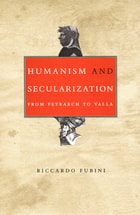
Humanism and Secularization
From Petrarch to VallaRiccardo Fubini
Duke University Press, 2003
Humanism and Secularization offers a nuanced account of humanists contesting medieval ideas about authority not in order to reject Christianity or even orthodoxy, but to claim for themselves the right to define what it meant to be a Christian. Fubini analyzes key texts by major humanists—isuch as Petrarch, Poggio, and Valla—from the first century of the movement. As he subtly works out these authors’ views on religion and the Church from both biographical and textual information, Fubini reveals in detail the new historical consciousness that animated the humanists in their reading of classical and patristic texts. His book as a whole shows convincingly just how radical the humanism of the first half of the fifteenth century was and how sharply it challenged well-entrenched ideas and institutions. Appearing here in English for the first time, his work provides a model set of readings of humanist texts and a critical perspective on Italian humanism that will alter and enrich discussion and understanding of the nature of the humanist movement.
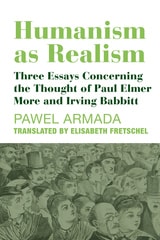
Humanism as Realism
Three Essays Concerning the Thought of Paul Elmer More and Irving BabbittLisa Fretschel
St. Augustine's Press, 2023
"This is a protreptic book. Its main goal is to encourage people to undertake independent studies or more generally, simply to think independently. If we want to think for ourselves, and not like preprogrammed humanoids, we can’t do so in a vacuum. We have to lean on something. In the Author’s view, the more than century-old writings of Paul Elmer More and Irving Babbitt are perfectly suited to the role of such a support for us, living in the here and now. They make it possible for us to dig ourselves out from underneath the heaps of opinions, “principles” or “theories” that allegedly can’t be rejected, that we’re obliged to follow, but that have a paralyzing and dumbing-down effect on us, making our lives from the
outset seems like the dream of a childish old man."
––Taken from the Preface by Pawel Armada
Humanism in Crisis
The Decline of the French RenaissancePhilippe Desan, Editor
University of Michigan Press, 1991
Humanism of the Other
Emmanuel Levinas
University of Illinois Press, 2003