Results by title
85 books match the query 'Humanities' and 18 start with h
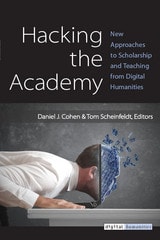
Hacking the Academy
New Approaches to Scholarship and Teaching from Digital HumanitiesDaniel J. Cohen and Tom Scheinfeldt, Editors
University of Michigan Press, 2013
On May 21, 2010, Daniel J. Cohen and Tom Scheinfeldt posted the following provocative questions online:
“Can an algorithm edit a journal? Can a library exist without books? Can students build and manage their own learning management platforms? Can a conference be held without a program? Can Twitter replace a scholarly society?”
As recently as the mid-2000s, questions like these would have been unthinkable. But today serious scholars are asking whether the institutions of the academy as they have existed for decades, even centuries, aren’t becoming obsolete. Every aspect of scholarly infrastructure is being questioned, and even more importantly, being hacked. Sympathetic scholars of traditionally disparate disciplines are canceling their association memberships and building their own networks on Facebook and Twitter. Journals are being compiled automatically from self-published blog posts. Newly minted PhDs are forgoing the tenure track for alternative academic careers that blur the lines between research, teaching, and service. Graduate students are looking beyond the categories of the traditional CV and building expansive professional identities and popular followings through social media. Educational technologists are “punking” established technology vendors by rolling out their own open source infrastructure.
Here, in Hacking the Academy, Daniel J. Cohen and Tom Scheinfeldt have gathered a sampling of the answers to their initial questions from scores of engaged academics who care deeply about higher education. These are the responses from a wide array of scholars, presenting their thoughts and approaches with a vibrant intensity, as they explore and contribute to ongoing efforts to rebuild scholarly infrastructure for a new millennium.
Handbook of Latin American Studies, Vol. 76
HumanitiesKatherine D. McCann, Volume Editor
University of Texas Press, 2023
Beginning with Number 41 (1979), the University of Texas Press became the publisher of the Handbook of Latin American Studies, the most comprehensive annual bibliography in the field. Compiled by the Hispanic Division of the Library of Congress and annotated by a corps of specialists in various disciplines, the Handbook alternates from year to year between social sciences and humanities.
The Handbook annotates works on Mexico, Central America, the Caribbean and the Guianas, Spanish South America, and Brazil, as well as materials covering Latin America as a whole. Most of the subsections are preceded by introductory essays that serve as biannual evaluations of the literature and research underway in specialized areas.

Heroes and Humanities
Detective Fiction and CultureRay B. Browne
University of Wisconsin Press, 1986
The present study of American, Australian, and Canadian detective fiction concerns literature which speaks in the ways of heroes and humanities about the human condition. All authors studied here, to one degree or another, demonstrate their concern with human society, some more strongly than others, but all with their eyes on the human situation and human existence. At times these studies lean toward the tragic in their outlook and development. In all instances they center on the humanistic.
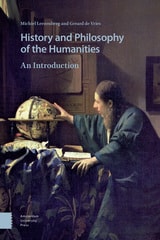
History and Philosophy of the Humanities
An IntroductionMichiel Leezenberg
Amsterdam University Press, 2018
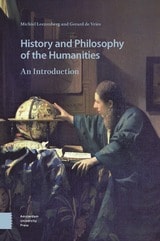
History and Philosophy of the Humanities
An IntroductionMichiel Leezenberg
Amsterdam University Press, 2019
'History and Philosophy of the Humanities: An Introduction' presents a reasoned overview of the conceptual and historical backgrounds of the humanities. In four sections, it discusses:
- the most influential views on scientific knowledge from Aristotle to Thomas Kuhn;
- the birth of the modern humanities and its relation to the natural and social sciences;
- the various methodological schools and conceptual issues in the humanities;
- several themes that set the agenda for current debates in the humanities: critiques of modernity; gender, sexuality and identity; and postcolonialism.
Thus, it provides students in the humanities with a comprehensive understanding of the backgrounds of their own discipline, its relation to other disciplines, and the state of the art of the humanities at large.
History of Humanities, volume 10 number 1 (Spring 2025)
The University of Chicago Press
University of Chicago Press Journals, 2025
History of Humanities, volume 10 number 2 (Fall 2025)
The University of Chicago Press
University of Chicago Press Journals, 2025
History of Humanities, volume 11 number 1 (Spring 2026)
The University of Chicago Press
University of Chicago Press Journals, 2026

History of Humanities, volume 6 number 1 (Spring 2021)
The University of Chicago Press
University of Chicago Press Journals, 2021
History of Humanities, volume 6 number 2 (Fall 2021)
The University of Chicago Press
University of Chicago Press Journals, 2021
History of Humanities, volume 7 number 1 (Spring 2022)
The University of Chicago Press
University of Chicago Press Journals, 2022
History of Humanities, volume 7 number 2 (Fall 2022)
The University of Chicago Press
University of Chicago Press Journals, 2022
History of Humanities, volume 8 number 1 (Spring 2023)
The University of Chicago Press
University of Chicago Press Journals, 2023
History of Humanities, volume 9 number 1 (Spring 2024)
The University of Chicago Press
University of Chicago Press Journals, 2024
History of Humanities, volume 9 number 2 (Fall 2024)
The University of Chicago Press
University of Chicago Press Journals, 2024
Hope, Heart, and the Humanities
How a Free College Course is Changing LivesJean Cheney and L. Jackson Newell, editors, with Hikmet Sidney Loe, Jeff Metcalf, and Bridget M. Newell
University of Utah Press, 2016
Hope, Heart, and the Humanities tells the story of how Venture, a free, interdisciplinary college humanities course inspired by the national Clemente Course, has helped open doors to improve the lives of people with low incomes who face barriers to attending college. For over a decade, this course has given hundreds of adults, some of them immigrants or refugees, the knowledge, confidence, and power to rechart their lives.
Readers will go inside Venture classrooms to see what occurs when adults enter serious discussions about literature, critical writing, art history, American history, and philosophy. Apparent also are the difficulties nontraditional students, who range in age from 18 to 60, often encounter in a college classroom and the hard choices they and their teachers make. What readers may remember most are the stories and words from people whose views of the world broaden and whose directions in life changed.
Interview with Tom Williams at Access Utah
How We Think
Digital Media and Contemporary TechnogenesisN. Katherine Hayles
University of Chicago Press, 2012
“How do we think?” N. Katherine Hayles poses this question at the beginning of this bracing exploration of the idea that we think through, with, and alongside media. As the age of print passes and new technologies appear every day, this proposition has become far more complicated, particularly for the traditionally print-based disciplines in the humanities and qualitative social sciences. With a rift growing between digital scholarship and its print-based counterpart, Hayles argues for contemporary technogenesis—the belief that humans and technics are coevolving—and advocates for what she calls comparative media studies, a new approach to locating digital work within print traditions and vice versa.
Humanities in the Time of AI
Laurent Dubreuil
University of Minnesota Press, 2025
Why AI offers a chance for the humanities to strengthen their relevance and significance
If humanistic research consists of the generation of consensus positions, simple expression, summarized texts, or passable translations, then we have arrived at the place where AI is able to accomplish these different missions to a convincing degree. However, Laurent Dubreuil argues, such tasks do not, in any way, constitute the humanities. On the contrary, he posits, a maximalist take on scholarship would not focus on generation but on creation, as a subject and as an object. Dubreuil seizes the opportunity of what AI reveals about the meaning of humanistic inquiry to offer a path for the renewal of the humanities on transhistorical, transcultural, and transdisciplinary grounds.