456 books match the query 'India' and 13 start with h
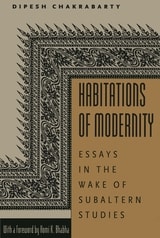
cover of Habitations of Modernity: Essays in the Wake of Subaltern Studies

Habitations of Modernity

Essays in the Wake of Subaltern Studies

Dipesh Chakrabarty

University of Chicago Press, 2002

In Habitations of Modernity, Dipesh Chakrabarty explores the complexities of modernism in India and seeks principles of humaneness grounded in everyday life that may elude grand political theories. The questions that motivate Chakrabarty are shared by all postcolonial historians and anthropologists: How do we think about the legacy of the European Enlightenment in lands far from Europe in geography or history? How can we envision ways of being modern that speak to what is shared around the world, as well as to cultural diversity? How do we resist the tendency to justify the violence accompanying triumphalist moments of modernity?

Chakrabarty pursues these issues in a series of closely linked essays, ranging from a history of the influential Indian series Subaltern Studies to examinations of specific cultural practices in modern India, such as the use of khadi—Gandhian style of dress—by male politicians and the politics of civic consciousness in public spaces. He concludes with considerations of the ethical dilemmas that arise when one writes on behalf of social justice projects.
[more]
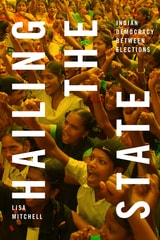
cover of Hailing the State: Indian Democracy between Elections

Hailing the State

Indian Democracy between Elections

Lisa Mitchell

Duke University Press, 2023

In Hailing the State, Lisa Mitchell explores the methods of collective assembly that people in India use to hold elected officials and government administrators accountable, demand inclusion in decision making, and stage informal referendums. Mitchell traces the colonial and postcolonial lineages of collective forms of assembly, in which—rather than rejecting state authority—participants mobilize with expectations that officials will uphold the law and fulfill electoral promises. She shows how assembly, which ranges from sit-ins, hunger strikes, and demands for meetings with officials to massive general strikes and road and rail blockades, is fundamental to the functioning of democracy in India. These techniques are particularly useful for historically marginalized groups and others whose voices may not be easily heard. Moving beyond an exclusive focus on electoral processes, Mitchell argues that to understand democracy—both in India and beyond—we must also pay attention to what occurs between elections, thereby revising understanding of what is possible for democratic action around the world.
[more]
cover of Haunting Bollywood: Gender, Genre, and the Supernatural in Hindi Commercial Cinema

Haunting Bollywood

Gender, Genre, and the Supernatural in Hindi Commercial Cinema

By Meheli Sen

University of Texas Press, 2017

Haunting Bollywood is a pioneering, interdisciplinary inquiry into the supernatural in Hindi cinema that draws from literary criticism, postcolonial studies, queer theory, history, and cultural studies. Hindi commercial cinema has been invested in the supernatural since its earliest days, but only a small segment of these films have been adequately explored in scholarly work; this book addresses this gap by focusing on some of Hindi cinema’s least explored genres.

From Gothic ghost films of the 1950s to snake films of the 1970s and 1980s to today’s globally influenced zombie and vampire films, Meheli Sen delves into what the supernatural is and the varied modalities through which it raises questions of film form, history, modernity, and gender in South Asian public cultures. Arguing that the supernatural is dispersed among multiple genres and constantly in conversation with global cinematic forms, she demonstrates that it is an especially malleable impulse that routinely pushes Hindi film into new formal and stylistic territories. Sen also argues that gender is a particularly accommodating stage on which the supernatural rehearses its most basic compulsions; thus, the interface between gender and genre provides an exceptionally productive lens into Hindi cinema’s negotiation of the modern and the global. Haunting Bollywood reveals that the supernatural’s unruly energies continually resist containment, even as they partake of and sometimes subvert Hindi cinema’s most enduring pleasures, from songs and stars to myth and melodrama.

[more]
cover of Healing at the Periphery: Ethnographies of Tibetan Medicine in India

Healing at the Periphery

Ethnographies of Tibetan Medicine in India

Laurent Pordié and Stephan Kloos, editors

Duke University Press, 2022

India has long occupied an important place in Tibetan medicine's history and development. However, Indian Himalayan practitioners of Tibetan medicine, or amchi, have largely remained overlooked at the Tibetan medical periphery, despite playing a central social and medical role in their communities. Power and legitimacy, religion and economic development, biomedical encounters and Indian geopolitics all intersect in the work and identities of contemporary Himalayan amchi. This volume examines the crucial moment of crisis and transformation that occurred in the early 2000s to offer insights into the beginnings of Tibetan medicine's professionalization, industrialization, and official recognition in India and elsewhere. Based on fine-grained ethnographic studies in Ladakh, Zangskar, Sikkim, and the Darjeeling Hills, Healing at the Periphery asks how the dynamics of capitalism, social change, and the encounter with biomedicine affect small communities on the fringes of modern India, and, conversely, what local transformations of Tibetan medicine tell us about contemporary society and health care in the Himalayas and the Tibetan world.

Contributors. Florian Besch, Calum Blaikie, Sienna R. Craig, Barbara Gerke, Isabelle Guérin, Kim Gutschow, Pascale Hancart Petitet, Stephan Kloos, Fernanda Pirie, Laurent Pordié
[more]
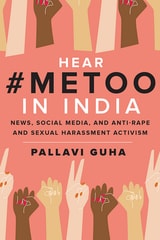
cover of Hear #MeToo in India: News, Social Media,  and Anti-Rape and Sexual Harassment Activism

Hear #MeToo in India

News, Social Media, and Anti-Rape and Sexual Harassment Activism

Pallavi Guha

Rutgers University Press, 2021
This book examines the role media platforms play in anti-rape and sexual harassment activism in India. Including 75 interviews with feminist activists and journalists working across India, it proposes a framework of agenda-building and establishes a theoretical framework to examine media coverage of issues in the digitally emerging Global South.
[more]
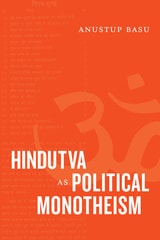
cover of Hindutva as Political Monotheism

Hindutva as Political Monotheism

Anustup Basu

Duke University Press, 2020
In Hindutva as Political Monotheism, Anustup Basu offers a genealogical study of Hindutva—Hindu right-wing nationalism—to illustrate the significance of Western anthropology and political theory to the idea of India as a Hindu nation. Connecting Nazi jurist Carl Schmitt's notion of political theology to traditional theorems of Hindu sovereignty and nationhood, Basu demonstrates how Western and Indian theorists subsumed a vast array of polytheistic, pantheistic, and henotheistic cults featuring millions of gods into a singular edifice of faith. Basu exposes the purported “Hindu Nation” as itself an orientalist vision by analyzing three crucial moments: European anthropologists’ and Indian intellectuals’ invention of a unified Hinduism during the long nineteenth century; Indian ideologues’ adoption of ethnoreligious nationalism in pursuit of a single Hindu way of life in the twentieth century; and the transformations of this project in the era of finance capital, Bollywood, and new media. Arguing that Hindutva aligns with Enlightenment notions of nationalism, Basu foregrounds its significance not just to Narendra Modi's right-wing, anti-Muslim government but also to mainstream Indian nationalism and its credo of secularism and tolerance.
[more]
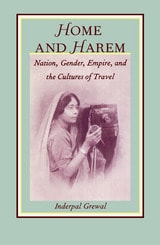
cover of Home and Harem: Nation, Gender, Empire and the Cultures of Travel

Home and Harem

Nation, Gender, Empire and the Cultures of Travel

Inderpal Grewal

Duke University Press, 1996

Moving across academic disciplines, geographical boundaries, and literary genres, Home and Harem examines how travel shaped ideas about culture and nation in nineteenth-century imperialist England and colonial India. Inderpal Grewal’s study of the narratives and discourses of travel reveals the ways in which the colonial encounter created linked yet distinct constructs of nation and gender and explores the impact of this encounter on both English and Indian men and women. Reworking colonial discourse studies to include both sides of the colonial divide, this work is also the first to discuss Indian women traveling West as well as English women touring the East.

In her look at England, Grewal draws on nineteenth-century aesthetics, landscape art, and debates about women’s suffrage and working-class education to show how all social classes, not only the privileged, were educated and influenced by imperialist travel narratives. By examining diverse forms of Indian travel to the West and its colonies and focusing on forms of modernity offered by colonial notions of travel, she explores how Indian men and women adopted and appropriated aspects of European travel discourse, particularly the set of oppositions between self and other, East and West, home and abroad.

Rather than being simply comparative, Home and Harem is a transnational cultural study of the interaction of ideas between two cultures. Addressing theoretical and methodological developments across a wide range of fields, this highly interdisciplinary work will interest scholars in the fields of postcolonial and cultural studies, feminist studies, English literature, South Asian studies, and comparative literature.



[more]
cover of Home in the Dark: Selected Stories

Home in the Dark

Selected Stories

Jayanta Dey

Seagull Books, 2025

When civility is just a mask, what happens when it slips? This collection of gripping stories pries open the cracks in urban life, revealing the chaos and cruelty beneath.

Home in the Dark peels back the polished surface of middle-class life to expose the shadows lurking underneath: violence, betrayal, and the unsettling truths we refuse to see. In these fifteen gripping stories, Jayanta Dey weaves a world where desperation takes strange forms: a woman on the brink of suicide finds an unlikely savior in a rat, a stolen clock carries the weight of communal hatred, and a writer–publisher duo rides the highs of literary success—until their lucrative business in pornography turns against them.

Set in Calcutta and its suburbs, these tales decipher the moral and psychological conflicts simmering beneath genteel facades, where people will do anything to survive. With elements of the macabre and the psychological, Home in the Dark delivers sharp twists that unsettle as much as they illuminate. Translated from Bengali by Sayari Debnath, this collection brings a new and daring voice to readers, offering a rare glimpse into the dark undercurrents of contemporary urban life in India.
[more]
cover of Homo Hierarchicus: The Caste System and Its Implications

Homo Hierarchicus

The Caste System and Its Implications

Louis Dumont

University of Chicago Press, 1981

Louis Dumont's modern classic, here presented in an enlarged, revised, and corrected second edition, simultaneously supplies that reader with the most cogent statement on the Indian caste system and its organizing principles and a provocative advance in the comparison of societies on the basis of their underlying ideologies. Dumont moves gracefully from the ethnographic data to the level of the hierarchical ideology encrusted in ancient religious texts which are revealed as the governing conception of the contemporary caste structure. On yet another plane of analysis, homo hierarchicus is contrasted with his modern Western antithesis, homo aequalis.

This edition includes a lengthy new Preface in which Dumont reviews the academic discussion inspired by Homo Hierarchicus and answers his critics. A new Postface, which sketches the theoretical and comparative aspects of the concept of hierarchy, and three significant Appendixes previously omitted from the English translation complete this innovative and influential work.
[more]
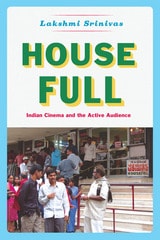
cover of House Full: Indian Cinema and the Active Audience

House Full

Indian Cinema and the Active Audience

Lakshmi Srinivas

University of Chicago Press, 2016

India is the largest producer and consumer of feature films in the world, far outstripping Hollywood in the number of movies released and tickets sold every year. Cinema quite simply dominates Indian popular culture, and has for many decades exerted an influence that extends from clothing trends to music tastes to everyday conversations, which are peppered with dialogue quotes.
            With House Full, Lakshmi Srinivas takes readers deep into the moviegoing experience in India, showing us what it’s actually like to line up for a hot ticket and see a movie in a jam-packed theater with more than a thousand seats. Building her account on countless trips to the cinema and hundreds of hours of conversation with film audiences, fans, and industry insiders, Srinivas brings the moviegoing experience to life, revealing a kind of audience that, far from passively consuming the images on the screen, is actively engaged with them. People talk, shout, whistle, cheer; others sing along, mimic, or dance; at times audiences even bring some of the ritual practices of Hindu worship into the cinema, propitiating the stars onscreen with incense and camphor. The picture Srinivas paints of Indian filmgoing is immersive, fascinating, and deeply empathetic, giving us an unprecedented understanding of the audience’s lived experience—an aspect of Indian film studies that has been largely overlooked.
[more]
cover of House, but No Garden: Apartment Living in Bombay's Suburbs, 1898-1964

House, but No Garden

Apartment Living in Bombay's Suburbs, 1898-1964

Nikhil Rao

University of Minnesota Press, 2013

Between the well-documented development of colonial Bombay and sprawling contemporary Mumbai, a profound shift in the city’s fabric occurred: the emergence of the first suburbs and their distinctive pattern of apartment living. In House, but No Garden Nikhil Rao considers this phenomenon and its significance for South Asian urban life. It is the first book to explore an organization of the middle-class neighborhood that became ubiquitous in the mid-twentieth-century city and that has spread throughout the subcontinent.

Rao examines how the challenge of converting lands from agrarian to urban use created new relations between the state, landholders, and other residents of the city. At the level of dwellings, apartment living in self-contained flats represented a novel form of urban life, one that expressed a compromise between the caste and class identities of suburban residents who are upper caste but belong to the lower-middle or middle class. Living in such a built environment, under the often conflicting imperatives of maintaining the exclusivity of caste and subcaste while assembling residential groupings large enough to be economically viable, led suburban residents to combine caste with class, type of work, and residence to forge new metacaste practices of community identity.

As it links the colonial and postcolonial city—both visually and analytically—Rao’s work traces the appearance of new spatial and cultural configurations in the middle decades of the twentieth century in Bombay. In doing so, it expands our understanding of how built environments and urban identities are constitutive of one another.
[more]
cover of Hungry Translations: Relearning the World through Radical Vulnerability

Hungry Translations

Relearning the World through Radical Vulnerability

Richa Nagar

University of Illinois Press, 2019
Experts often assume that the poor, hungry, rural, and/or precarious need external interventions. They frequently fail to recognize how the same people create politics and knowledge by living and honing their own dynamic visions. How might scholars and teachers working in the Global North ethically participate in producing knowledge in ways that connect across different meanings of struggle, hunger, hope, and the good life?Informed by over twenty years of experiences in India and the United States, Hungry Translations bridges these divides with a fresh approach to academic theorizing. Through in-depth reflections on her collaborations with activists, theatre artists, writers, and students, Richa Nagar discusses the ongoing work of building embodied alliances among those who occupy different locations in predominant hierarchies. She argues that such alliances can sensitively engage difference through a kind of full-bodied immersion and translation that refuses comfortable closures or transparent renderings of meanings. While the shared and unending labor of politics makes perfect translation--or retelling--impossible, hungry translations strive to make our knowledges more humble, more tentative, and more alive to the creativity of struggle.
[more]
cover of Hydraulic City: Water and the Infrastructures of Citizenship in Mumbai

Hydraulic City

Water and the Infrastructures of Citizenship in Mumbai

Nikhil Anand

Duke University Press, 2017

In Hydraulic City Nikhil Anand explores the politics of Mumbai's water infrastructure to demonstrate how citizenship emerges through the continuous efforts to control, maintain, and manage the city's water. Through extensive ethnographic fieldwork in Mumbai's settlements, Anand found that Mumbai's water flows, not through a static collection of pipes and valves, but through a dynamic infrastructure built on the relations between residents, plumbers, politicians, engineers, and the 3,000 miles of pipe that bind them. In addition to distributing water, the public water network often reinforces social identities and the exclusion of marginalized groups, as only those actively recognized by city agencies receive legitimate water services. This form of recognition—what Anand calls "hydraulic citizenship"—is incremental, intermittent, and reversible. It provides residents an important access point through which they can make demands on the state for other public services such as sanitation and education. Tying the ways Mumbai's poorer residents are seen by the state to their historic, political, and material relations with water pipes, the book highlights the critical role infrastructures play in consolidating civic and social belonging in the city.
[more]