Results by title
468 books match the query 'Industries' and 11 start with h
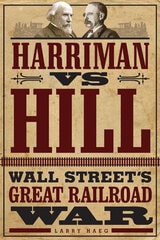
Harriman vs. Hill
Wall Street’s Great Railroad WarLarry Haeg
University of Minnesota Press, 2013
In 1901, the Northern Pacific was an unlikely prize: a twice-bankrupt construction of the federal government, it was a two-bit railroad (literally—five years back, its stock traded for twenty-five cents a share). But it was also a key to connecting eastern markets through Chicago to the rising West. Two titans of American railroads set their sights on it: James J. Hill, head of the Great Northern and largest individual shareholder of the Northern Pacific, and Edward Harriman, head of the Union Pacific and the Southern Pacific. The subsequent contest was unprecedented in the history of American enterprise, pitting not only Hill against Harriman but also Big Oil against Big Steel and J. P. Morgan against the Rockefellers, with a supporting cast of enough wealthy investors to fill the ballroom of the Waldorf Astoria.
The story, told here in full for the first time, transports us to the New York Stock Exchange during the unfolding of the earliest modern-day stock market panic. Harriman vs. Hill re-creates the drama of four tumultuous days in May 1901, when the common stock of the Northern Pacific rocketed from one hundred ten dollars a share to one thousand in a mere seventeen hours of trading—the result of an inadvertent “corner” caused by the opposing forces. Panic followed and then, in short order, a calamity for the “shorts,” a compromise, the near-collapse of Wall Street brokerages and banks, the most precipitous decline ever in American stock values, and the fastest recovery. Larry Haeg brings to life the ensuing stalemate and truce, which led to the forming of a holding company, briefly the biggest railroad combine in American history, and the U.S. Supreme Court ruling against the deal, launching the reputation of Justice Oliver Wendell Holmes as the “great dissenter” and President Theodore Roosevelt as the “trust buster.”
The forces of competition and combination, unfettered growth, government regulation, and corporate ambition—all the elements of American business at its best and worst—come into play in the account of this epic battle, whose effects echo through our economy to this day.
Health and Welfare during Industrialization
Edited by Richard H. Steckel and Roderick Floud
University of Chicago Press, 1997
The essays incorporate several indicators of quality of life, especially real per capita income and health, but also real wages, education, and inequality. And while the authors use traditional measures of health such as life expectancy and mortality rates, this volume stands alone in its extensive use of new "anthropometric" data—information about height, weight and body mass index that indicates changes in nations' well-being. Consequently, Health and Welfare during Industrialization signals a new direction in economic history, a broader and more thorough understanding of what constitutes standard of living.
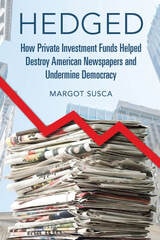
Hedged
How Private Investment Funds Helped Destroy American Newspapers and Undermine DemocracyMargot Susca
University of Illinois Press, 2024
The ultrawealthy largely own and guide the newspaper system in the United States. Through entities like hedge funds and private equity firms, this investor class continues to dismantle the one institution meant to give voice to average citizens in a democracy.
Margot Susca reveals the little-known history of how private investment took over the newspaper industry. Drawing on a political economy of media, Susca’s analysis uses in-depth interviews and documentary evidence to examine issues surrounding ownership and power. Susca also traces the scorched-earth policies of layoffs, debt, cash-outs, and wholesale newspaper closings left behind by private investors and the effects of the devastation on the future of news and information. Throughout, Susca reveals an industry rocked less by external forces like lost ad revenue and more by ownership and management obsessed with profit and beholden to private fund interests that feel no responsibility toward journalism or the public it is meant to serve.

History of Pedlars in Europe
Laurence Fontaine
Duke University Press, 1996
Focusing primarily on the fifteenth through eighteenth centuries, Fontaine traces the origins and development of peddling and the establishment of trading networks. She analyzes the changing social construction of the practice and the effect of encounters between traders of different regions. Following the pedlars’ trade routes across Europe from Spain to Sweden and Scotland to the upper Rhine, she examines their importance as channels of communication as well as of goods and raises such issues as the impact of pedlars on the values and cultural practices of the communities they visited and the ways in which being merchants changed the lives of these migrants.
History of Pedlars in Europe separates the mythology that surrounds peddling from the historically reliable and integrates existing studies with new archival research to illuminate one of the most remote areas of the social and economic history of early modern Europe. A means of trade based on mobility, uncertainty, and interdependence, peddling is rediscovered as a dynamic force involved in nothing less than the creation of a modern consumer society.
Holding Up More Than Half the Sky
Chinese Women Garment Workers in New York City, 1948-92Xiaolan Bao
University of Illinois Press, 2001
In 1982, 20,000 Chinese-American garment workers—most of them women—went on strike in New York City. Every Chinese garment industry employer in the city soon signed a union contract. The successful action reflected the ways women's changing positions within their families and within the workplace galvanized them to stand up for themselves.
Xiaolan Bao's now-classic study penetrates to the heart of Chinese American society to explain how this militancy and organized protest, seemingly so at odds with traditional Chinese female behavior, came about. Drawing on more than one hundred interviews, Bao blends the poignant personal stories of Chinese immigrant workers with the interwoven history of the garment industry and the city's Chinese community. Bao shows how the high rate of married women employed outside the home profoundly transformed family culture and with it the image and empowerment of Chinese American women. At the same time, she offers a complex and subtle discussion of the interplay of ethnic and class factors within New York's garment industry.
Passionately told and prodigiously documented, Holding Up More Than Half the Sky examines the journey of a community's women through an era of change in the home, on the shop floor, and walking the picket line.
Hollywood Diplomacy
Film Regulation, Foreign Relations, and East Asian RepresentationsHye Seung Chung
Rutgers University Press, 2020
Hollywood Unions
Kate Fortmueller
Rutgers University Press, 2025

Hollywood and Broadcasting
From Radio to CableMichelle Hilmes
University of Illinois Press, 1990
an excellent introduction to a most important subject. This is an invaluable
work for both scholars and students that places film, radio, and television
within the context of the national culture experience."
--- American Historical Review
"Hilmes is one of the few historians
of broadcasting to move beyond a political economy of the media. . . . Her work
should serve as a model for future histories of broadcasting."
--- Journal of Communication
"All media historians will
find this work a critical addition to their bookshelves."
--- American Journalism
"A major addition to media
history literature."
--- Journalism History

Housekeeping by Design
Hotels and LaborDavid Brody
University of Chicago Press, 2016
With Housekeeping by Design, David Brody introduces us to those people—the housekeepers whose labor keeps the rooms clean and the guests happy. Through unprecedented access to staff at several hotels, Brody shows us just how much work goes on behind the scenes—and how much management goes out of its way to make sure that labor stays hidden. We see the incredible amount of hard physical work that is involved in cleaning and preparing a room, how spaces, furniture, and other objects are designed to facilitate a smooth flow of hidden labor, and, crucially, how that design could be improved for workers and management alike if front-line staff were involved in the design process. After reading this fascinating exposé of the ways hotels work—or don’t for housekeepers—one thing is certain: checking in will never be the same again.

How to Start a Farm Stop
A Pattern Language for Local Food SystemsKathryn Barr
Michigan Publishing Services, 2023

How to Think about Information
Dan Schiller
University of Illinois Press, 2006
It is common wisdom that the U.S. economy has adapted to losses in its manufacturing base because of the booming information sector, with high-paying jobs for everything from wireless networks to video games. We are told we live in the Information Age, in which communications networks and media and information services drive the larger economy. While the Information Age may have looked sunny in the beginning, as it has developed it looks increasingly ominous: its economy and benefits grow more and more centralized--and in the United States, it has become less and less subject to democratic oversight.
Corporations around the world have identified the value of information and are now seeking to control its production, transmission, and consumption. In How to Think about Information, Dan Schiller explores the ways information has been increasingly commodified as a result and how it both resembles and differs from other commodities. Through a linked series of theoretical, historical, and contemporary studies, Schiller reveals this commodification as both dynamic and expansionary, but also deeply conflicted and uncertain. He examines the transformative political and economic changes occurring throughout the informational realm and analyzes key dimensions of the process, including the buildup of new technological platforms, the growth of a transnationalizing culture industry, and the role played by China as it reinserts itself into an informationalized capitalism.