Results by title
751 books match the query 'International Relations' and 13 start with h
Haim Nahum
A Sephardic Chief Rabbi in Politics, 1892-1923Esther Benbassa
University of Alabama Press, 1995
A collection of rare writings and correspondence by a rabbi and diplomat active at the end of the Ottoman Empire
Rabbi, diplomat, linguist, fixer of delicate problems, Haim Nahum moved through the last years of the Ottoman world and the birth of the modern Middle East with uncommon dexterity. He left behind a rich trove of letters and writing, the best of which are collected in this volume. For contemporary readers, his story feels surprisingly current. He inhabited an age crowded with competing identities, clashing nationalisms, and endless political improvisations. In other words, he would feel perfectly at home today.
The most intriguing feature of Nahum is not that he occupied important positions, but that he seemed constitutionally incapable of belonging to only one world. Equally at ease among statesmen, clerics, scholars, and bureaucrats, he functioned as a human connecting flight between cultures. In this fascinating biography first edited and published in French in 1990, Esther Benbassa captures this cosmopolitan figure without embalming him in reverence, allowing readers to encounter a subtle, resourceful, and occasionally elusive man whose métier was negotiation and whose natural habitat was complexity.
This book will delight readers of Ottoman history, Jewish history, Middle Eastern affairs, diplomatic history, biography, religious studies, and Mediterranean culture. It will also appeal to polyglots, antiquarians, devotees of vanished empires, and anyone attracted to those liminal figures who stand at the crossroads of civilizations, translating not merely languages but entire ways of seeing the world.
Handbook of War Studies III
The Intrastate DimensionManus I. Midlarsky, ed.
University of Michigan Press, 2009
"Midlarsky has done it again, another state-of-the art handbook on the most recent developments in the study of war. This volume is entirely new with a focus on internal war. It is a 'must-read' for scholars and students of conflict. Even the most knowledgeable will learn a great deal from the book."
---John A. Vasquez, Thomas B. Mackie Scholar in International Relations, University of
Illinois at Urbana-Champaign
"Handbook of War Studies III is a tour de force. This is a compelling and comprehensive work of scholarship. Midlarsky, as with previous volumes, has assembled an 'all star' team from the interdisciplinary field of conflict processes. In response to trends in place over the last few decades, this third volume rightly focuses on the intrastate dimension of international conflict. The volume includes lucid presentations on rational choice and political psychology as alternative visions, along with convincing treatments of civil war, ethnic conflict, genocide, and related issues. This book will be required reading for anyone with an interest in conflict processes."
---Patrick James, Director, Center for International Studies, University of Southern California
"This third volume of the Handbook is a very welcome addition with its focus on intrastate conflict. Scholarship on internal conflict has proliferated over the past decade, and therefore it is time to take stock of the work that has been done and to point out directions for future research. In this volume a team of leading scholars do just that as they provide trenchant assessments of what has been accomplished and what are the remaining big questions that require further research. This volume will be indispensable to students and scholars alike."
---Paul Huth, Editor, Journal of Conflict Resolution, and Professor of Government and Politics, University of Maryland, College Park
Handbook of War Studies III is a follow-up to Handbook of War Studies I (1993) and II (2000). This new volume collects original work from leading international relations scholars on domestic strife, ethnic conflict, genocide, and other timely topics. Special attention is given to civil war, which has become one of the dominant forms---if not the dominant form---of conflict in the world today.
Nils Petter Gleditsch, International Peace Research Institute, Oslo (PRIO), and Norwegian University of Science and Technology (NTNU), Trondheim
Håvard Hegre, University of Oslo, and International Peace Research Institute, Oslo (PRIO)
Erin K. Jenne, Central European University, Budapest
Mark Irving Lichbach, University of Maryland
Roy Licklider, Rutgers University, New Brunswick
T. David Mason, University of North Texas
Rose McDermott, Cornell University
Stephen Saideman, McGill University
Håvard Strand, International Peace Research Institute, Oslo (PRIO)
Monica Duffy Toft, Harvard University
Hands Across the Sea?
U.S.-Japan Relations, 1961–1981Timothy P. Maga
Ohio University Press, 1997
In 1961, the U.S. economy and military remained unassailable in the eyes of the world. Within twenty years, America faced defeat in Vietnam and its economy had been shaken. Japan was now considered the great economic superpower, while the U.S. and Japan reversed roles as surplus and debtor nations. Hands across the Sea? examines this reversal of roles, determining how and why America and Japan became the post-World War II era’s most argumentative allies.
Through extensive research in a number of presidential libraries and author interviews with both American and Japanese policy-makers, Professor Maga finds a U.S.-Japan relationship forever troubled by cultural misunderstanding, America’s Cold War obsession, Japanese pride, and strangely conflicting goals in both trade and defense. Given the intensity of the arguments over some of these issues, it is remarkable that Washington and Tokyo continued a working dialogue during this critical time.
Hands across the Sea? represents the first in-depth study of the modern U.S.-Japan relationship. It especially discovers how serious the U.S.-Japan disagreements over trade, defense, the direction of the Cold War, nuclear policy, and the environment had become.
Whereas American observers of U.S.-Japan relations are quick to point out their fellow countrymen’s ignorance of other cultures and Japan’s brilliance in analyzing American policy and life, the evidence suggests otherwise. Steering far away from anyone’s political correctness, this book’s bottom line involves hard-hitting investigation and analysis.
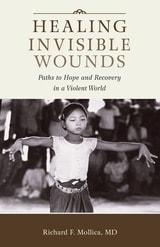
Healing Invisible Wounds
Paths to Hope and Recovery in a Violent WorldRichard F. Mollica
Vanderbilt University Press, 2006
Here is how Neil Boothby, Director of the Program on Forced Migration and Health at the Mailman School of Public Health, Columbia University, describes the book:
"Mollica provides a wealth of ethnographic and clinical evidence that suggests the human capacity to heal is innate--that the 'survival instinct' extends beyond the physical to include the psychological as well. He enables us to see how recovery from 'traumatic life events' needs to be viewed primarily as a 'mystery' to be listened to and explored, rather than solely as a 'problem' to be identified and solved. Healing involves a quest for meaning--with all of its emotional, cultural, religious, spiritual and existential attendants--even when bio-chemical reactions are also operative."
Healing Invisible Wounds reveals how trauma survivors, through the telling of their stories, teach all of us how to deal with the tragic events of everyday life. Mollica's important discovery that humiliation--an instrument of violence that also leads to anger and despair--can be transformed through his therapeutic project into solace and redemption is a remarkable new contribution to survivors and clinicians.
This book reveals how in every society we have to move away from viewing trauma survivors as "broken people" and "outcasts" to seeing them as courageous people actively contributing to larger social goals. When violence occurs, there is damage not only to individuals but to entire societies, and to the world. Through the journey of self-healing that survivors make, they enable the rest of us not only as individuals but as entire communities to recover from injury in a violent world.

Hemispheric Imaginings
The Monroe Doctrine and Narratives of U.S. EmpireGretchen Murphy
Duke University Press, 2005
Murphy juxtaposes close readings of novels with analyses of nonfiction texts. From uncovering the literary inspirations for the Monroe Doctrine itself to tracing visions of hemispheric unity and transatlantic separation in novels by Lydia Maria Child, Nathaniel Hawthorne, María Amparo Ruiz de Burton, Lew Wallace, and Richard Harding Davis, she reveals the Doctrine’s forgotten cultural history. In making a vital contribution to the effort to move American Studies beyond its limited focus on the United States, Murphy questions recent proposals to reframe the discipline in hemispheric terms. She warns that to do so risks replicating the Monroe Doctrine’s proprietary claim to isolate the Americas from the rest of the world.

Holidays in the Danger Zone
Entanglements of War and TourismDebbie Lisle
University of Minnesota Press, 2016
Holidays in the Danger Zone exposes the mundane and everyday interactions between two seemingly opposed worlds: warfare and tourism. Debbie Lisle shows how a tourist sensibility shapes the behavior of soldiers in war—especially the experiences of Western military forces in “exotic” settings. This includes not only R&R but also how battlefields become landscapes of leisure and tourism. She further explores how a military sensibility shapes the development of tourism in the postwar context, from “Dark Tourism” (engaging with displays of conflict and atrocity) to exhibitions of conflict in museums and at memorial sites, as well as advertising, film, journals, guidebooks, blogs, and photography.
Focused on how war and tourism reinforce prevailing modes of domination, Holidays in the Danger Zone critically examines the long historical arc of the war–tourism nexus—from nineteenth-century imperialism to World War I and World War II, from the Cold War to globalization and the War on Terror.
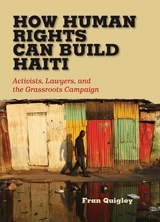
How Human Rights Can Build Haiti
Activists, Lawyers, and the Grassroots CampaignFran Quigley
Vanderbilt University Press, 2014
The only way to transform Haiti's dismal human rights legacy is through a bottom-up social movement, supported by local and international challenges to the status quo. That recipe for reform mirrors the strategy followed by Mario Joseph, Brian Concannon, and their clients and colleagues profiled in this book. Together, Joseph, Concannon, and their allies represent Haiti's best hope to escape the cycle of disaster, corruption, and violence that has characterized the country's two-hundred-year history. At the same time, their efforts are creating a template for a new and more effective human rights-focused strategy to turn around failed states and end global poverty.

How Many Exceptionalisms?
Explorations in Comparative MacroanalysisAristide R. Zolberg
Temple University Press, 2008
The essays in How Many Exceptionalisms? span the long history of the intellectual output of Aristide Zolberg, one of the most distinguished social scientists of our time. In this collection, Zolberg shows his originality, insights, and breadth of thought as he addresses subjects ranging from theories of immigration policy, the making of Belgium, and the origins of the modern world system.
Written over three decades, and featuring many essays that have not been in wide circulation, Zolberg here draws from political science, cultural anthropology, sociology, and history to provide a configurative analysis of and long-term approach to the cultural diversity in Africa, Europe, and the United States.
How World Politics Is Made
France and the Reunification of GermanyTilo Schabert
University of Missouri Press, 2009
Human Rights and Transnational Solidarity in Cold War Latin America
Edited by Jessica Stites Mor
University of Wisconsin Press, 2013
Edited by Jessica Stites Mor, this book offers fine-grained case studies that show how Latin America’s re-emerging Left transformed the struggles against dictatorship and repression of the Cold War into the language of anti-colonialism, socioeconomic rights, and identity.
Human Rights at Risk
Global Governance, American Power, and the Future of DignitySalvador Santino F. Regilme Jr. and Irene Hadiprayitno
Rutgers University Press, 2022
Humanity's Ruins
Ethics, Feminism, and Genocidal HumanitarianismDanielle Bouchard
Duke University Press, 2025
Hungary in the Cold War, 1945-1956
Between the United States and the Soviet UnionLászló Borhi
Central European University Press, 2004