Results by title
593 books match the query 'Jews' and 18 start with h
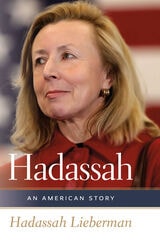
Hadassah
An American StoryHadassah Lieberman
Brandeis University Press, 2021
Born in Prague to Holocaust survivors, Hadassah Lieberman and her family immigrated in 1949 to the United States. She went on to earn a BA from Boston University in government and dramatics and an MA in international relations and American government from Northeastern University. She built a career devoted largely to public health that has included positions at Lehman Brothers, Pfizer, and the National Research Council. After her first marriage ended in divorce, she married Joe Lieberman, a US senator from Connecticut who was the Democratic nominee for vice president with Al Gore and would go on to run for president.
In Hadassah, Lieberman pens the compelling story of her extraordinary life: from her family's experience in Eastern Europe to their move to Gardner, Massachusetts; forging her career; experiencing divorce; and, following her remarriage, her life on the national political stage. By offering insight into her identity as an immigrant, an American Jew, a working woman, and a wife, mother, and grandmother, Lieberman’s moving memoir speaks to many of the major issues of our time, from immigration to gender politics. Featuring an introduction by Joe Lieberman and an afterword by Megan McCain, it is a true American story.
Haim Nahum
A Sephardic Chief Rabbi in Politics, 1892-1923Esther Benbassa
University of Alabama Press, 1995
A collection of rare writings and correspondence by a rabbi and diplomat active at the end of the Ottoman Empire
Rabbi, diplomat, linguist, fixer of delicate problems, Haim Nahum moved through the last years of the Ottoman world and the birth of the modern Middle East with uncommon dexterity. He left behind a rich trove of letters and writing, the best of which are collected in this volume. For contemporary readers, his story feels surprisingly current. He inhabited an age crowded with competing identities, clashing nationalisms, and endless political improvisations. In other words, he would feel perfectly at home today.
The most intriguing feature of Nahum is not that he occupied important positions, but that he seemed constitutionally incapable of belonging to only one world. Equally at ease among statesmen, clerics, scholars, and bureaucrats, he functioned as a human connecting flight between cultures. In this fascinating biography first edited and published in French in 1990, Esther Benbassa captures this cosmopolitan figure without embalming him in reverence, allowing readers to encounter a subtle, resourceful, and occasionally elusive man whose métier was negotiation and whose natural habitat was complexity.
This book will delight readers of Ottoman history, Jewish history, Middle Eastern affairs, diplomatic history, biography, religious studies, and Mediterranean culture. It will also appeal to polyglots, antiquarians, devotees of vanished empires, and anyone attracted to those liminal figures who stand at the crossroads of civilizations, translating not merely languages but entire ways of seeing the world.
Hasmonean Realities behind Ezra, Nehemiah, and Chronicles
Archaeological and Historical PerspectivesIsrael Finkelstein
SBL Press, 2018
A thorough case for a later date for of Ezra, Nehemiah, and Chronicles
In this collection of essays, Israel Finkelstein deals with key topics in Ezra, Nehemiah, and 1 and 2 Chronicles, such as the list of returnees, the construction of the city wall of Jerusalem, the adversaries of Nehemiah, the tribal genealogies, and the territorial expansion of Judah in 2 Chronicles. Finkelstein argues that the geographical and historical realities cached behind at least parts of these books fit the Hasmonean period in the late second century BCE. Seven previously published essays are supplemented by maps, updates to the archaeological material, and references to recent publications on the topics.
Features:
- Analysis of geographical chapters of Ezra, Nehemiah, and Chronicles
- Study of the Hasmonean period in the late second century BCE
- Unique arguments regarding chronology and historical background
Heidegger And The Jews
Jean-Francois Lyotard
University of Minnesota Press, 1990
Heidegger and the Myth of a Jewish World Conspiracy
Peter Trawny
University of Chicago Press, 2015
While Heidegger’s affiliation with National Socialism is well known, the anti-Semitic dimension of that engagement could not be fully told until now. Trawny traces Heidegger’s development of a grand “narrative” of the history of being, the “being-historical thinking” at the center of Heidegger’s work after Being and Time. Two of the protagonists of this narrative are well known to Heidegger’s readers: the Greeks and the Germans. The world-historical antagonist of this narrative, however, has remained hitherto undisclosed: the Jews, or, more specifically, “world Judaism.” As Trawny shows, world Judaism emerges as a racialized, destructive, and technological threat to the German homeland, indeed, to any homeland whatsoever. Trawny pinpoints recurrent, anti-Semitic themes in the Notebooks, including Heidegger’s adoption of crude cultural stereotypes, his assigning of racial reasons to philosophical decisions (even undermining his Jewish teacher, Edmund Husserl), his endorsement of a Jewish “world conspiracy,” and his first published remarks on the extermination camps and gas chambers (under the troubling aegis of a Jewish “self-annihilation”). Trawny concludes with a thoughtful meditation on how Heidegger’s achievements might still be valued despite these horrifying facets. Unflinching and systematic, this is one of the most important assessments of one of the most important philosophers in our history.
Heshel's Kingdom
Dan Jacobson
Northwestern University Press, 1999
Hidden in Plain Sight
Jews and Jewishness in British Film, Television, and Popular CultureEdited by Nathan Abrams
Northwestern University Press, 2016
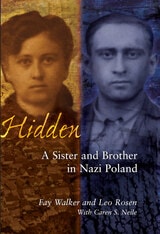
Hidden
A Sister and Brother in Nazi PolandFay Walker
University of Wisconsin Press, 2002
Of the Rosenbluth family, only the older children, Faiga and Luzer, had gone into hiding before the SS rounded up the Jews of Kanczuga, Poland. Hidden is Faiga and Luzer’s story, a memoir whose intimate and quiet particularity makes the incomprehensible enormity of the Holocaust immediate, human, and devastatingly real.
In alternating first-person narratives, Faiga (Fay) and Luzer (Leo) take readers into their very different but inextricably linked experiences in Nazi-occupied Poland. Faiga, the once-dignified young lady from a good home with servants and a seat by the eastern wall of the synagogue, spends two years wandering the perilous countryside, hoping to be taken for a peasant. Mere miles away, knowing nothing of his sister’s fate, Luzer, the leather wholesaler’s only son, lies silent all day in the stifling dark corner of a barn, where the smell of the cows’ warm hides are a piquant reminder of his lost world. Hidden deftly summons that world, as the familiar comforts and squabbles of life in a well-to-do, religious Jewish family are slowly overwhelmed by the grim news coming out of Germany. We follow Faiga and Luzer through the early forebodings and deprivations of the war, into hiding among righteous Poles and erstwhile neighbors-turned-betrayers, and finally, at war’s end, back once more into the world—but not necessarily into safety. Told in a confident, clear, and unsentimental prose, this is a story of heroism and tragedy writ large and small, of two young people coming of age in a world in chaos and then trying to return to "normal" after experiences as unimaginable as they are unforgettable.
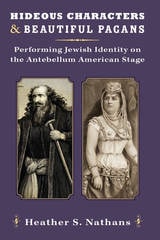
Hideous Characters and Beautiful Pagans
Performing Jewish Identity on the Antebellum American StageHeather S. Nathans
University of Michigan Press, 2017
Using an eclectic range of sources including theatrical reviews, diaries, letters, cartoons, portraiture, tax records, rumors flying around the tavern, and more, Heather S. Nathans has listened for the echoes of vanished audiences who witnessed and responded to these stereotypes onstage, from the earliest appearance of Shylock on an American stage in 1752 to Jewish theater artists on the eve of the Civil War. The book integrates social, political, and cultural histories, with an examination of those texts (both dramatic and literary) that shaped the stage Jew.
Hiding the Holocaust
Memoir of a Deaf DaughterIrene W. Leigh
Gallaudet University Press, 2026
History of Ancient Israel
Christian Frevel
SBL Press, 2023
This English translation of the second edition of Christian Frevel’s essential textbook Geschichte Israels (Kohlhammer, 2018) covers the history of Israel from its beginnings until the Bar Kokhba revolt (132–135 CE). Frevel draws on archaeological evidence, inscriptions and monuments, as well as the Bible to sketch a picture of the history of ancient Israel within the context of the southern Levant that is sometimes familiar but often fresh and unexpected. Frevel has updated the second German edition with the most recent research of archaeologists and biblical scholars, including those based in Europe. Tables of rulers, a glossary, a timeline of the ancient Near East, and resources arranged by subject make this book an accessible, essential textbook for students and scholars alike.
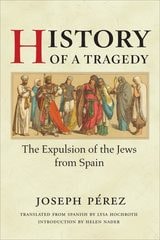
History of a Tragedy
THE EXPULSION OF THE JEWS FROM SPAINJoseph Perez
University of Illinois Press, 2006
Few events in the history of Spain have provoked as much controversy as the expulsion of the Jews in 1492. Conflicts within the Catholic Church, suspicions within the newly unified Spain, and the claims of Spanish merchants combined to make the Spain of Ferdinand and Isabella intolerant and inquisitorial. Yet the roots of Spanish anti-Semitism went deeper. In this concise survey of the expulsion of the Sephardic Jews, Joseph Pérez studies the evolution of the Jewish community in Spain from the time of the Visigoths to the reign of the Catholic kings. He explores the Jewish community’s role in creating and sustaining the vibrant cultural, political, and economic world of medieval Spain, and how growing religious intolerance, a pervasive resentment of the “others,” and a string of escalating encroachments culminated in expulsion.
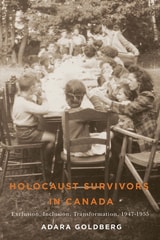
Holocaust Survivors in Canada
Exclusion, Inclusion, Transformation, 1947-1955Adara Goldberg
University of Manitoba Press, 2015
Homelands
Southern Jewish Identity in Durham-Chapel Hill and North CarolinaLeonard Rogoff
University of Alabama Press, 2001
Exploring how Southern Jews forged identity, community, and belonging in the evolving landscape of the New South.
Homelands is a case study of a unique ethnic group in North America—small-town southern Jews. Both Jews and southerners, Leonard Rogoff points out, have long struggled with questions of identity and whether to retain their differences or try to assimilate into the national culture. Rogoff shows how, as immigrant Jews became small-town southerners, they constantly renegotiated their identities and reinvented their histories.
The Durham-Chapel Hill Jewish community was formed during the 1880s and 1890s, when the South was recovering from the Reconstruction era and Jews were experiencing ever-growing immigration as well as challenging the religious traditionalism of the previous 4,000 years. Durham and Chapel Hill Jews, recent arrivals from the traditional societies of eastern Europe, assimilated and secularized as they lessened their differences with other Americans. Some Jews assimilated through intermarriage and conversion, but the trajectory of the community as a whole was toward retaining their religious and ethnic differences while attempting to integrate with their neighbors.
The Durham-Chapel Hill area is uniquely suited to the study of the southern Jewish experience, Rogoff maintains, because the region is exemplary of two major trends: the national population movement southward and the rise of Jews into the professions. The Jewish peddler and storekeeper of the 1880s and the doctor and professor of the 1990s, Rogoff says, are representative figures of both Jewish upward mobility and southern progress.
How America Met the Jews
Hasia R. Diner
SBL Press, 2017
Explore how American conditions and Jewish circumstances collided in the nineteenth and early twentieth centuries
In this new book award-winning author Hasia R. Diner explores the issues behind why European Jews overwhelmingly chose to move to the United States between the 1820s and 1920s. Unlike books that tend to romanticize American freedom as the force behind this period of migration or that tend to focus on Jewish contributions to America or that concentrate on how Jewish traditions of literacy and self-help made it possible for them to succeed, Diner instead focuses on aspects of American life and history that made it the preferred destination for 90 percent of European Jews.
Features:
- Examination of the realities of race, immigration, color, money, economic development, politics, and religion in America
- Exploration of an America agenda that sought out white immigrants to help stoke economic development and that valued religion as a force for morality
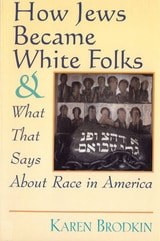
How Jews Became White Folks and What That Says About Race in America
Brodkin, Karen
Rutgers University Press, 1998
The history of Jews in the United States is one of racial change that provides useful insights on race in America. Prevailing classifications have sometimes assigned Jews to the white race and at other times have created an off-white racial designation for them. Those changes in racial assignment have shaped the ways American Jews of different eras have constructed their ethnoracial identities. Brodkin illustrates these changes through an analysis of her own family's multi-generational experience. She shows how Jews experience a kind of double vision that comes from racial middleness: on the one hand, marginality with regard to whiteness; on the other, whiteness and belonging with regard to blackness.
Class and gender are key elements of race-making in American history. Brodkin suggests that this country's racial assignment of individuals and groupsconstitutes an institutionalized system of occupational and residential segregation, is a key element in misguided public policy, and serves as a pernicious foundational principle in the construction of nationhood. Alternatives available to non-white and alien "others" have been either to whiten or to be consigned to an inferior underclass unworthy of full citizenship. The American ethnoracial map-who is assigned to each of these poles-is continually changing, although the binary of black and white is not. As a result, the structure within which Americans form their ethnoracial, gender, and class identities is distressingly stable. Brodkin questions the means by which Americans construct their political identities and what is required to weaken the hold of this governing myth.
How Strange It Seems
The Cultural Life of Jews in Small-Town New EnglandMichael Hoberman
University of Massachusetts Press, 2008
Jews have lived in small-town New England since the colonial era, but during the last hundred years they have been especially active contributors to the region's cultural life. Part oral history, part ethnography, and part literary portrait, How Strange It Seems tells the story of this often overlooked group, tracing its patterns of settlement, economic activity, civic involvement, and religious life since the late 1800s.
Based on more than fifty interviews with men and women of all ages from Maine, New Hampshire, Vermont, Massachusetts, and Connecticut, it seeks to understand what is distinctive—and not so distinctive—about contemporary Jewish communities outside the larger urban centers of the Northeast. Michael Hoberman weaves the personal stories of these individuals and families into a collective narrative that offers as much folklore as history and is equal parts Jewish and Yankee. He introduces us to Hiram Adelman, a Russian immigrant peddler and potato farmer who settled in northernmost Maine because its climate was comparable to his native Siberia, and to Shmuel Simenowitz, an urban transplant who produces kosher maple syrup in southern Vermont. We also meet Suzie Laskin, who moved to the White Mountains region of New Hampshire in the 1900s and soon established a local havurah, and Bob August of Whately, Massachusetts, who once ran what may have been the world's only Christmas tree farm owned by a Jewish family.
Each section of the book explores how small-town New England Jews have both departed from and mimicked the broader patterns of Jewish American experience, while also illustrating how they have acclimated themselves to local practices without relinquishing a strong sense of Jewish identity. Accompanying the text are photographs by Janice Sorensen that include portraits of many of the interviewees and lively glimpses of the region's present-day Jewish revival.
How They Lived
The Everyday Lives of Hungarian Jews, 1867–1940András Koerner
Central European University Press, 2015