Results by title
403 books match the query 'Journalism' and 8 start with h

Hell of a Way to Make a Living
The Unvarnished Truth about What It's Like to Cover Major League BaseballPaul Hagen
Temple University Press, 2027
For 50 years, Paul Hagen lived the dream of being a beat writer covering the Dodgers, Rangers, and Phillies. But, as Hell of a Way to Make a Living demonstrates, the enviable job isn’t always as glamorous as it seems.
This insider’s account gives readers an all-access pass to the press box, clubhouse, and dugout to discover what the experience is really about. It’s both a clear-eyed dissection of the daily grind and a breezy, occasionally gossipy, account of being to paid to watch baseball games.
Hagen features entertaining and insightful anecdotes such as confirming to manager Terry Francona that the Phillies were going to fire him two weeks before it happened and building trust with players from the last man on the roster to future Hall of Famers like Mike Schmidt, Ferguson Jenkins, Billy Wagner, and Scott Rolen. He also addresses the changing media landscape, what’s on the record and off, the ethics of reporting on a team fairly, and how sports writing has changed over the decades.
Covering all the bases, Hell of a Way to Make a Living is an ode to the importance of conscientious beat writing and building trust with readers.
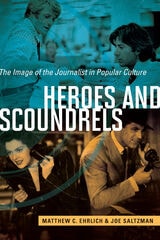
Heroes and Scoundrels
The Image of the Journalist in Popular CultureMatthew C. Ehrlich and Joe Saltzman
University of Illinois Press, 2015
Drawing on portrayals of journalists in television, film, radio, novels, comics, plays, and other media, Matthew C. Ehrlich and Joe Saltzman survey how popular media has depicted the profession across time. Their creative use of media artifacts provides thought-provoking forays into such fundamental issues as how pop culture mythologizes and demythologizes key events in journalism history and how it confronts issues of race, gender, and sexual orientation on the job.
From Network to The Wire, from Lois Lane to Mikael Blomkvist, Heroes and Scoundrels reveals how portrayals of journalism's relationship to history, professionalism, power, image, and war influence our thinking and the very practice of democracy.

Hired Pens
Professional Writers in America’s Golden Age of PrintRonald Weber
Ohio University Press, 1997
Just as mass-market magazines and cheap books have played important roles in the creation of an American identity, those skilled craftsmen (and women) whose careers are the subjects of Ronald Weber’s narrative profoundly influenced the outlook and strategies of the high-culture writers who are generally the focus of literary studies.
Hired Pens, a history of the writing profession in the United States, recognizes the place of independent writers who wrote for their livelihood from the 1830s and 1840s, with the first appearance of a broad-based print culture, to the 1960s.
Many realist authors began on this American Grub Street. Jack London turned out hackwork for any paying market he could find, while Scott Fitzgerald’s stories in slick magazines in the 1920s and early ’30s established his name as a writer.
From Edgar Allen Poe’s earliest forays into writing for pay to Sylvia Plath’s attempts to produce fiction for mass-circulation journals, Hired Pens documents without agenda the evolution of professional writing in all its permutations—travel accounts, sport, popular biography and history, genre and series fiction—and the culture it fed.
How Free Can the Press Be?
Randall P. Bezanson
University of Illinois Press, 2003
The cases concerned matters ranging from The New York Times's publication of the Pentagon Papers to Hugo Zacchini's claim that TV broadcasts of his human cannonball act threatened his livelihood. Bezanson also examines the case of politician blackballed by the Miami Herald; the Pittsburgh Press's argument that it had the right to use gender based column headings in its classifieds; and a crime victim suing the Des Moines Register over the paper's publication of intimate details, including the victim's name.
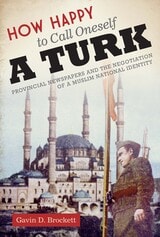
How Happy to Call Oneself a Turk
Provincial Newspapers and the Negotiation of a Muslim National IdentityBy Gavin D. Brockett
University of Texas Press, 2011
The modern nation-state of Turkey was established in 1923, but when and how did its citizens begin to identify themselves as Turks? Mustafa Kemal Atatürk, Turkey's founding president, is almost universally credited with creating a Turkish national identity through his revolutionary program to "secularize" the former heartland of the Ottoman Empire. Yet, despite Turkey's status as the lone secular state in the Muslim Middle East, religion remains a powerful force in Turkish society, and the country today is governed by a democratically elected political party with a distinctly religious (Islamist) orientation.
In this history, Gavin D. Brockett takes a fresh look at the formation of Turkish national identity, focusing on the relationship between Islam and nationalism and the process through which a "religious national identity" emerged. Challenging the orthodoxy that Atatürk and the political elite imposed a sense of national identity from the top down, Brockett examines the social and political debates in provincial newspapers from around the country. He shows that the unprecedented expansion of print media in Turkey between 1945 and 1954, which followed the end of strict, single-party authoritarian government, created a forum in which ordinary people could inject popular religious identities into the new Turkish nationalism. Brockett makes a convincing case that it was this fruitful negotiation between secular nationalism and Islam—rather than the imposition of secularism alone—that created the modern Turkish national identity.
How Partisan Media Polarize America
Matthew Levendusky
University of Chicago Press, 2013
In How Partisan Media Polarize America, Matthew Levendusky confirms—but also qualifies—both of these claims. Drawing on experiments and survey data, he shows that Americans who watch partisan programming do become more certain of their beliefs and less willing to weigh the merits of opposing views or to compromise. And while only a small segment of the American population watches partisan media programs, those who do tend to be more politically engaged, and their effects on national politics are therefore far-reaching.
In a time when politics seem doomed to partisan discord, How Partisan Media Polarize America offers a much-needed clarification of the role partisan media might play.
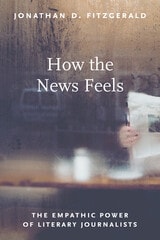
How the News Feels
The Empathic Power of Literary JournalistsJonathan D. Fitzgerald
University of Massachusetts Press, 2023
Literary journalism’s origins can be traced to the nineteenth century, when it developed alongside the era’s sentimental literature. Combining fact-based reporting with the sentimentality of popular fiction, literary journalism encouraged readers to empathize with subjects by presenting more nuanced and engaging stories than typical news coverage. While women writers were central to the formation and ongoing significance of the genre, literary journalism scholarship has largely ignored their contributions.
How the News Feels re-centers the work of a range of writers who were active from the nineteenth century until today, including Catharine Williams, Margaret Fuller, Nellie Bly, Winifred Black, Zora Neale Hurston, Joan Didion, Adrian Nicole LeBlanc, and Alexis Okeowo. Offering intimate access to their subjects’ thoughts, motivations, and yearnings, these journalists encouraged readers to empathize with society’s outcasts, from asylum inmates and murder suspects to “fallen women” and the working poor. As this carefully researched study shows, these writers succeeded in defining and developing the genre of literary journalism, with stories that inspire action, engender empathy, and narrow the gap between writer, subject, and audience.

How to Look Good in a War
Justifying and Challenging State ViolenceBrian Rappert
Pluto Press, 2012
How to Look Good in A War examines the methods used to depict, defend and justify the use of state violence. Many books have shown how 'truth is the first casualty of war' but this is the first to analyse exactly how pro-war narratives are constructed and normalised.
Brian Rappert details the 'upside-down' world of war in which revelation conceals, knowledge fosters uncertainty, and transparency obscures. He looks at government spin during recent wars in Iraq, Afghanistan and Libya where officials manoeuvre between circulating and withholding information.
Examining how organised violence is justified, How to Look Good in A War draws on experiences from recent controversy to consider how ignorance about the operation of war is produced and how concerned individuals and groups can intervene to make a difference.