Results by title
4030 books match the query 'Language Arts & Disciplines' and 68 start with h
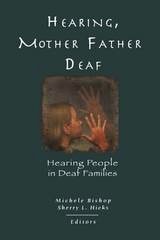
HEARING, MOTHER-FATHER DEAF
Hearing People in Deaf FamiliesMichele Bishop
Gallaudet University Press, 2009
The newest entry in the Sociolinguistics in Deaf Communities series explores the richness and complexity of the lives of hearing people in deaf families. Along with their own contributions, volume editors Michele Bishop and Sherry L. Hicks present the work of an extraordinary cadre of deaf, hearing, and Coda (children of deaf adults) researchers: Susan Adams, Jean Andrews, Oya Ataman, Anne E. Baker, Beppie van den Bogaerde , Helsa B. Borinstein, Karen Emmorey, Tamar H. Gollan, Mara Lúcia Masutti, Susan Mather, Ronice Müller de Quadros, Jemina Napier, Paul Preston, Jennie E. Pyers, Robin Thompson, and Andrea Wilhelm. Their findings represent research in a number of countries, including Australia, Brazil, England, Germany, the Netherlands, and the United States.
Hearing, Mother^Father Deaf: Hearing People in Deaf Families includes a comprehensive description of the societal influences at work in the lives of deaf people and their hearing children, which serves as a backdrop for the essays. The topics range from bimodal bilingualism in adults to cultural and linguistic behaviors of hearing children from deaf families; sign and spoken language contact phenomena; and to issues of self-expression, identity, and experience. A blend of data-based research and personal writings, the articles in this sociolinguistic study provide a thorough understanding of the varied experiences of hearing people and their deaf families throughout the world.
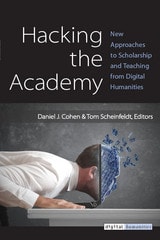
Hacking the Academy
New Approaches to Scholarship and Teaching from Digital HumanitiesDaniel J. Cohen and Tom Scheinfeldt, Editors
University of Michigan Press, 2013
On May 21, 2010, Daniel J. Cohen and Tom Scheinfeldt posted the following provocative questions online:
“Can an algorithm edit a journal? Can a library exist without books? Can students build and manage their own learning management platforms? Can a conference be held without a program? Can Twitter replace a scholarly society?”
As recently as the mid-2000s, questions like these would have been unthinkable. But today serious scholars are asking whether the institutions of the academy as they have existed for decades, even centuries, aren’t becoming obsolete. Every aspect of scholarly infrastructure is being questioned, and even more importantly, being hacked. Sympathetic scholars of traditionally disparate disciplines are canceling their association memberships and building their own networks on Facebook and Twitter. Journals are being compiled automatically from self-published blog posts. Newly minted PhDs are forgoing the tenure track for alternative academic careers that blur the lines between research, teaching, and service. Graduate students are looking beyond the categories of the traditional CV and building expansive professional identities and popular followings through social media. Educational technologists are “punking” established technology vendors by rolling out their own open source infrastructure.
Here, in Hacking the Academy, Daniel J. Cohen and Tom Scheinfeldt have gathered a sampling of the answers to their initial questions from scores of engaged academics who care deeply about higher education. These are the responses from a wide array of scholars, presenting their thoughts and approaches with a vibrant intensity, as they explore and contribute to ongoing efforts to rebuild scholarly infrastructure for a new millennium.

Hand and Mind
What Gestures Reveal about ThoughtDavid McNeill
University of Chicago Press, 1992

Handbook Of Academic Writing For Librarians
Assoc of College & Research Libraries, 2013
Handbook for Language Engineers
Edited by Ali Farghaly
CSLI, 2002
Handbook for Science Public Information Officers
W. Matthew Shipman
University of Chicago Press, 2015
W. Matthew Shipman’s Handbook for Science Public Information Officers covers all aspects of communication strategy and tactics for members of this growing specialty. It includes how to pitch a story, how to train researchers to navigate interviews, how to use social media effectively, and how to respond to a crisis. The handbook offers a wealth of practical advice while teaching science PIOs how to think critically about what they do and how they do it, so that they will be prepared to take advantage of any situation, rather than being overwhelmed by it.
For all science communicators—whether they’re starting their careers, crossing over from journalism or the research community, or professional communicators looking to hone their PIO skills—Shipman’s Handbook for Science Public Information Officers will become their go-to reference.
Handbook of Academic Writing for Librarians
Christopher Hollister
Assoc of College & Research Libraries, 2014
This primary reference tool for the library and information science (LIS) community supports those who either desire or are required to publish in the professional literature. LIS students at the masters and doctoral levels can also benefit from this comprehensive volume.
Handbook of Academic Writing for Librarians - Revised Edition
Christopher V. Hollister
Assoc of College & Research Libraries, 2014
Handbook of French Semantics
Edited by Francis Corblin and Henriëtte de Swart
CSLI, 2003
Handbook of Middle American Indians, Volume 5
LinguisticsRobert Wauchope, series editor; Norman A. McQuown, volume editor
University of Texas Press, 1967
This volume, the fifth in the Handbook of Middle American Indians, presents a summary of work accomplished since the Spanish conquest in the contemporary description and historical reconstruction of the indigenous languages and language families of Mexico and Central America.
The essays include the following: “Inventory of Descriptive Materials” by William Bright; “Inventory of Classificatory Materials” by Maria Teresa Fernández de Miranda, “Lexicostatistic Classification” by Morris Swadesh, “Systemic Comparison and Reconstruction” by Robert Longacre, and “Environmental Correlational Studies” by Sarah C. Gudschinsky.
Sketches of Classical Nahuatl by Stanley Newman, Classical Yucatec Maya by Norman A. McQuown, and Classical Quiché by Munro S. Edmonson provide working tools for tackling the voluminous early postconquest texts in these languages of late preconquest empires (Aztec, Maya, Quiché). Further sketches of Sierra Popoluca by Benjamin F. Elson, of Isthmus Zapotec by Velma B. Pickett, of Huautla de Jiménez Mazatec by Eunice V. Pike, of Jiliapan Pame by Leonardo Manrique C., and of Huamelultec Chontal by Viola Waterhouse—together with those of Nahuatl, Maya, and Quiché—provide not only descriptive outlines of as many different linguistic structures but also linguistic representatives of seven structurally different families of Middle American languages. Miguel Léon-Portilla presents an outline of the relations between language and the culture of which it is a part and provides examples of some of these relations as revealed by contemporary research in indigenous Middle America.
The volume editor, Norman A. McQuown (1914–2005), was Professor of Anthropology at The University of Chicago. He formerly taught at Hunter College and served with the Mexican Department of Indian Affairs. He carried out fieldwork with Totonac, Huastec, Tzeltal-Tzotzil, Mame, and other tribes.
The Handbook of Middle American Indians was assembled and edited at the Middle American Research Institute of Tulane University with the assistance of grants from the National Science Foundation and under the sponsorship of the National Research Council Committee on Latin American Anthropology.

Handbook of the Linguistic Atlas of the Middle and South Atlantic States
William A. Kretzschmar Jr., Virginia G. McDavid, Theodore K. Lerud, and Ellen Johnson
University of Chicago Press, 1993
This handbook is an essential guide to the LAMSAS project, laying out its history and describing its scope and methodology. In addition, the handbook reveals biographical information about the informants and social histories of the communities in which they lived, including primary settlement areas of the original colonies. Dialectologists will rely on it for understanding the LAMSAS, and historians will find it valuable for its original historical research.
Since much of the LAMSAS questionnaire concerns rural terms, the data collected from the interviews can pinpoint such language differences as those between areas of plantation and small-farm agriculture. For example, LAMSAS reveals that two waves of settlement through the Appalachians created two distinct speech types. Settlers coming into Georgia and other parts of the Upper South through the Shenandoah Valley and on to the western side of the mountain range had a Pennsylvania-influenced dialect, and were typically small farmers. Those who settled the Deep South in the rich lowlands and plateaus tended to be plantation farmers from Virginia and the Carolinas who retained the vocabulary and speech patterns of coastal areas.
With these revealing findings, the LAMSAS represents a benchmark study of the English language, and this handbook is an indispensable guide to its riches.
Handwriting in Early America
A Media HistoryEdited by Mark Alan Mattes, Foreword by Karen Sánchez-Eppler, Afterword by Christopher Hager
University of Massachusetts Press, 2023
As digital communication has become dominant, commentators have declared that handwriting is a thing of the past, a relic of an earlier age. This volume of original essays makes it clear that anxiety around handwriting has existed for centuries and explores writing practices from a variety of interdisciplinary fields, including manuscript studies, Native American studies, media history, African American studies, book history, bibliography, textual studies, and archive theory.
By examining how a culturally diverse set of people grappled with handwriting in their own time and weathered shifting relationships to it, Handwriting in Early America uncovers perspectives that are multiethnic and multiracial, transatlantic and hemispheric, colonial and Indigenous, multilingual and illiterate. Essays describe a future of handwriting as envisioned by practitioners, teachers, and even government officials of this time, revealing the tension between the anxiety of loss and the need to allow for variations going forward.
Contributors include James Berkey, Blake Bronson-Bartlett, John J. Garcia, Christopher Hager, Desirée Henderson, Frank Kelderman, Michelle Levy, Lisa Maruca, Christen Mucher, Alan Niles, Seth Perlow, Carla L. Peterson, Sarah Robbins, Patricia Jane Roylance, Karen Sánchez-Eppler, and Danielle Skeehan.

Hard Right
Muscular Rhetoric and the New NationalismCasey Ryan Kelly
The Ohio State University Press, 2026
A groundbreaking examination of far-right rhetoric around fitness and the human body and how such rhetoric serves white nationalist, masculinist aims.
In recent years, far-right, white-nationalist groups in the US have churned out streams of discourse glorifying “muscularity” as the ideal masculine form. This preoccupation with physical fitness—along with expressed fears of declining testosterone levels in men, race-mixing, and transgender women—all reveal the masculine bodily fantasies and anxieties that underwrite the political unconscious of the far right. In Hard Right, Casey Ryan Kelly examines the link between extreme fitness culture and fascist organizations, arguing that the human body operates as a privileged signifier of national belonging in the rhetoric of the far right.
Drawing from psychoanalytic theory, Kelly shows that far-right rhetoric constructs fantasies of recovering the “natural” or primal masculine body. These fantasies are frequently accompanied by anxieties about “soft,” disabled, and ambiguously gendered bodies, all of which are seen as signs of degeneracy that must be transformed, exiled, or eradicated for the sake of national and racial health. Through its examination of “Red Pill” fitness influencers, “bro science” conspiracy theories, far-right podcasts, and more, Hard Right ultimately shows how the cultural logics of men’s health and physical fitness converge with the political logics of white nationalism and late fascism.
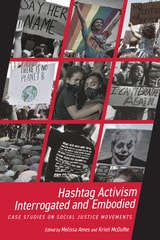
Hashtag Activism Interrogated and Embodied
Case Studies on Social Justice Movementsedited by Melissa Ames & Kristi McDuffie
Utah State University Press, 2022
The chapters capture twenty-first-century digital activism unfolding in different social and geopolitical climates. Delving into hashtag activism in various forms (tweets, memes, and personal narratives) and spaces (Twitter, Facebook, and in-person protests), these chapters reveal how participants question and construct online and offline identities and imagined and actualized communities. They also showcase the complicated ways hashtag activism intersects with consumer, popular, and celebrity cultures.
Hashtag Activism Interrogated and Embodied calls for broader inclusion in what is considered hashtag activism, such as digital fandom, how hashtags are co-opted for nefarious purposes, the effects of anti-activism, and the role of journalism and the media. It will appeal to a range of disciplines including rhetoric and composition, internet studies, communication studies, media studies, feminist studies, affect studies, cultural studies, technical communication, and sociology.
Contributors: Robert Barry, André Brock, Elizabeth Buchanan, Rosemary Clark-Parsons, Gabriel I. Green, Neha Gupta, Jeffrey J. Hall, Kyesha Jennings, Morgan K. Johnson, Salma Kalim, Megan McIntyre, Sean Milligan, Avishek Ray, Sarah Riddick, Stephanie Vie, Erin B. Waggoner, Holly M. Wells, William I. Wolff
Head-Driven Phrase Structure Grammar
Carl Pollard and Ivan A. Sag
University of Chicago Press, 1994
This self-contained volume demonstrates the applicability of the HPSG approach to a wide range of empirical problems, including a number which have occupied center-stage within syntactic theory for well over twenty years: the control of "understood" subjects, long-distance dependencies conventionally treated in terms of wh-movement, and syntactic constraints on the relationship between various kinds of pronouns and their antecedents. The authors make clear how their approach compares with and improves upon approaches undertaken in other frameworks, including in particular the government-binding theory of Noam Chomsky.

Health Informatics for Medical Librarians
Ana D. Cleveland
American Library Association, 2009

Health and the Rhetoric of Medicine
Judy Z. Segal
Southern Illinois University Press, 2005
Assessing rhetorical principles of contemporary health issues
Hypochondriacs are vulnerable to media hype, anorexics are susceptible to public scrutiny, and migraine sufferers are tainted with the history of the “migraine personality,” maintains rhetorical theorist Judy Z. Segal. All are influenced by the power of persuasion.
Health and the Rhetoric of Medicine explores persistent health conditions that resist conventional medical solutions. Using a range of rhetorical principles, Segal analyzes how patients and their illnesses are formed within the physician/patient relationship. The intractable problem of a patient’s rejection of a doctor’s advice, says Segal, can be considered a rhetorical failure—a failure of persuasion.
Examining the discourse of medicine through case studies, applications, and analyses, Segal illustrates how illnesses are described in ways that limit
patients’ choices and satisfaction. She also illuminates psychiatric conditions, infectious diseases, genetic testing, and cosmetic surgeries through the lens of rhetorical theory.
Health and the Rhetoric of Medicine bridges critical analysis for scholarly, professional, and lay audiences. Segal highlights the persuasive element in diagnosis, health policy, illness experience, and illness narratives. She also addresses questions of direct-to-consumer advertising of prescription drugs, the role of health information in creating the “worried well” and problems of trust and expertise in physician/patient relationships. A useful resource for critical common sense in everyday life, the text provides an effective examination of a society increasingly influenced by the rhetoric of health and medicine.
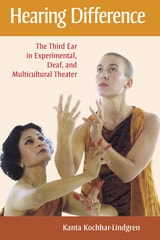
Hearing Difference
The Third Ear in Experimental, Deaf, and Multicultural TheaterKanta Kochhar-Lindgren
Gallaudet University Press, 2006
Kochhar-Lindgren then charts a genealogy of the theater of the third ear from the mid-1800s to the 1960s in examples ranging from Denis Diderot, the Symbolists, the Dadaists, Antonin Artaud, and others. She also analyzes the work of playwright Robert Wilson, the National Theatre of the Deaf, and Asian American director Ping Chong. She shows how the model of the third ear can address not only deaf performance but also multicultural performance, by analyzing the Seattle dance troupe Ragamala’s 2001 production of Transposed Heads, which melded classical South Indian use of mudras, or hand gestures, and ASL signing.
The shift in attention limned in Hearing Difference leads to a different understanding of the body, intersubjectivity, communication, and cross-cultural relations, confirming it as a critically important contribution to contemporary Deaf studies.
Hearing the Hurt
Rhetoric, Aesthetics, and Politics of the New Negro MovementEric King Watts
University of Alabama Press, 2012

Heartland English
Variation and Transition in the American MidwestTimothy C. Frazer
University of Alabama Press, 1993
Mapping the Diverse Voices of America's Linguistic Heartland.
Heartland English is the first book-length scholarly treatment of English spoken in the Midwest, or the northern interior of the continental United States. For generations, the American Midwest has been portrayed as the home of a single, uniform variety of "standard" American English. Heartland English: Variation and Transition in the American Midwest challenges that assumption through the first book-length scholarly examination of the rich linguistic diversity that exists across the region. Bringing together the work of leading dialectologists and language scholars, editor Timothy C. Frazer presents a groundbreaking exploration of how history, migration, settlement patterns, geography, culture, and social change have shaped the spoken language of the Midwest.
Covering communities across the northern interior of the United States, the volume reveals a complex linguistic landscape marked by regional dialect boundaries, evolving pronunciations, distinctive vocabulary, and shifting patterns of speech. Rather than viewing Midwestern English as a static or homogeneous dialect, the contributors demonstrate how linguistic variation reflects the movement of peoples, the influence of neighboring regions, and the ongoing transformation of American society.
Drawing on research in dialect geography, sociolinguistics, historical linguistics, and language variation studies, Heartland English offers valuable insights into the ways language both shapes and reflects regional identity. The collection examines how speakers perceive dialect differences, how those differences develop over time, and why the Midwest remains one of the most important regions for understanding the evolution of American English. As a landmark contribution to the study of language in North America, the book continues to serve as an essential resource for scholars investigating the relationship between language, culture, and place.
A Publication in the Centennial Series of the American Dialect Society in celebration of the beginning of its second century of research into language variation in America.
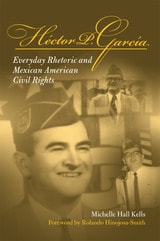
Hector P Garcia
Everyday Rhetoric and Mexican American Civil RightsMichelle Hall Kells. Foreword by Rolando Hinojosa-Smith
Southern Illinois University Press, 2006
Examining the Mexican American civil rights movement through the public rhetoric of a veteran activist
Héctor P. García: Everyday Rhetoric and Mexican American Civil Rights examines the transition of Mexican Americans from political and social marginalization to civic inclusion after World War II. Focusing on the public rhetoric of veteran rights activist and physician Dr. Héctor P. García, a Mexican immigrant who achieved unprecedented influence within the U.S. political system, author Michelle Hall Kells provides an important case study in the exercise of influence, the formation of civic identity, and the acquisition of social power among this underrepresented group.
As a major influence in national twentieth-century civil rights reform, García effectively operated between Anglo and Mexican American sociopolitical structures. The volume illustrates how García, a decorated World War II veteran and founder of the American GI Forum in Texas in 1948, successfully engendered a discourse that crossed geographical, political, and cultural borders, forming associations with the working poor as well as with prominent national figures such as John F. Kennedy and Lyndon B. Johnson. Through his rhetoric and action, García publicly revealed the plight of Mexican Americans, crossing class, regional, and racial lines to improve socioeconomic conditions for his people.
Héctor P. García, which is enhanced by sixteen illustrations, contributes to rhetorical, cultural, and historical studies and offers new scholarship establishing García’s role on the national front, effectively tracing Garcia’s legacy of resistance, the process of achieving enfranchisement, and the role of racism in the evolution from social marginalization to national influence.
Hegemonies of Language and Their Discontents
The Southwest North American Region Since 1540Carlos G. Vélez-Ibáñez
University of Arizona Press, 2017
Well-regarded author Carlos G. Vélez-Ibáñez details the linguistic and cultural processes used by penetrating imperial and national states. He argues that these impositions have been not linear but hydra-headed, complex and contradictory, sometimes accommodated and sometimes forcefully imposed. Such impositions have created discontent resulting in physical and linguistic revolts, translanguage versions, and multilayered capacities of use and misuse of imposed languages—even the invention of community-created trilingual dictionaries.
Vélez-Ibáñez gives particular attention to both sides of the border, explaining the consequences of the fragile splitting of the area through geopolitical border formation. He illustrates the many ways those discontents have manifested in linguistic, cultural, educational, political, and legal forms.
From revolt to revitalization, from silent objection to expressive defiance, people in the Southwest North American Region have developed arcs of discontent from the Spanish colonial period to the present. These narratives are supported by multiple sources, including original Spanish colonial documents and new and original ethnographic studies of performance rituals like the matachines of New Mexico. This unique work discusses the most recent neurobiological studies of bilingualism and their implications for cognitive development and language as it spans multiple disciplines. Finally, it provides the most important models for dual language development and their integration to the "Funds of Knowledge" concept as creative contemporary discontents with monolingual approaches.

Hell of a Way to Make a Living
The Unvarnished Truth about What It's Like to Cover Major League BaseballPaul Hagen
Temple University Press, 2027
For 50 years, Paul Hagen lived the dream of being a beat writer covering the Dodgers, Rangers, and Phillies. But, as Hell of a Way to Make a Living demonstrates, the enviable job isn’t always as glamorous as it seems.
This insider’s account gives readers an all-access pass to the press box, clubhouse, and dugout to discover what the experience is really about. It’s both a clear-eyed dissection of the daily grind and a breezy, occasionally gossipy, account of being to paid to watch baseball games.
Hagen features entertaining and insightful anecdotes such as confirming to manager Terry Francona that the Phillies were going to fire him two weeks before it happened and building trust with players from the last man on the roster to future Hall of Famers like Mike Schmidt, Ferguson Jenkins, Billy Wagner, and Scott Rolen. He also addresses the changing media landscape, what’s on the record and off, the ethics of reporting on a team fairly, and how sports writing has changed over the decades.
Covering all the bases, Hell of a Way to Make a Living is an ode to the importance of conscientious beat writing and building trust with readers.
Helping Homeschoolers in the Library
Adrienne Pettinelli
American Library Association, 2008
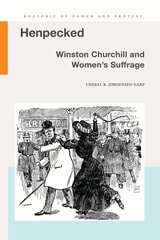
Henpecked
Winston Churchill and Women's SuffrageCheryl R. Jorgensen-Earp
Michigan State University Press, 2027
Henpecked: Winston Churchill and Women’s Suffrage explores the recurrent interactions between Winston Churchill and the women’s suffrage movement in Britain. Churchill purposely concealed, under a discursive veil, his complex and shifting perceptions of women’s competency to use the franchise. In balancing a public stance that vaguely favored the “principle” of women’s suffrage with his, often private, opposition to the movement’s legislative efforts, he employed every available rhetorical tool. This book presents a new understanding of his early Parliamentary career, his ability to manipulate public and private discourse, and his complicated stance on women’s right to vote. This rhetorical history challenges the view that Winston Churchill was only dissuaded in his support of women’s suffrage by the militancy of suffrage activists.
Heracles' Bow
Essays On The Rhetoric & Poetics Of The LawJames B. White
University of Wisconsin Press, 1989
White’s essays, though bound by a common perspective, are thematically varied. Each of these pieces makes eloquent and insightful reading. Taken as a whole, they establish, by triangulation, a position from which they all proceed: a view of poetry, law, and rhetoric as essentially synonymous. Only when we perceive the links between these processes, White stresses, can we begin to unite the concerns of truth, beauty, and justice in a single field of action and expression.
Here or There
Research on Interpreting via Video LinkJemina Napier
Gallaudet University Press, 2018
Here or There presents cutting edge, empirical research that informs the professional practice of remote interpreting, whether it be video relay service, video conference, or video remote interpreting. The research is augmented by the perspectives of stakeholders and deaf consumers on the quality of the interpreted work. Among the topics covered are professional attitudes and motivations, interpreting in specific contexts, and adaptation strategies. The contributors also address potential implications for relying on remote interpreting, discuss remote interpreter education, and offer recommendations for service providers.
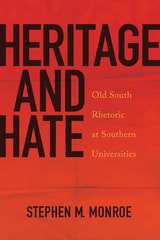
Heritage and Hate
Old South Rhetoric at Southern UniversitiesStephen M. Monroe
University of Alabama Press, 2021
How southern universities continue to wrestle with the words and symbols that embody and perpetuate Old South traditions
The US South is a rhetorical landscape that pulsates with division, a place where words and symbols rooted in a deeply problematic past litter the ground and contaminate the soil. Stephen M. Monroe’s provocative study focuses on predominantly white southern universities where Old South rhetoric still reverberates, where rebel flags cast a shadow over attempts at racial harmony, school cheers to reinforce racial barriers, and student yearbooks to create and protect an oppressive culture of exclusion. Across the region, in college towns like Oxford, Mississippi; Athens, Georgia; and Tuscaloosa, Alabama—communities remain locked in a difficult, recursive, and inherently rhetorical struggle that wrestles with this troubling legacy.
Words, images, and symbols are not merely passive artifacts of southern history, Monroe argues, but formative agents that influence human behavior and shape historical events. Drawing on research from many disciplines, including rhetoric, southern studies, history, sociology, and African American studies, Monroe develops the concept of confederate rhetoric: the collection of Old South words and symbols that have been and remain central to the identity conflicts of the South. He charts examples of such rhetoric at work in southern universities from Reconstruction to the present day.
Tracing the long life and legacy of Old South words and symbols at southern universities, this book provides close and nuanced analysis of the rhetorical conflicts that have resulted at places like the University of Mississippi and the University of Missouri. Some conflicts erupted during the civil rights movement, when the first African American students sought admission to all-white southern universities and colleges, and others are brewing now, as African Americans (and their progressive white peers) begin to cement genuine agency and voice in these communities. Tensions have been, and remain, high.
Ultimately, Monroe offers hope and optimism, contending that if words and symbols can be used to damage and divide, then words and symbols can also be used to heal and unify. Racist rhetoric can be replaced by antiracist rhetoric. The old South can become new. While resisting naïve or facile arguments, Heritage and Hate ultimately finds the promise of progress within the tremendous power of language.
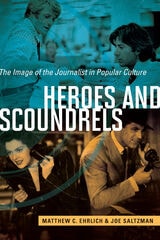
Heroes and Scoundrels
The Image of the Journalist in Popular CultureMatthew C. Ehrlich and Joe Saltzman
University of Illinois Press, 2015
Drawing on portrayals of journalists in television, film, radio, novels, comics, plays, and other media, Matthew C. Ehrlich and Joe Saltzman survey how popular media has depicted the profession across time. Their creative use of media artifacts provides thought-provoking forays into such fundamental issues as how pop culture mythologizes and demythologizes key events in journalism history and how it confronts issues of race, gender, and sexual orientation on the job.
From Network to The Wire, from Lois Lane to Mikael Blomkvist, Heroes and Scoundrels reveals how portrayals of journalism's relationship to history, professionalism, power, image, and war influence our thinking and the very practice of democracy.
Hidden Architectures of Information Literacy Programs
Structures, Practices, and ContextsCarolyn Caffrey Gardner
Assoc of College & Research Libraries, 2020
Hidden Inequities in Labor-Based Contract Grading
Ellen C. Carillo
Utah State University Press, 2021
Current Arguments in Composition Series
The Hidden Inequities in Labor-Based Contract Grading intervenes in the increasingly popular practice of labor-based grading by expanding the scope of this assessment practice to include students who are disabled and multiply marginalized. Through the lens of disability studies, the book critiques the assumption that labor is a neutral measure by which to assess students and explores how labor-based grading contracts put certain groups of students at a disadvantage. Ellen C. Carillo offers engagement-based grading contracts as an alternative that would provide a more equitable assessment model for students of color, those with disabilities, and students who are multiply marginalized.
This short book explores the history of labor-based grading contracts, reviews the scholarship on this assessment tool, highlights the ways in which it normalizes labor as an unbiased tool, and demonstrates how to extend the conversation in new and generative ways both in research and in classrooms. Carillo encourages instructors to reflect on their assessment practices by demonstrating how even assessment methods that are designed through a social-justice lens may unintentionally privilege some students over others.
High Tech, High Touch
Library Customer Service through TechnologyLynn Hawkins
American Library Association, 2003
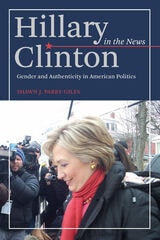
Hillary Clinton in the News
Gender and Authenticity in American PoliticsShawn J. Parry-Giles
University of Illinois Press, 2014
The charge of inauthenticity has trailed Hillary Clinton from the moment she entered the national spotlight and stood in front of television cameras. Hillary Clinton in the News: Gender and Authenticity in American Politics shows how the U.S. news media created their own news frames of Clinton's political authenticity and image-making, from her participation in Bill Clinton's 1992 presidential campaign through her own 2008 presidential bid.
Using theories of nationalism, feminism, and authenticity, Parry-Giles tracks the evolving ways the major networks and cable news programs framed Clinton's image as she assumed roles ranging from surrogate campaigner, legislative advocate, and financial investor to international emissary, scorned wife, and political candidate. This study magnifies how the coverage that preceded Clinton's entry into electoral politics was grounded in her earliest presence in the national spotlight, and in long-standing nationalistic beliefs about the boundaries of authentic womanhood and first lady comportment. Once Clinton dared to cross those gender boundaries and vie for office in her own right, the news exuded a rhetoric of sexual violence. These portrayals served as a warning to other women who dared to enter the political arena and violate the protocols of authentic womanhood.
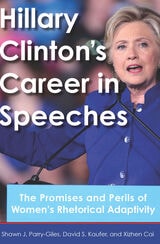
Hillary Clinton's Career in Speeches
The Promises and Perils of Women's Rhetorical AdaptivityShawn J. Parry-Giles
Michigan State University Press, 2023

Hired Pens
Professional Writers in America’s Golden Age of PrintRonald Weber
Ohio University Press, 1997
Just as mass-market magazines and cheap books have played important roles in the creation of an American identity, those skilled craftsmen (and women) whose careers are the subjects of Ronald Weber’s narrative profoundly influenced the outlook and strategies of the high-culture writers who are generally the focus of literary studies.
Hired Pens, a history of the writing profession in the United States, recognizes the place of independent writers who wrote for their livelihood from the 1830s and 1840s, with the first appearance of a broad-based print culture, to the 1960s.
Many realist authors began on this American Grub Street. Jack London turned out hackwork for any paying market he could find, while Scott Fitzgerald’s stories in slick magazines in the 1920s and early ’30s established his name as a writer.
From Edgar Allen Poe’s earliest forays into writing for pay to Sylvia Plath’s attempts to produce fiction for mass-circulation journals, Hired Pens documents without agenda the evolution of professional writing in all its permutations—travel accounts, sport, popular biography and history, genre and series fiction—and the culture it fed.
Hiring, Training, and Supervising Library Shelvers
Patricia Tunstall
American Library Association, 2009
Historical Linguistics and Biblical Hebrew
Steps Toward an Integrated ApproachRobert Rezetko
SBL Press, 2014
A philologically robust approach to the history of ancient Hebrew
In this book the authors work toward constructing an approach to the history of ancient Hebrew that overcomes the chasm of academic specialization. The authors illustrate how cross-textual variable analysis and variation analysis advance research on Biblical Hebrew and correct theories based on extra-linguistic assumptions, intuitions, and ideologies by focusing on variation of forms/uses in the Masoretic text and variation between the Masoretic text and other textual traditions.
Features:
- A unique approach that examines the nature of the sources and the description of their language together
- Extensive bibliography for further research
- Tables of linguistic variables and parallels
Hit List for Young Adults 2
Frequently Challenged BooksTeri S. American Library Association
American Library Association, 2002
Hollywood and Broadcasting
From Radio to CableMichelle Hilmes
University of Illinois Press, 1990
an excellent introduction to a most important subject. This is an invaluable
work for both scholars and students that places film, radio, and television
within the context of the national culture experience."
--- American Historical Review
"Hilmes is one of the few historians
of broadcasting to move beyond a political economy of the media. . . . Her work
should serve as a model for future histories of broadcasting."
--- Journal of Communication
"All media historians will
find this work a critical addition to their bookshelves."
--- American Journalism
"A major addition to media
history literature."
--- Journalism History
Homer's Text and Language
Gregory Nagy
University of Illinois Press, 2004
In Homeric studies, there has been an ongoing debate centering on different ways to establish the text of Homer and the different ways to appreciate the poetry created in the language of Homer. Gregory Nagy, a lifelong Homer scholar, takes a stand in the midst of this debate. He presents an overview of millennia of scholarly engagement with Homer's poetry, shows the different editorial principles that have been applied to the texts, and evaluates their impact.
Homework Help from the Library
In Person and OnlineCarol American Library Association
American Library Association, 2011
Hope, Hype and VoIP
Riding the Library Technology CycleChar American Library Association
American Library Association, 2010
Hopeful Visions, Practical Actions
Cultural Humility in Library WorkEdited by Sarah R. Kostelecky, Lori Townsend, and David A. Hurley
American Library Association, 2023
- how Indigenous adages can be tools for reflection and guidance in developing cultural humility;
- the experiences of two Black librarians who are using cultural humility to change the profession;
- new perspectives on core concepts of customer service;
- rethinking policies and practices in libraries both large and small;
- using cultural humility in approaching collection development and creating resource guides;
- what cultural humility can look like for a tribal librarian working in a tribal college library; and
- reflecting on cultural humility itself and where it is going.
Horror Readers' Advisory
The Librarian's Guide to Vampires, Killer Tomatoes, and Haunted HousesAmerican Library Association, 2004
Hospitality and Authoring
An Essay for the English ProfessionRichard Haswell
Utah State University Press, 2015
Hospitality and Authoring, a sequel to the Haswells’ 2010 volume Authoring, attempts to open the path for hospitality practice in the classroom, making a strong argument for educational use and offering an initial map of the territory for teachers and authors.
Hospitality is a social and ethical relationship not only between host and guest but also between writer and reader or teacher and student. Hospitality initiates, maintains, and completes acts of authoring. This extended essay explores the ways that a true hospitable classroom community can be transformed through assigned reading, one-on-one conferencing, interpretation, syllabus, reading journals, topic choice, literacy narrative, writing centers, program administration, teacher training, and many other passing habitations.
Hospitality and Authoring strives to offer a few possibilities of change to help make college an institution where singular students and singular teachers create a room to learn with room to learn.
Hosting a Library Mystery
A Programming GuideElizabeth M. Karle
American Library Association, 2009

Houston, We Have a Narrative
Why Science Needs StoryRandy Olson
University of Chicago Press, 2015
That’s a huge mistake, says Randy Olson: Hollywood has a lot to teach scientists about how to tell a story—and, ultimately, how to do science better. With Houston, We Have a Narrative, he lays out a stunningly simple method for turning the dull into the dramatic. Drawing on his unique background, which saw him leave his job as a working scientist to launch a career as a filmmaker, Olson first diagnoses the problem: When scientists tell us about their work, they pile one moment and one detail atop another moment and another detail—a stultifying procession of “and, and, and.” What we need instead is an understanding of the basic elements of story, the narrative structures that our brains are all but hardwired to look for—which Olson boils down, brilliantly, to “And, But, Therefore,” or ABT. At a stroke, the ABT approach introduces momentum (“And”), conflict (“But”), and resolution (“Therefore”)—the fundamental building blocks of story. As Olson has shown by leading countless workshops worldwide, when scientists’ eyes are opened to ABT, the effect is staggering: suddenly, they’re not just talking about their work—they’re telling stories about it. And audiences are captivated.
Written with an uncommon verve and enthusiasm, and built on principles that are applicable to fields far beyond science, Houston, We Have a Narrative has the power to transform the way science is understood and appreciated, and ultimately how it’s done.
How Free Can the Press Be?
Randall P. Bezanson
University of Illinois Press, 2003
The cases concerned matters ranging from The New York Times's publication of the Pentagon Papers to Hugo Zacchini's claim that TV broadcasts of his human cannonball act threatened his livelihood. Bezanson also examines the case of politician blackballed by the Miami Herald; the Pittsburgh Press's argument that it had the right to use gender based column headings in its classifieds; and a crime victim suing the Des Moines Register over the paper's publication of intimate details, including the victim's name.
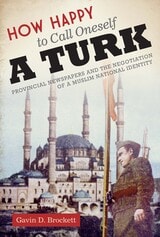
How Happy to Call Oneself a Turk
Provincial Newspapers and the Negotiation of a Muslim National IdentityBy Gavin D. Brockett
University of Texas Press, 2011
The modern nation-state of Turkey was established in 1923, but when and how did its citizens begin to identify themselves as Turks? Mustafa Kemal Atatürk, Turkey's founding president, is almost universally credited with creating a Turkish national identity through his revolutionary program to "secularize" the former heartland of the Ottoman Empire. Yet, despite Turkey's status as the lone secular state in the Muslim Middle East, religion remains a powerful force in Turkish society, and the country today is governed by a democratically elected political party with a distinctly religious (Islamist) orientation.
In this history, Gavin D. Brockett takes a fresh look at the formation of Turkish national identity, focusing on the relationship between Islam and nationalism and the process through which a "religious national identity" emerged. Challenging the orthodoxy that Atatürk and the political elite imposed a sense of national identity from the top down, Brockett examines the social and political debates in provincial newspapers from around the country. He shows that the unprecedented expansion of print media in Turkey between 1945 and 1954, which followed the end of strict, single-party authoritarian government, created a forum in which ordinary people could inject popular religious identities into the new Turkish nationalism. Brockett makes a convincing case that it was this fruitful negotiation between secular nationalism and Islam—rather than the imposition of secularism alone—that created the modern Turkish national identity.
How I Became the Kind of Writer I Became
An Experiment in AutoethnographyCharles Bazerman
University Press of Colorado, 2024