Results by title
914 books match the query 'Medieval' and 25 start with h
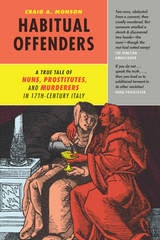
Habitual Offenders
A True Tale of Nuns, Prostitutes, and Murderers in Seventeenth-Century ItalyCraig A. Monson
University of Chicago Press, 2016
Drawing on over four thousand pages of primary sources, the intrepid Craig A. Monson reconstructs this fascinating history of crime and punishment in seventeenth-century Italy. Along the way, he explores Italy’s back streets and back stairs, giving us access to voices we rarely encounter in conventional histories: prostitutes and maidservants, mercenaries and bandits, along with other “dubious” figures negotiating the boundaries of polite society. Painstakingly researched and breathlessly told, Habitual Offenders will delight historians and true-crime fans alike.
Harmful Eloquence
Ovid's Amores from Antiquity to ShakespeareM. L. Stapleton
University of Michigan Press, 1996
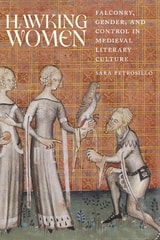
Hawking Women
Falconry, Gender, and Control in Medieval Literary CultureSara Petrosillo
The Ohio State University Press, 2023
Healing and Society in Medieval England
A Middle English Translation of the Pharmaceutical Writings of Gilbertus AnglicusFaye M. Getz
University of Wisconsin Press, 1991
Originally composed in Latin by Gilbertus Anglicus (Gilbert the Englishman), his Compendium of Medicine was a primary text of the medical revolution in thirteenth-century Europe. Composed mainly of medicinal recipes, it offered advice on diagnosis, medicinal preparation, and prognosis. In the fifteenth-century it was translated into Middle English to accommodate a widening audience for learning and medical “secrets.”
Faye Marie Getz provides a critical edition of the Middle English text, with an extensive introduction to the learned, practical, and social components of medieval medicine and a summary of the text in modern English. Getz also draws on both the Latin and Middle English texts to create an extensive glossary of little-known Middle English pharmaceutical and medical vocabulary.
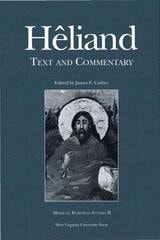
Heliand
Text and CommentaryEdited by James E. Cathey
West Virginia University Press, 2002
James E. Cathey's Hêliand: Text and Commentary is a simply unique, wonderfully encompassing, and helpful text, and nothing quite like it exists anywhere in the world. The commentary portion of the book consists of an interweaving of interpretation and philological consideration. This work presents the reader with explanatory commentary that encompasses both the scientific and the poetic and treats them both with equal felicity. The volume also contains something that is exceptionally valuable and cannot be found in English: a compact and serviceable grammar of Old Saxon and an appended glossary that defines all of the vocabulary found in this edited version of the Hêliand.
Heloise and Abelard
Etienne Gilson
University of Michigan Press, 1960

Heterosyncrasies
Female Sexuality When Normal Wasn’tKarma Lochrie
University of Minnesota Press, 2005
Hispanic Philosophy in the Age of Discovery
Kevin White
Catholic University of America Press, 2018
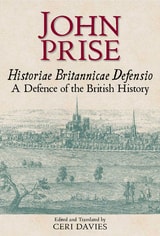
Historiae Britannicae Defensio / A Defence of the British History
John Prise
Bodleian Library Publishing, 2015

Historical Anthropology of the Middle Ages
Aaron Gurevich
University of Chicago Press, 1992
Gurevich's writing, while informed by the history of mentalities as practiced by the French school of Le Goff and Duby, reflects a broader view of European culture outside France. He rejects reductionist concepts and operates with a total view of culture, using a wide range of sources—legal as well as ecclesiastical, popular as well as learned, oral and visual as well as literary.
This collection amply demonstrates this breadth of Gurevich's work and highlights his ability to synthesize historical, anthropological, and semiotic approaches to culture. Especially valuable are pieces such as Gurevich's essay Wealth and Gift-Bestowal Among the Ancient Scandinavians, about the importance of gift exchange in the medieval world. One of the first studies for this practice, this classic essay has for years been unavailable. Other pieces range from the deities and heroes of Germanic poetry to the image of the Beyond in the Middle Ages.
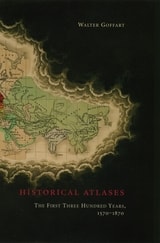
Historical Atlases
The First Three Hundred Years, 1570-1870Walter Goffart
University of Chicago Press, 2003
Beginning in the sixteenth century, and continuing down to the late nineteenth, Walter Goffart discusses milestones in the origins of historical atlases as well as individual maps illustrating historical events in alternating, paired chapters. He focuses on maps of the medieval period because the development of maps for history hinged particularly on portrayals of this segment of the postclassical, "modern" past. Goffart concludes the book with a detailed catalogue of more than 700 historical maps and atlases produced from 1570 to 1870.
Historical Atlases will immediately take its place as the single most important reference on its subject. Historians of cartography, medievalists, and anyone seriously interested in the role of maps in portraying history will find it invaluable.
Historiography
Ancient, Medieval, and ModernErnst Breisach
University of Chicago Press, 1995
Historiography
Ancient, Medieval, and Modern, Third EditionErnst Breisach
University of Chicago Press, 2007
In this pioneering work, Ernst Breisach presents an effective, well-organized, and concise account of the development of historiography in Western culture. Neither a handbook nor an encyclopedia, this up-to-date third edition narrates and interprets the development of historiography from its origins in Greek poetry to the present, with compelling sections on postmodernism, deconstructionism, African-American history, women’s history, microhistory, the Historikerstreit, cultural history, and more. The definitive look at the writing of history by a historian, Historiography provides key insights into some of the most important issues, debates and innovations in modern historiography.
History of Christian Philosophy in the Middle Ages
Etienne Gilson
Catholic University of America Press, 2019
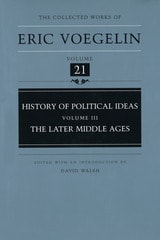
History of Political Ideas, Volume 3 (CW21)
The Later Middle AgesEric Voegelin, Edited & Intro by David Walsh
University of Missouri Press, 1998
In The Later Middle Ages, the third volume of his monumental History of Political Ideas, Eric Voegelin continues his exploration of one of the most crucial periods in the history of political thought. Illuminating the great figures of the high Middle Ages, Voegelin traces the historical momentum of our modern world in the core evocative symbols that constituted medieval civilization. These symbols revolved around the enduring aspiration for the sacrum imperium, the one order capable of embracing the transcendent and immanent, the ecclesiastical and political, the divine and human. The story of the later Middle Ages is that of the "civilizational schism"—the movement in which not only the reality but the aspiration for the sacrum imperium gradually disappeared and the unification of faith and reason dissolved.
His recognition of this civilizational schism provides Voegelin with a unique perspective on medieval society. William of Ockham, Dante, Giles of Rome, and Marsilius of Padua all emerge in Voegelin's study as predecessors to modern thought; each turns to personal authority and intellectual analysis in an attempt to comprehend the loss of the sacrum imperium as an authoritative ideal. Voegelin is further drawn into investigations that, despite insufficient attention by scholars, still bear relevance to the study of the later Middle Ages. The mysticism apparent in Piers Plowman and the apocalyptic revolt of Cola di Rienzo are merely two reactions to the disintegration of wholeness.
Yet the story of the later Middle Ages does not merely revolve around disintegration. Voegelin recognizes the emergence of the constitutional political tradition as the most positive development of this period. He is at his best when explaining the difference between the presence of a representative institution and the growth of communal consciousness. Voegelin's study of the English political pattern is matched only by his unique perspective on the German imperial zone, culminating in a fitting conclusion on Nicholas of Cusa—the one political thinker with the ability to evoke the unity of mankind beyond fragmentation.
The Later Middle Ages is at once a brilliant examination of the symbols that characterized medieval society and a remarkable predecessor to Voegelin's study of the modern world, beginning with the Renaissance and the Reformation.
History of the Bishops of Salona and Split
Thomas Spalatensis
Central European University Press, 2006
History of the Byzantine Empire, 324–1453, Volume I
Alexander A. Vasiliev
University of Wisconsin Press, 1958
History of the Byzantine Empire, 324–1453, Volume II
Alexander A. Vasiliev
University of Wisconsin Press, 1958
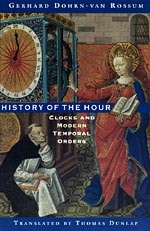
History of the Hour
Clocks and Modern Temporal OrdersGerhard Dohrn-van Rossum
University of Chicago Press, 1996
"In tracing the evolution of time consciousness with scholarship and skill . . . Dohrn-van Rossum evokes the many ways that the small moments of life have come to be reckoned with the passage of time."—Dava Sobel, Civilization
"Dohrn-van Rossum paints a highly nuanced picture of time's conquest of modern life."—Steven Lagerfeld, Wilson Quarterly
"This book is definitive in showing the clock's pervasive influence over European society."—Virginia Quarterly Review
"[A] delightful, excellently translated history."—Choice
"Dohrn-van Rossum has produced a persuasive and brilliantly documented new understanding of how modern time-consciousness arose."—Owen Gingerich, Nature
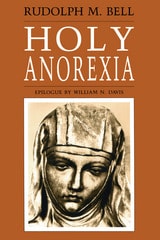
Holy Anorexia
Rudolph M. Bell
University of Chicago Press, 1985
"Everyone interested in anorexia nervosa . . . should skim this book or study it. It will make you realize how dependent upon culture the definition of disease is. I will never look at an anorexic patient in the same way again."—Howard Spiro, M.D., Gastroenterology
"[This] book is a first-class social history and is well-documented both in its historical and scientific portions."—Vern L. Bullough, American Historical Review
"A significant contribution to revisionist history, which re-examines events in light of feminist thought. . . . Bell is particularly skillful in describing behavior within its time and culture, which would be bizarre by today's norms, without reducing it to the pathological."—Mary Lassance Parthun, Toronto Globe and Mail
"Bell is both enlightened and convincing. His book is impressively researched, easy to read, and utterly fascinating."—Sheila MacLeod, New Statesman
How Not to Make a Human
Pets, Feral Children, Worms, Sky Burial, OystersKarl Steel
University of Minnesota Press, 2019
From pet keeping to sky burials, a posthuman and ecocritical interrogation of and challenge to human particularity in medieval texts
Mainstream medieval thought, like much of mainstream modern thought, habitually argued that because humans alone had language, reason, and immortal souls, all other life was simply theirs for the taking. But outside this scholarly consensus teemed a host of other ways to imagine the shared worlds of humans and nonhumans. How Not to Make a Human engages with these nonsystematic practices and thought to challenge both human particularity and the notion that agency, free will, and rationality are the defining characteristics of being human.
Recuperating the Middle Ages as a lost opportunity for decentering humanity, Karl Steel provides a posthuman and ecocritical interrogation of a wide range of medieval texts. Exploring such diverse topics as medieval pet keeping, stories of feral and isolated children, the ecological implications of funeral practices, and the “bare life” of oysters from a variety of disanthropic perspectives, Steel furnishes contemporary posthumanists with overlooked cultural models to challenge human and other supremacies at their roots.
By collecting beliefs and practices outside the mainstream of medieval thought, How Not to Make a Human connects contemporary concerns with ecology, animal life, and rethinkings of what it means to be human to uncanny materials that emphasize matters of death, violence, edibility, and vulnerability.
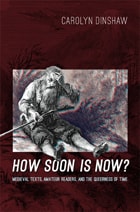
How Soon Is Now?
Medieval Texts, Amateur Readers, and the Queerness of TimeCarolyn Dinshaw
Duke University Press, 2012
Whether discussing Victorian men of letters who parodied the Book of John Mandeville, a fictionalized fourteenth-century travel narrative, or Hope Emily Allen, modern coeditor of the early-fifteenth-century Book of Margery Kempe, Dinshaw argues that these and other medievalists outside the academy inhabit different temporalities than modern professionals operating according to the clock. How Soon Is Now? clears space for amateurs, hobbyists, and dabblers who approach medieval worlds from positions of affect and attachment, from desires to build other kinds of worlds. Unruly, untimely, they urge us toward a disorderly and asynchronous collective.

How the West Came to Rule
The Geopolitical Origins of CapitalismAlex Anievas and Kerem Nisancioglu
Pluto Press, 2015
***Winner, British International Studies Association International Political Economy Working Group Book Prize 2016***
Mainstream historical accounts of the development of capitalism describe a profess which is fundamentally European—a system that was born in the mills and factories of English and under the guillotines of the French Revolution. This groundbreaking book tells a very difference story.
How the West Came to Rule offers a unique interdisciplinary and international historical account of the origins of capitalism. It argues that, contrary to dominant wisdom, capitalism’s origins should not be understood as a development confined to the geographically and culturally sealed borders of Europe, but the outcome of a wider array of global processes in which non-European societies played a decisive role.
Here is a provocative, incisive explanation of how capitalism emerged in England and Europe through a dialectical intersocietal and geopolitical process. The authors’ aim to undermine a Eurocentric bias that has been prominent in the debate about capitalisms rise to supremacy, and their case is remarkably convincing. They provide a fundamental rethinking. Anievas and Nisancioglu contend that often cited assumptions are neither theoretically nor empirically tenable and deny the agency of non-Western societies to the emergence of capitalism. Topics covered include:
*The Problem of Eurocentrism
*The Problem of Historical Specificity
*The Brenner Thesis: Explanation and Critique
*The Geopolitical in the Making of Capitalism
*The Political Marxist Conception of Capitalism
*Rethinking the Origins of Capitalism
*And much more!
Through an outline of the uneven histories of Mongolian expansion, New World discoveries, Ottoman-Habsburg rivalry, the development of the colonies, and bourgeois revolutions, Alex Anievas and Kerem Nisancioglu offer an account of capitalism’s origins that convincingly argues against the prevailing Eurocentric narratives. It will change minds and open the eyes of historians, economists, and political thinkers.
Humanism and Secularization
From Petrarch to VallaRiccardo Fubini
Duke University Press, 2003
Humanism and Secularization offers a nuanced account of humanists contesting medieval ideas about authority not in order to reject Christianity or even orthodoxy, but to claim for themselves the right to define what it meant to be a Christian. Fubini analyzes key texts by major humanists—isuch as Petrarch, Poggio, and Valla—from the first century of the movement. As he subtly works out these authors’ views on religion and the Church from both biographical and textual information, Fubini reveals in detail the new historical consciousness that animated the humanists in their reading of classical and patristic texts. His book as a whole shows convincingly just how radical the humanism of the first half of the fifteenth century was and how sharply it challenged well-entrenched ideas and institutions. Appearing here in English for the first time, his work provides a model set of readings of humanist texts and a critical perspective on Italian humanism that will alter and enrich discussion and understanding of the nature of the humanist movement.
Hungarians and Europe in the Early Middle Ages
An Introduction to Early Hungarian HistoryAndrás Róna-Tas
Central European University Press, 1999