Results by title
364 books match the query 'Michigan' and 6 start with h

Harry Burns Hutchins and the University of Michigan
Shirley W. Smith
University of Michigan Press, 1951
Harry Burns Hutchins and the University of Michigan
[more]

Here
Women Writing on Michigan's Upper PeninsulaRonald Riekki
Michigan State University Press, 2015
How does place impact prose? Here: Women Writing on Michigan’s Upper Peninsula explores that very question, drawing on the work of Upper Peninsula authors past and present to create a vibrant kaleidoscope of voices and experiences. Bame-wa-wa-ge-zhik-aquay, Janet Loxley Lewis, Lorine Niedecker, Catie Rosemurgy, and thirty-one other authors important to the region appear in this exceptional and diverse volume. In poetry (“Spring” by Beverly Matherne, “For Those Who Dream of Cranes” by Elinor Benedict, and “Skin on Skin” by Sally Brunk), short fiction (“North Country” by Roxane Gay, “For the Healing of All Women” by April Lindala, and “Winter Mines” by Sharon Dilworth), and novel excerpts (from Once on This Island by Gloria Whelan, South of Superior by Ellen Airgood, and Dandelion Cottage by Carroll Watson Rankin), the unique character of the U.P. materializes on the page. The book also shines a spotlight on powerful emerging voices such as Lisa Fay Coutley, Charmi Keranen, and Saara Myrene Raappana. The first of its kind, this is an anthology for all seasons, an homage to the rich literary heritage of the region.
[more]
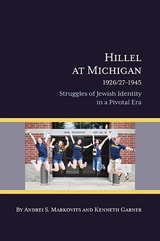
Hillel at Michigan, 1926/27-1945
Struggles of Jewish Identity in a Pivotal EraAndrei S. Markovits and Kenneth Garner
Michigan Publishing Services, 2016
This book provides the very first in-depth analysis of the founding decades of a major Hillel chapter in the United States. Hillel at the University of Michigan was founded in 1926 as the fourth such chapter in the United States following its establishment at three other public universities in the Midwest: Illinois (1923); Wisconsin (1924); Ohio State (1925).
The study analyzes Hillel's challenges as a big-tent, catch-all institution trying to represent all Jewish students on campus regardless of their religious orientation, cultural preferences, and ideological predilections. It looks at Hillel's interactions with the then powerful Jewish fraternities and sororities that provided the main locus of Jewish life on campus at the time, as well as its relations with the University's leadership and many of its cultural and political constituencies. Most of these activities occurred at a time when anti-Semitism was rife in the United States, particularly in the larger Detroit area, home to Henry Ford and Father Charles Edward Coughlin.
The study analyzes Hillel's challenges as a big-tent, catch-all institution trying to represent all Jewish students on campus regardless of their religious orientation, cultural preferences, and ideological predilections. It looks at Hillel's interactions with the then powerful Jewish fraternities and sororities that provided the main locus of Jewish life on campus at the time, as well as its relations with the University's leadership and many of its cultural and political constituencies. Most of these activities occurred at a time when anti-Semitism was rife in the United States, particularly in the larger Detroit area, home to Henry Ford and Father Charles Edward Coughlin.
[more]

History Is Bunk
Assembling the Past at Henry Ford's Greenfield VillageSwigger Jessie
University of Massachusetts Press, 0
[more]
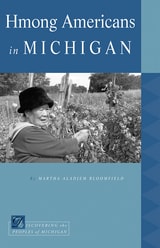
Hmong Americans in Michigan
Martha Aladjem Bloomfield
Michigan State University Press, 2014
The Hmong people, originating from the mountainous regions of China, Vietnam, Thailand, and Laos, are unique among American immigrants because of their extraordinary history of migration; loyalty to one another; prolonged abuse, trauma, and suffering at the hands of those who dominated them; profound loss; and independence, as well as their amazing capacity to adapt and remain resilient over centuries. This introduction to their experience in Michigan discusses Hmong American history, culture, and more specifically how they left homelands filled with brutality and warfare to come to the United States since the mid-1970s. More than five thousand Hmong Americans live in Michigan, and many of them have faced numerous challenges as they have settled in the Midwest. How did these brave and innovative people adapt to strange new lives thousands of miles away from their homelands? How have they preserved their past through time and place, advanced their goals, and cultivated plans for their children and education? What are their lives like in the diaspora? As this book documents via personal interviews and extensive research, despite the tremendous losses they have suffered for many years, the Hmong people in Michigan continue to demonstrate courage and profound resilience.
[more]
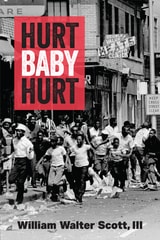
Hurt, Baby, Hurt
William Walter Scott, III
University of Michigan Press, 2025
The 1967 Detroit Rebellion was the bloodiest of the urban riots in the United States during the “Long hot summer of 1967.” Hurt, Baby, Hurt takes a personal look at the Rebellion from the perspective of William Walter Scott, III. The Rebellion began when police raided an unlicensed drinking club owned by Scott’s father and continued for five days, resulting in forty-three deaths and even more injuries, fires, and arrests. Scott, who was just 19 at the time and working as a doorman at his father’s club, is widely recognized as the man who started the Rebellion by throwing a bottle at one of the police officers.
This memoir recounts Scott’s life from his birth up through the Rebellion. It tells the story of how the Rebellion started and provides an on-the-ground account of the Rebellion and its immediate aftermath, including the police detainment of the people involved. Now with a new foreword by Austin McCoy that considers the lasting impact of the rebellion, Hurt, Baby, Hurt offers valuable insight into an important part of Detroit history.
This memoir recounts Scott’s life from his birth up through the Rebellion. It tells the story of how the Rebellion started and provides an on-the-ground account of the Rebellion and its immediate aftermath, including the police detainment of the people involved. Now with a new foreword by Austin McCoy that considers the lasting impact of the rebellion, Hurt, Baby, Hurt offers valuable insight into an important part of Detroit history.
[more]