Results by title
941 books match the query 'Military' and 16 start with h

Hanoi Jane
War, Sex, and Fantasies of BetrayalJerry Lembcke
University of Massachusetts Press, 2010
From Aristophanes' Lysistrata to the notorious Mata Hari and the legendary Tokyo Rose, stories of female betrayal during wartime have recurred throughout human history. The myth of Hanoi Jane, Jerry Lembcke argues, is simply the latest variation on this enduring theme. Like most of the iconic femmes fatales who came before, it is based on a real person, Jane Fonda. And also like its predecessors, it combines traces of fact with heavy doses of fiction to create a potent symbol of feminine perfidy—part erotic warrior-woman Barbarella, part savvy antiwar activist, and part powerful entrepreneur.
Hanoi Jane, the book, deconstructs Hanoi Jane, the myth, to locate its origins in the need of Americans to explain defeat in Vietnam through fantasies of home-front betrayal and the emasculation of the national will-to-war. Lembcke shows that the expression “Hanoi Jane” did not reach the eyes and ears of most Americans until five or six years after the end of the war in Vietnam. By then, anxieties about America's declining global status and deteriorating economy were fueling a populist reaction that pointed to the loss of the war as the taproot of those problems. Blaming the antiwar movement for undermining the military's resolve, many found in the imaginary Hanoi Jane the personification of their stab-in-the- back theories.
Ground zero of the myth was the city of Hanoi itself, which Jane Fonda had visited as a peace activist in July 1972. Rumors surrounding Fonda's visits with U.S. POWs and radio broadcasts to troops combined to conjure allegations of treason that had cost American lives. That such tales were more imagined than real did not prevent them from insinuating themselves into public memory, where they have continued to infect American politics and culture.
Hanoi Jane is a book about the making of Hanoi Jane by those who saw a formidable threat in the Jane Fonda who supported soldiers and veterans opposed to the war they fought, in the postcolonial struggle of the Vietnamese people to make their own future, and in the movements of women everywhere for gender equality.
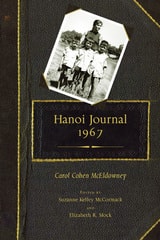
Hanoi Journal, 1967
Carol McEldowney
University of Massachusetts Press, 2007
McEldowney first gained the respect of her fellow activists as a student organizer at the University of Michigan. High regard for her intelligence, skill, and hard work with SDS's Economic Recovery Action Program during the years following her graduation in 1964 earned her an invitation to attend an international conference in Czechoslovakia and an offer to continue on to North Vietnam. Though her journal displays only traces of the feminist consciousness that would mark her later political activism, she recorded her observations of North Vietnam clearly aware that she was an outsider—a woman not subject to the military draft, not married to a soldier, and without the heartache of a brother or even a close friend serving in the war.
McEldowney searched for glimpses of everyday life that would help her to better relate to women in Hanoi and the hardships they faced during wartime. As she traveled in North Vietnam, she sought a deeper understanding of the events of her time. Her journal provides readers with a unique lens through which to study those events and gain a new perspective on the Vietnam War era.
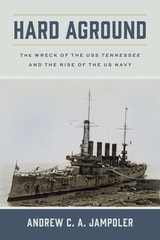
Hard Aground
The Wreck of the USS Tennessee and the Rise of the US NavyAndrew C. A. Jampoler
University of Alabama Press, 2023
Three intertwined stories that reveal the challenges faced by the US Navy in its evolution between the Civil War and the First World War
Hard Aground brings together three intertwined stories documenting the US Navy’s strategic and matériel evolution from the end of Civil War through the First World War. These incidents had lasting consequences for how the navy would modernize itself throughout the rest of the twentieth century.
The first story focuses on the reconstruction of the US Navy following the swift and near-total dismantling of the Union Navy infrastructure after the Civil War. This reconstruction began with barely enough time for the navy’s campaigns in the Spanish-American War, and for its role in the First World War. Jampoler argues that the federal government discovered that the fleet requested by the navy, and paid for by Congress, was the wrong fleet. Focus was on battleships and cruisers rather than destroyers and other small combat vessels needed to hunt submarines and serve as convoy escorts.
The second story relates the short, tragic life of the USS Tennessee (later renamed Memphis), one of the steel-hulled ships of the new Armored Cruiser Squadron that was a centerpiece of the navy’s modernization effort. The USS Tennessee was ordered on two unusual missions in the early months of the First World War, long before the United States formally entered the war. These little-known missions and the ship's shocking destruction in a storm surge in the Caribbean serve as the centerpiece of the story. Threaded through the narrative are biographical sketches of the principal players in the drama that unfolded following the ship’s demise, including two of Tennessee’s commanding officers: Vice Admiral Sims, who commanded the US Navy squadrons deployed to Europe in support of the Royal Navy; Rear Admiral William Caperton, who commanded the Caribbean squadron before the Memphis (formerly the Tennessee) was lost; Charles Pond, squadron commander during the wreck; and the American ambassador to the Ottoman court, President Wilson’s enthusiastic supporter, Henry Morgenthau.
Jampoler rounds out this fascinating account with the story of how the USS Tennessee’s destruction prompted fierce deliberations about the US Navy’s operations and chains of command for the remainder of the First World War and the high-level political wrangling inside the Department of the Navy immediately after the war, as civilian appointees and senior officers wrestled to reshape the department in their image.
Harry S. Truman and the Cold War Revisionists
Robert H. Ferrell
University of Missouri Press, 2006
Hawker Hunter
the story of a thoroughbredSreco Bradic
Amsterdam University Press, 2023
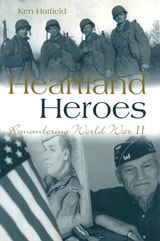
Heartland Heroes
Remembering World War IIKen Hatfield
University of Missouri Press, 2003
"War is about patriotism, about sacrifice, about conquering fear. And perhaps most of all, it's about the guy in the foxhole next to you, taking care of each other, protecting each other, loving each other; a camaraderie so intense only men who have been in combat can ever know what it's like. Yes, most of all, war is about love."
Heartland Heroes is a collection of remarkable stories from ordinary men and women who lived through extraordinary times. They resided in places like Lee’s Summit, Independence, and Kansas City, yet their experiences were very much like those of World War II veterans everywhere. Some were marines, nurses, or fighter pilots, others were simply civilians who lived through the war under the martial law imposed on the Hawaiian Islands after the attack on Pearl Harbor.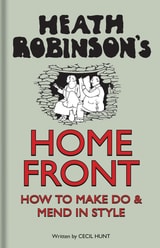
Heath Robinson's Home Front
How to Make Do and Mend in StyleW. Heath Robinson and Cecil Hunt
Bodleian Library Publishing, 2016
Heath Robinson was a household name in Britain, and millions of readers around the world continue to thoroughly enjoy his cartoons today. A classic military-themed compendium, Heath Robinson’s Home Front will be a favorite with fans of the cartoonist’s complicated, fanciful contraptions.
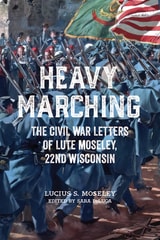
Heavy Marching
The Civil War Letters of Lute Moseley, 22nd WisconsinLucius S. Moseley, edited by Sara DeLuca
University of Wisconsin Press, 2023
From 1862 to 1865, Moseley fought in the Civil War as an infantry soldier in Wisconsin’s 22nd Volunteers. Briefly captured and interred in a Confederate POW Camp, he returned to action and participated in Sherman’s Atlanta campaign. He marched in the Washington, D.C., Grand Review before returning to the Beloit area, where he remained for the rest of his life.
Mosely wrote detailed missives to his family in Beloit about his wartime experiences, demonstrating a flair for describing both camp life and battles. Frank and forthright, he was remarkably articulate, insightful, and thoughtful, whether describing mundane activities or the nearly unfathomable death of President Lincoln. These 125 letters, never before made available to scholars or students of the war, became touchstones and sources of pride for the Moseley family—and provide a uniquely candid and vivid view of this tumultuous period in US history.
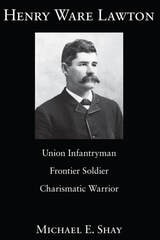
Henry Ware Lawton
Union Infantryman, Frontier Soldier, Charismatic WarriorMichael E. Shay
University of Missouri Press, 2016
Henry Ware Lawton’s nearly four decades as a professional soldier in the U.S. Army tie his story closely to that of America in the nineteenth century, from the Civil War to the settlement of the West, to the experiment with empire. Lawton served the country nearly uninterrupted from the day he enlisted at age 18—soon after Lincoln’s first call for volunteers to fight in the Civil War, where he earned a Medal of Honor—to his death at age 56, a major general in the Philippine War. In between, he fought in the Spanish-American War and the Indian Wars; during that time he rose to national prominence as the man who captured Geronimo.
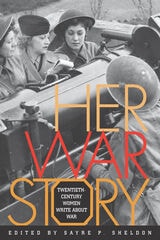
Her War Story
Twentieth-Century Women Write About WarEdited by Sayre P. Sheldon
Southern Illinois University Press, 1999
Sayre P. Sheldon chose the twentieth century for this collection of women's war writing because women's roles in war have changed dramatically in this century. The twentieth century has redefined the meaning of combat and expanded the territory of war to include women in larger numbers than ever before. When the technological advances of modern war began to target civilians, the home front became the front line. Women took an active part in war whether or not by choice, often by moving into occupations previously closed to them. Women covered wars for their newspapers, wrote war propaganda for their governments, published their wartime diaries, described fighting alongside men, and used wartime experience for their fiction and poetry.
Women writers also chose the right to imagine war, just as men for centuries had written about war without actually experiencing it. Women writers anthologized here include Anna Akhmatova, Vera Brittain, Gwendolyn Brooks, Willa Cather, Colette, Martha Gellhorn, H.D., Etty Hillesum, Käthe Kollwitz, Doris Lessing, Amy Lowell, Katherine Mansfield, Mary McCarthy, Toni Morrison, Dorothy Parker, Mary Lee Settle, Gertrude Stein, Huong Tram, Edith Wharton, Virginia Woolf, and Mitsuye Yamada.
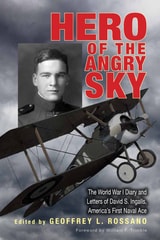
Hero of the Angry Sky
The World War I Diary and Letters of David S. Ingalls, America’s First Naval AceDavid S. Ingalls
Ohio University Press, 2012
Hero of the Angry Sky draws on the unpublished diaries, correspondence, informal memoir, and other personal documents of the U.S. Navy’s only flying “ace” of World War I to tell his unique story. David S. Ingalls was a prolific writer, and virtually all of his World War I aviation career is covered, from the teenager’s early, informal training in Palm Beach, Florida, to his exhilarating and terrifying missions over the Western Front. This edited collection of Ingalls’s writing details the career of the U.S. Navy’s most successful combat flyer from that conflict.
While Ingalls’s wartime experiences are compelling at a personal level, they also illuminate the larger, but still relatively unexplored, realm of early U.S. naval aviation. Ingalls’s engaging correspondence offers a rare personal view of the evolution of naval aviation during the war, both at home and abroad. There are no published biographies of navy combat flyers from this period, and just a handful of diaries and letters in print, the last appearing more than twenty years ago. Ingalls’s extensive letters and diaries add significantly to historians’ store of available material.
Hiroshima in History
The Myths of RevisionismEdited with an introduction by Robert James Maddox
University of Missouri Press, 2007
When President Harry Truman authorized the use of atomic weapons against Japan, he did so to end a bloody war that would have been bloodier still had the planned invasion of Japan proved necessary. Revisionists claim that Truman’s real interest was a power play with the Soviet Union and that the Japanese would have surrendered even earlier had the retention of their imperial system been assured. Truman wanted the war to continue, they insist, in order to show off America’s powerful new weapon.
This anthology exposes revisionist fallacies about Truman’s motives, the cost of an invasion, and the question of Japan’s surrender. Essays by prominent military and diplomatic historians reveal the hollowness of revisionist claims, exposing the degree to which these agenda-driven scholars have manipulated the historical record to support their contentions. They show that, although some Japanese businessmen and minor officials indicated a willingness to negotiate peace, no one in a governmental decision-making capacity even suggested surrender. And although casualty estimates for an invasion vary considerably, the more authoritative approximations point to the very bloodbath that Truman sought to avoid.
Volume editor Robert Maddox first examines the writings of revisionist Gar Alperovitz to expose the unscholarly methods Alperovitz employed to support his claims, then distinguished Japanese historian Sadao Asada reveals how difficult it was for his country’s peace faction to prevail even after the bombs had been dropped. Other contributors point to continuing Japanese military buildups, analyze the revisionists’ low casualty estimates for an invasion, reveal manipulations of the Strategic Bombing Survey of 1946, and show how even the exhibit commemorating the fiftieth anniversary of the bombing at the Smithsonian National Air and Space Museum hewed to the revisionist line. And a close reading of Tsuyoshi Hasegawa’s acclaimed Racing the Enemy exposes many grave discrepancies between that recent revisionist text and its sources.
The use of atomic bombs against Japan remains one of the most controversial issues in American history. Gathered in a single volume for the first time, these insightful readings take a major step toward settling that controversy by showing how insubstantial Hiroshima revisionism really is—and that sometimes history cannot proceed without decisive action, however regrettable.
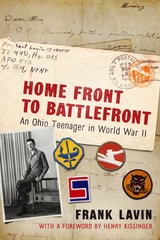
Home Front to Battlefront
An Ohio Teenager in World War IIFrank Lavin
Ohio University Press, 2016
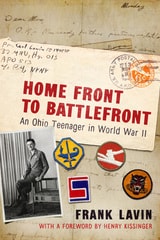
Carl Lavin was a high school senior when Pearl Harbor was attacked. The Canton, Ohio, native was eighteen when he enlisted, a decision that would take him with the US Army from training across the United States and Britain to combat with the 84th Infantry Division in the Battle of the Bulge. Home Front to Battlefront is the tale of a foot soldier who finds himself thrust into a world where he and his unit grapple with the horrors of combat, the idiocies of bureaucracy, and the oddities of life back home—all in the same day. The book is based on Carl’s personal letters, his recollections and those of the people he served beside, official military history, private papers, and more.
Home Front to Battlefront contributes the rich details of one soldier’s experience to the broader literature on World War II. Lavin’s adventures, in turn disarming and sobering, will appeal to general readers, veterans, educators, and students of the war. As a history, the book offers insight into the wartime career of a Jewish Ohioan in the military, from enlistment to training through overseas deployment. As a biography, it reflects the emotions and the role of the individual in a total war effort that is all too often thought of as a machine war in which human soldiers were merely interchangeable cogs.
Home Front to Battlefront
An Ohio Teenager in World War IIFrank Lavin
Ohio University Press, 2001
Carl Lavin was a high school senior when Pearl Harbor was attacked. The Canton, Ohio, native was eighteen when he enlisted, a decision that would take him with the US Army from training across the United States and Britain to combat with the 84th Infantry Division in the Battle of the Bulge. Home Front to Battlefront is the tale of a foot soldier who finds himself thrust into a world where he and his unit grapple with the horrors of combat, the idiocies of bureaucracy, and the oddities of life back home—all in the same day. The book is based on Carl’s personal letters, his recollections and those of the people he served beside, official military history, private papers, and more.
Home Front to Battlefront contributes the rich details of one soldier’s experience to the broader literature on World War II. Lavin’s adventures, in turn disarming and sobering, will appeal to general readers, veterans, educators, and students of the war. As a history, the book offers insight into the wartime career of a Jewish Ohioan in the military, from enlistment to training through overseas deployment. As a biography, it reflects the emotions and the role of the individual in a total war effort that is all too often thought of as a machine war in which human soldiers were merely interchangeable cogs.
How the Military Remembers
Human Rights and Countermemories in Latin AmericaEdited by Cynthia E. Milton and Michael J. Lazzara
University of Wisconsin Press, 2025
With attention to the distinct cultural, political, and historical contexts across Latin America, the essays reveal how military figures and institutions appropriate mechanisms of truth-telling and accountability to reframe the past, blur the lines between perpetrator and victim, and weaponize memory itself.
Contributors: Mariana Achugar, Gabriela Fried Amilivia, Rebecca Atencio, Jo-Marie Burt, Rachel Hatcher, Nicolás Rodríguez Idárraga, Michael J. Lazzara, Cynthia E. Milton, Carla Granados Moya, María Emma Wills Obregón, Leith Passmore, Valentina Salvi, Gladys Vásquez Zevallos
How to Shoot the Longbow
A Guide from Historical and Applied SourcesHugh D. H. Soar
Westholme Publishing, 2015
“Soar’s book [The Crooked Stick] is indispensible.”—Bernard Cornwell, New York Times bestselling author
Relying on more than fifty years’ experience in archery, historian Hugh D. H. Soar reflects on how the longbow was drawn and shot across the centuries through examining the design of the bow and early literature about the bow, combined with his and his colleagues’ applied knowledge using replica bows. No complete medieval longbow has survived, but those found aboard the Tudor warship Mary Rose provide the best archaeological evidence to the possible construction of the medieval bow. Contemporary treatises written about the proper manner of shooting the bow, together with the resurgence in interest and construction of replica bows beginning in the late sixteenth century that form part of the author’s collection provide the basis for this work. How to Shoot the Longbow: A Guide from Historical and Applied Sources is a fascinating and practical look at the use of a legendary invention.