94 books match the query 'Miscellanea' and 5 start with h
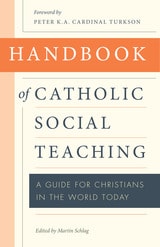
cover of Handbook of Catholic Social Teaching: A Guide for Christians in the World Today

Handbook of Catholic Social Teaching

A Guide for Christians in the World Today

Martin Schlag

Catholic University of America Press, 2017

Handbook of Catholic Social Teaching employs a question and answer format, to better accentuate the response of the Church's message to the questions Catholics have about their social role and what the Church intends to teach about it. Written in consultation with the Pontifical Council for Justice and Peace, the Handbook should take its place alongside the Catechism of the Social Doctrine of the Church on the shelf of informed Catholics as works that can inform what we believe and do in the public sphere.
[more]
cover of Hot Hands, Draft Hype, and DiMaggio's Streak: Debunking America's Favorite Sports Myths

Hot Hands, Draft Hype, and DiMaggio's Streak

Debunking America's Favorite Sports Myths

Sheldon Hirsch

University Press of New England, 2017
In sports there are lies, damned lies, and statistics. Joe DiMaggio’s fifty-six-game hitting streak was magical. The three-point shot is an essential part of NBA basketball. Babe Ruth shouldn’t have attempted to steal second base in the ninth inning of the 1926 World Series. Scientist and researcher Sheldon Hirsch has taken a decidedly unorthodox approach to sports history. He looks at myths, legends, conventional wisdom, shibboleths, and firm convictions of all kinds that sports lovers hold to be true, and demonstrates how analysis of facts and figures disproves what tradition—and sportswriters—would have us believe. Divided into three parts, on baseball, basketball, and football, Hot Hands, Draft Hype, and DiMaggio’s Streak contains enough clear-sightedness and shocking conclusions to delight any sports lover.
[more]
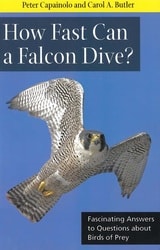
cover of How Fast Can A Falcon Dive?: Fascinating Answers to Questions about Birds of Prey

How Fast Can A Falcon Dive?

Fascinating Answers to Questions about Birds of Prey

Capainolo, Peter

Rutgers University Press, 2010

How Fast Can a Falcon Dive? explores the world of raptors in a way that will appeal to bird lovers and biology enthusiasts alike. This colorful volume is complete with more than fifty-five color and black and white images from photographers and artists around the world. In a reader friendly question and answer format, ornithologist Peter Capainolo and science writer Carol A. Butler define and classify raptors, explore the physical attributes of birds of prey, view how their bodies work, and explain the social and physical behaviors of these species-how they communicate, hunt, reproduce, and more. Capainolo, who received one of the first falconry licenses issued in New York state at age eighteen, relates his personal experience in falconry to describe raptor training and husbandry where the human-bird interactions are complex.

From stories of red-tailed hawks making their homes on the ledges of Manhattan skyscrapers to their role in protecting California's vineyards from flocks of grape-loving starlings, How Fast Can a Falcon Dive? explores how these avian predators interact with people and with their environment.
[more]
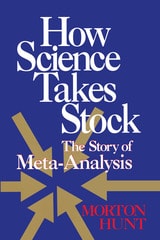
cover of How Science Takes Stock: The Story of Meta-Analysis

How Science Takes Stock

The Story of Meta-Analysis

Morton Hunt

Russell Sage Foundation, 1997

Policymakers, medical practitioners, and the public alike face an increasingly bewildering flood of new and often contradictory scientific studies on almost every topic. Whether the issue is the the best treatment for breast cancer, the need for prenatal food programs to improve the health of poor infants and mothers, or the ability of women to succeed in scientific professions, the healthy growth of modern science has at times done more to stir up controversy than to establish reliable knowledge. But now scientists in several fields have developed a sophisticated new methodology called meta-analysis to address this problem. By numerically combining diverse research findings on a single question, meta-analysis can be used to identify their central tendency and reach conclusions far more reliable than those of any single investigation. How Science Takes Stock vividly tells the story of meta-analysis through the eyes of its architects and champions, and chronicles its history, techniques, achievements, and controversies. Noted science author Morton Hunt visits key practitioners and recounts their use of meta-analysis to resolve important scientific puzzles and longstanding debates. Does psychotherapy work, and if so what form works best? Does spending federal money on education really improve student performance? Can a single enzyme significantly decrease the risk of heart attack? Do boot camps reduce juvenile delinquency? With each account, Hunt illustrates the major components of the meta-analytic method, reveals strategies for resolving practical and theoretical problems, and discusses the impact of meta-analysis on the science and policy communities. In many cases, he demonstrates how meta-analysts have gone a step further to determine the causes of earlier discrepancies. In this way they not only identify successful approaches to the question at hand, but also clarify the conditions under which they will work best. Hunt also portrays the important but frequently controversial business of doing meta-analysis for legislators and government agencies, particularly in sensitive areas of social policy. How Science Takes Stock demonstrates how the statistical techniques of meta-analysis produce more accurate data than the standard literature review or the old-fashioned process of tallying up the results of each scientific study as if they were votes in an election to decide the truth. Hunt also addresses issues of quality control in each phase of the meta-analytic process, and answers skeptics who claim that the dissimilarities between studies are often too significant for meta-analysis to be any more than an apples and oranges approach. This volume conveys the power of meta-analysis to help social policymakers and health professionals resolve their most pressing problems. How Science Takes Stock concludes with a discussion of the future of meta-analysis that examines its potential for further refinements, its growth in the scientific literature, and exciting new possibilities for its future use. An appendix by meta-analysis expert Harris Cooper offers some finer points on the mechanics of conducting a meta-analytic investigation.
[more]
cover of How to Be a Texan: The Manual

How to Be a Texan

The Manual

By Andrea Valdez

University of Texas Press, 2016

There are certain things every Texan should know how to do and say, whether your Lone Star roots reach all the way back to the 1836 Republic or you were just transplanted here yesterday. Some of these may be second nature to you, but others . . . well, maybe it wouldn’t hurt to have a few handy hints if, say, branding the herd or hosting a tamalada aren’t your usual pastimes. That’s where How to Be a Texan can help.

In a friendly, lighthearted style, Andrea Valdez offers illustrated, easy-to-follow steps for dozens of authentic Texas activities and sayings. In no time, you’ll be talking like a Texan and dressing the part; hunting, fishing, and ranching; cooking your favorite Texas dishes; and dancing cumbia and two-step. You’ll learn how to take a proper bluebonnet photo and build a Día de los Muertos altar, and you’ll have a bucket list of all the places Texans should visit in their lifetime. Not only will you know how to do all these things, you’ll finish the book with a whole new appreciation for what it means to be a Texan and even more pride in saying “I’m from Texas” anywhere you wander in the world.

[more]