Results by title
210 books match the query 'Missouri' and 6 start with h
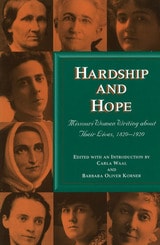
Hardship and Hope
Missouri Women Writing about Their Lives, 1820-1920Carla Waal and Barbara Oliver Korner, eds.
University of Missouri Press, 1997
Over the years Missouri women have endured many hardships: Civil War troops in their homes, the harshness of westward travel, the loneliness of the Gold Rush, and slavery. They have also greatly influenced the state's history. Marie Watkins Oliver made the state flag; Margaret Nelson Stephens was a gifted politician; Carry A. Nation fought for prohibition; and Mary Ezit Bulkley was active in the woman suffrage movement.
Hardship and Hope brings to life these and other known and unknown Missouri women through their own writings in journals, letters, diaries, and memoirs. Most of these pieces have never been published or have long been out of print. Carla Waal and Barbara Oliver Korner have skillfully crafted this anthology to represent myriad Missouri women. There are pieces representing the experiences of Jewish, Irish, and German immigrants, African Americans, well-educated women, and deeply religious women. Preceding each entry is a useful introduction that provides history and background on the woman and her work.
Readers will meet women like Phoebe Wilson Couzins, who was the first woman law graduate in Missouri. She went on to work with Susan B. Anthony for the suffrage movement but died in poverty, physically handicapped and emotionally unstable. Emma J. Ray was born a slave just before the Civil War. She and her husband did missionary work in jails and on the streets of Kansas City. Other women represented are Laura Ingalls Wilder, Kate Chopin, Fannie Hurst, and Henriette Geisberg Bruns.
Hardship and Hope began as a series of performances around the state of Missouri through which the book's editors demonstrated the roles women played in that state's past. Because of the enthusiastic response to their performances, Waal and Korner continued searching for documents by Missouri women and now share their discoveries in book form. Covering a little more than a century, from just before Missouri's admission to the Union in 1821 to the ratification of the Nineteenth Amendment that gave women the right to vote in 1920, the excerpts here both captivate and inform.
This anthology will appeal to those interested in women's studies, Missouri and midwestern history, and oral interpretation.
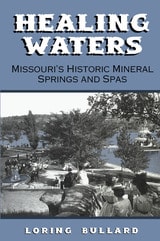
Healing Waters
Missouri's Historic Mineral Springs and SpasLoring Bullard
University of Missouri Press, 2004
By visiting the sites, gathering local historical accounts, interviewing local citizens, and photographing remaining artifacts, Bullard has done a masterful job in providing the answers to why these vibrant social centers came to be and why they faded.

High Art Down Home
An Economic Ethnography of a Local Art MarketStuart Plattner
University of Chicago Press, 1996
To answer this question, Stuart Plattner eschews the spotlights and media-hype of glitzy New York galleries, and focuses instead upon the more localized, and much more typical, world of the St. Louis art scene. What emerges is the most comprehensive description ever published of a contemporary regional avant-garde center, where noble aesthetic ambitions compete with the exigencies of economic survival. Plattner's skillful use of in-depth interviews enables the market's key participants to speak for themselves, giving voice to the many frustrations and rewards, motivations and constraints that influence their interactions with their work, the market, and each other.
"Plattner analyzes the social and economic factors that govern art markets outside the long shadow cast by chic New York galleries. An insightful and fascinating work."—Library Journal
"Explains much about the conundrums and paradoxes of the art world as a whole."—Eddie Silva, Riverfront Times
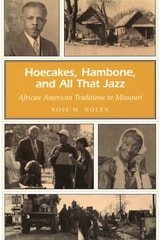
Hoecakes, Hambone, and All That Jazz
African American Traditions in MissouriRose M. Nolen
University of Missouri Press, 2003
Nolen writes, “Instead of the bond of common ancestors and a common language, which families had shared in Africa, the enslaved in the United States were bound together by skin color, hair texture, and condition of bondage. Out of this experience a strong sense of community was born.” Nolen traces the cultural traditions shaped by African Americans in Missouri from the early colonial period through the Civil War and Reconstruction and shows how those traditions were reshaped through the struggles of the civil rights movement and integration. Nolen demonstrates how the strong sense of community built on these traditions has sustained African Americans throughout their history.
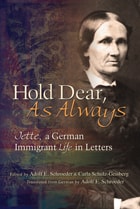
Hold Dear, As Always
Jette, a German Immigrant Life in LettersAdolf E. Schroeder and Carla Schulz-Geisberg
University of Missouri Press, 1988
Henriette Geisberg Bruns was twenty-three when she arrived in 1836 at the isolated Westphalia Settlement in central Missouri with her husband, baby son, two brothers, and a maid. Jette, as she was known to her family and friends, had not come to America by inclination, but from duty. Her husband Bernhard, a physician, had fallen victim to the emigration fever sweeping Germany in the 1830s and was convinced that he could provide a better life for his family in the American Free States where land was plentiful, the soil was fertile, and taxes were low. Born into a large, prosperous, closely knit family, Jette had set out for the New World reluctantly; but once in Missouri, she was determined not to give up and go back home, as a neighboring family did.
Although she maintained her resolve, this collection of letters written to her family in Germany shows that her life in America was often beset by deprivation, disease, and loneliness. Jette had been persuaded to emigrate for the sake of her children’s future; however, of the ten born in central Missouri, five died in childhood, three within three weeks in September and October 1841.Despite the family responsibilities and the hardships she faced in Missouri, Jette maintained a lively interest in American political and social life. For fifteen years in Westphalia and almost fifty in Jefferson City and St. Louis, she observed and offered astute—if sometimes acerbic—commentary on the historic as well as the daily events of nineteenth-century life. Left destitute by the death of her husband, who had served as mayor of Jefferson City during the Civil War, she opened a boarding-house in her home across from the state capitol to support her own children and those of her brother. There the German radicals in state government gathered to argue and debate.This rare collection of personal family letters, combined with an autobiographical sketch Jette wrote after the Civil War, illuminates the experience of one immigrant woman in a land that was always foreign to her.
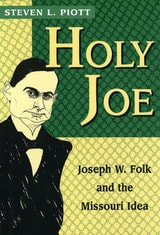
Holy Joe
Joseph W. Folk and the Missouri IdeaSteven L. Piott
University of Missouri Press, 1997
One of Missouri's best-known leaders of the Progressive Era, Joseph W. Folk epitomized the moral reformer in politics. As a crusading district attorney in St. Louis, Folk won national acclaim for his investigations of wrongdoing in municipal government. With the help of muckraking journalist Lincoln Steffens, Folk revealed for the first time the extent of political corruption then plaguing America's cities and helped bring about a popular demand for the regeneration of municipal government nationwide.
A firm believer that the law was a weapon with which to check political corruption and restrain powerful special interests, Folk popularized the "Missouri Idea," the doctrine that public office is a public trust, not merely an opportunity for private gain. Elected as governor of Missouri in 1904, Folk orchestrated a remarkable record of legislative accomplishment. He established himself as one of Missouri's outstanding governors and one of the nation's leading progressive reformers.
In asserting that traditional moral values could be applied to politics, Folk became known among friends and enemies as Holy Joe. His refusal to make any distinction between public and private morality, however, alienated some Missourians, while his disregard for party organization angered politicians. His idealism cost him political advancement and ultimately a place in national politics.
Whereas some studies of the Progressive Era have minimized the moral dimension of Progressivism and downplayed the importance of reformers like Joseph W. Folk, Holy Joe establishes him as a major leader of the Progressive movement. This biography will be a welcome addition to the literature on the subject.