Results by title
111 books match the query 'Museum Studies' and 3 start with h
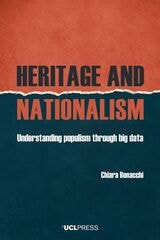
Heritage and Nationalism
Understanding Populism through Big DataChiara Bonacchi
University College London, 2021
An empirically grounded analysis of the repurposing of ancient and medieval European history in digital-age populism.
How was the Roman Empire invoked in Brexit Britain and in the United States during Donald Trump’s presidency, and to what purpose? And why is it critical to answer these kinds of questions? Heritage and Nationalism explores how people’s perceptions and experiences of the ancient past shape political identities in the digital age. It examines the multiple ways in which politicians, parties, and private citizens mobilize aspects of the Iron Age, Roman, and Medieval past of Britain and Europe to include or exclude others based on culture, religion, class, race, and ethnicity.
The book uses quantitative and qualitative methods to investigate how premodern periods are leveraged to support or oppose populist-nationalist arguments as part of social media discussions concerning Brexit, the Italian Election of 2018, and the US-Mexican border debate in the United States. Analyzing millions of tweets and Facebook posts, comments, and replies, this book is the first to use big data to answer questions about public engagement with the past and identity politics. The findings and conclusions revise and reframe the meaning of populist nationalism today and help to build a shared basis for the democratic engagement of citizens in public life in the future. The book offers a fascinating and unmissable read for anyone interested in how the past and its contemporary legacy, or heritage, influence our political thinking and feeling in a time of hyper-connectivity.
[more]
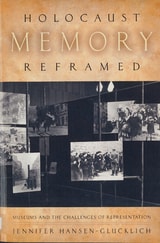
Holocaust Memory Reframed
Museums and the Challenges of RepresentationHansen-Glucklich, Jennifer
Rutgers University Press, 2014
Holocaust memorials and museums face a difficult task as their staffs strive to commemorate and document horror. On the one hand, the events museums represent are beyond most people’s experiences. At the same time they are often portrayed by theologians, artists, and philosophers in ways that are already known by the public. Museum administrators and curators have the challenging role of finding a creative way to present Holocaust exhibits to avoid clichéd or dehumanizing portrayals of victims and their suffering.
In Holocaust Memory Reframed, Jennifer Hansen-Glucklich examines representations in three museums: Israel’s Yad Vashem in Jerusalem, Germany’s Jewish Museum in Berlin, and the United States Holocaust Memorial Museum in Washington, D.C. She describes a variety of visually striking media, including architecture, photography exhibits, artifact displays, and video installations in order to explain the aesthetic techniques that the museums employ. As she interprets the exhibits, Hansen-Glucklich clarifies how museums communicate Holocaust narratives within the historical and cultural contexts specific to Germany, Israel, and the United States. In Yad Vashem, architect Moshe Safdie developed a narrative suited for Israel, rooted in a redemptive, Zionist story of homecoming to a place of mythic geography and renewal, in contrast to death and suffering in exile. In the Jewish Museum in Berlin, Daniel Libeskind’s architecture, broken lines, and voids emphasize absence. Here exhibits communicate a conflicted ideology, torn between the loss of a Jewish past and the country’s current multicultural ethos. The United States Holocaust Memorial Museum presents yet another lens, conveying through its exhibits a sense of sacrifice that is part of the civil values of American democracy, and trying to overcome geographic and temporal distance. One well-know example, the pile of thousands of shoes plundered from concentration camp victims encourages the visitor to bridge the gap between viewer and victim.
Hansen-Glucklich explores how each museum’s concept of the sacred shapes the design and choreography of visitors’ experiences within museum spaces. These spaces are sites of pilgrimage that can in turn lead to rites of passage.
[more]
How Art Can Be Thought
A Handbook for ChangeAl-An deSouza
Duke University Press, 2018
What terms do we use to describe and evaluate art, and how do we judge if art is good, and if it is for the social good? In How Art Can Be Thought Allan deSouza investigates such questions and the popular terminology through which art is discussed, valued, and taught. Adapting art viewing to contemporary demands within a rapidly changing world, deSouza outlines how art functions as politicized culture within a global industry. In addition to offering new pedagogical strategies for MFA programs and the training of artists, he provides an extensive analytical glossary of some of the most common terms used to discuss art while focusing on their current and changing usage. He also shows how these terms may be crafted to new artistic and social practices, particularly in what it means to decolonize the places of display and learning. DeSouza's work will be invaluable to the casual gallery visitor and the arts professional alike, to all those who regularly look at, think about, and make art—especially art students and faculty, artists, art critics, and curators.
[more]