Results by title
36 books match the query 'More'

A Year of Programs for Millennials and More
Amy Alessio
American Library Association, 2015

AND SIN NO MORE
SOCIAL POLICY AND UNWED MOTHERS IN CLEVEMARIAN J. MORTON
The Ohio State University Press, 1993
Baby Storytime Magic
Active Early Literacy through Bounces, Rhymes, Tickles, and MoreKathy MacMillan
American Library Association, 2014
Behind the Stars, More Stars
The Tagus/Disquiet Collection of New Luso-American WritingEdited by Christopher Larkosh and Oona Patrick
Tagus Press, 2019
Presenting experimental and boundary-breaking prose from women, people of color, and LGBTQ writers, Behind the Stars, More Stars imagines a more diverse and inclusive Luso-American and Portuguese-American literary scene, which has traditionally been dominated by male voices. Since its first “Writing the Luso Experience” workshops were held in 2011, Dzanc Books's Disquiet International Literary Program in Lisbon has aimed to break silences within today's Luso-American communities. Disquiet faculty Katherine Vaz and Frank X. Gaspar appear alongside up-and-coming writers from the workshops, such as Traci Brimhall, Megan Fernandes, Hugo Dos Santos, and previously unpublished women writers.
Biofeedback for the Brain
How Neurotherapy Effectively Treats Depression, ADHD, Autism, and MorePaul G. Swingle, PhD
Rutgers University Press, 2008
Neurofeedback is a cutting-edge, drug-free therapeutic technique used by over a thousand licensed therapists in North America to treat a range of conditions from attention deficit and hyperactivity disorders to epilepsy, stroke, anxiety, migraine, and depression. First popularized in the 1970s, this naturalistic method is based on the idea that we can control our brain activity and that, through training, the brain can learn to modify its own electrical patterns for more efficient processing or to overcome various states of dysfunction.
In Biofeedback for the Brain, Dr. Paul G. Swingle describes in clear and coherent language how these procedures work. With numerous actual case examples, readers follow the progress of clients from the initial “brain map” that shows the location and severity of the neurological abnormalities to the various stages of treatment. Conditions often considered untreatable by conventional health practitioners respond positively to neurotherapeutic treatment and Swingle describes many of these remarkable recoveries. Other chapters describe the use of neurotherapy for a variety of surprising purposes, including performance training for elite athletes, of which the most famous example is the Italian soccer team who considered the technique to be their “secret weapon” in attaining a World Cup victory.
Despite wide-ranging success stories and the endorsement of the American Psychological Association, many health care practitioners remain skeptical of neurofeedback and the procedures are still not well-known by the public or conventional health care providers. This book provides a thorough, definitive, and highly readable presentation of this remarkable health care alternative that offers millions of individuals a chance for healing.
Catfish, Fiddles, Mules, and More
Missouri's State SymbolsJohn C. Fisher
University of Missouri Press, 2003
Cite Right, Second Edition
A Quick Guide to Citation Styles--MLA, APA, Chicago, the Sciences, Professions, and MoreCharles Lipson
University of Chicago Press, 2011
Lipson first explains why it is so important to use citations—and to present them accurately—in research writing. He then outlines the main citation styles students and researchers are likely to encounter in their academic work: Chicago; MLA; APA; AAA (anthropology and ethnography); CSE (biological sciences); AMA (medical sciences); ACS (chemistry); physics, astrophysics, and astronomy;and mathematics, computer science, and engineering. New sections have been added on IEEE and ASCE styles, often used in engineering. Each style is presented simply and clearly with examples drawn from a wide range of source types crossing all disciplines, from the arts and humanities to the sciences and medicine. The second edition has also been updated to include a discussion of the merits and pitfalls of citation software, as well as new examples showing proper citation style for video blogs, instant messages, social networking sites, and other forms of digital media.
Based on deep experience in the academic trenches,this thoroughly revised edition is intended to appeal to anyone—student, professional, or academic—who needs an efficient, authoritative guide for citing sources across a wide range of disciplines.
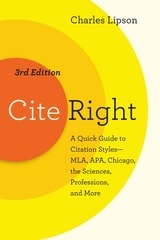
Cite Right, Third Edition
A Quick Guide to Citation Styles--MLA, APA, Chicago, the Sciences, Professions, and MoreCharles Lipson
University of Chicago Press, 2018
Cite Right is the perfect guide for anyone who needs to learn a new citation style or who needs an easy reference to Chicago, MLA, APA, AMA, and other styles. Each chapter serves as a quick guide that introduces the basics of a style, explains who might use it, and then presents an abundance of examples. This edition includes updates reflecting the most recent editions of The Chicago Manual of Style and the MLA Handbook. With this book, students and researchers can move smoothly among styles with the confidence they are getting it right.
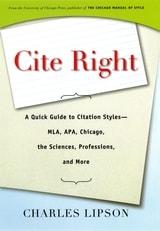
Cite Right
A Quick Guide to Citation Styles--MLA, APA, Chicago, the Sciences, Professions, and MoreCharles Lipson
University of Chicago Press, 2006
In his bestselling guide, Doing Honest Work in College: How to Prepare Citations, Avoid Plagiarism, and Achieve Real Academic Success, veteran teacher Charles Lipson brought welcome clarity to the principles of academic honesty as well as to the often murky issues surrounding plagiarism in the digital age. Thousands of students have turned to Lipson for no-nonsense advice on how to cite sources properly—and avoid plagiarism—when writing their research papers. With his latest book, Cite Right, Lipson once again provides much-needed counsel in a concise and affordable handbook for students and researchers. Building on Doing Honest Work in College, Lipson’s new book offers a wealth of information on an even greater range of citation styles and details the intricacies of many additional kinds of sources.
Lipson’s introductory essay, “Why Cite,” explains the reasons it is so important to use citations—and to present them accurately—in research writing. In subsequent chapters, Lipson explains the main citation styles students and researchers are likely to encounter in their academic work: Chicago; MLA; APA; CSE (biological sciences); AMA (medical sciences); ACS (chemistry, mathematics, and computer science); physics, astrophysics, and astronomy; Bluebook and ALWD (law); and AAA (anthropology and ethnography). His discussions of these styles are presented simply and clearly with examples drawn from a wide range of source types crossing all disciplines, from the arts and humanities to science, law, and medicine.
Based on deep experience in the academic trenches, Cite Right is an accessible, one-stop resource—a must-have guide for students and researchers alike who need to prepare citations in any of the major disciplines and professional studies.
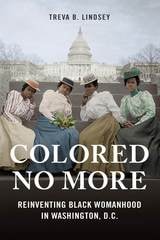
Colored No More
Reinventing Black Womanhood in Washington, D.C.Treva B. Lindsey
University of Illinois Press, 2017
Treva B. Lindsey presents New Negro womanhood as a multidimensional space that included race women, blues women, mothers, white collar professionals, beauticians, fortune tellers, sex workers, same-gender couples, artists, activists, and innovators. Drawing from these differing but interconnected African American women's spaces, Lindsey excavates a multifaceted urban and cultural history of struggle toward a vision of equality that could emerge and sustain itself. Upward mobility to equal citizenship for African American women encompassed challenging racial, gender, class, and sexuality status quos. Lindsey maps the intersection of these challenges and their place at the core of New Negro womanhood.

Constables, Marshals, and More
Forgotten Offices in Texas Law EnforcementLorie Rubenser
University of North Texas Press, 2011
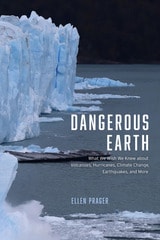
Dangerous Earth
What We Wish We Knew about Volcanoes, Hurricanes, Climate Change, Earthquakes, and MoreEllen Prager
University of Chicago Press, 2020
Today, we know more than ever before about the powerful forces that can cause catastrophe, but significant questions remain. Why can’t we better predict some natural disasters? What do scientists know about them already? What do they wish they knew? In Dangerous Earth, marine scientist and science communicator Ellen Prager explores the science of investigating volcanoes, earthquakes, tsunamis, hurricanes, landslides, rip currents, and—maybe the most perilous hazard of all—climate change. Each chapter considers a specific hazard, begins with a game-changing historical event (like the 1980 eruption of Mt. St. Helens or the landfall and impacts of Hurricane Harvey), and highlights what remains unknown about these dynamic phenomena. Along the way, we hear from scientists trying to read Earth’s warning signs, pass its messages along to the rest of us, and prevent catastrophic loss.
A sweeping tour of some of the most awesome forces on our planet—many tragic, yet nonetheless awe-inspiring—Dangerous Earth is an illuminating journey through the undiscovered, unresolved, and in some cases unimagined mysteries that continue to frustrate and fascinate the world’s leading scientists: the “wish-we-knews” that ignite both our curiosity and global change.
Exotic No More, Second Edition
Anthropology for the Contemporary WorldEdited by Jeremy MacClancy
University of Chicago Press, 2019
Contributors:Ruben Andersson, Philippe Bourgois, Catherine Buerger, James G. Carrier, Marcus Colchester, James Fairhead, Kim Fortun, Mike Fortun, Katy Gardner, Faye Ginsburg, Roberto J. González, Tom Griffiths, Chris Hann, Susan Harding, Faye V. Harrison, Laurie Kain Hart, Richard Jenkins, George Karandinos, Christopher M. Kelty, Melissa Leach, Margaret Lock, Jeremy MacClancy, Sally Engle Merry, Fernando Montero, Matt Sakakeeny, Anthony Alan Shelton, Christopher B. Steiner, Richard Ashby Wilson
Exotic No More
Anthropology on the Front LinesEdited by Jeremy MacClancy
University of Chicago Press, 2002
In Exotic No More, an initiative of the Royal Anthropological Institute, some of today's most respected anthropologists demonstrate, in clear, unpretentious prose, the tremendous contributions that anthropology can make to contemporary society. They cover issues ranging from fundamentalism to forced migration, child labor to crack dealing, human rights to hunger, ethnicity to environmentalism, intellectual property rights to international capitalisms. But Exotic No More is more than a litany of gloom and doom; the essays also explore topics usually associated with leisure or "high" culture, including the media, visual arts, tourism, and music. Each author uses specific examples from their fieldwork to illustrate their discussions, and 62 photographs enliven the text.
Throughout the book, the contributors highlight anthropology's commitment to taking people seriously on their own terms, paying close attention to what they are saying and doing, and trying to understand how they see the world and why. Sometimes this bottom-up perspective makes the strange familiar, but it can also make the familiar strange, exposing the cultural basis of seemingly "natural" behaviors and challenging us to rethink some of our most cherished ideas—about gender, "free" markets, "race," and "refugees," among many others.
Contributors:
William O. Beeman
Philippe Bourgois
John Chernoff
E. Valentine Daniel
Alex de Waal
Judith Ennew
James Fairhead
Sarah Franklin
Michael Gilsenan
Faye Ginsburg
Alma Gottlieb
Christopher Hann
Faye V. Harrison
Richard Jenkins
Melissa Leach
Margaret Lock
Jeremy MacClancy
Jonathan Mazower
Ellen Messer
A. David Napier
Nancy Scheper-Hughes
Jane Schneider
Parker Shipton
Christopher B. Steiner
Human No More
Digital Subjectivities, Unhuman Subjects, and the End of AnthropologyNeil L. Whitehead
University Press of Colorado, 2012
Online worlds have recently thrown into question the traditional anthropological conception of place-based ethnography. They break definitions, blur distinctions, and force us to rethink the notion of the "subject." Human No More asks how digital cultures can be integrated and how the ethnography of both the "unhuman" and the "digital" could lead to possible reconfiguring the notion of the "human."
This provocative and groundbreaking work challenges fundamental assumptions about the entire field of anthropology. Cross-disciplinary research from well-respected contributors makes this volume vital to the understanding of contemporary human interaction. It will be of interest not only to anthropologists but also to students and scholars of media, communication, popular culture, identity, and technology.
Ignoring Nature No More
The Case for Compassionate ConservationEdited by Marc Bekoff
University of Chicago Press, 2013
This collection of diverse essays is the first book devoted to compassionate conservation, a growing global movement that translates discussions and concerns about the well-being of individuals, species, populations, and ecosystems into action. Written by leading scholars in a host of disciplines, including biology, psychology, sociology, social work, economics, political science, and philosophy, as well as by locals doing fieldwork in their own countries, the essays combine the most creative aspects of the current science of animal conservation with analyses of important psychological and sociocultural issues that encourage or vex stewardship. The contributors tackle topics including the costs and benefits of conservation, behavioral biology, media coverage of animal welfare, conservation psychology, and scales of conservation from the local to the global. Taken together, the essays make a strong case for why we must replace our habits of domination and exploitation with compassionate conservation if we are to make the world a better place for nonhuman and human animals alike.

Inside Pitch and More
Baseball's Business and the Public TrustGENE A. BUDIG
West Virginia University Press, 2004
The Inside Pitch and More: Baseball’s Business and the Public Trust, written by former American League President Gene Budig, investigates the human and corporate sides of our nation’s pastime. Throughout the course of this book, the author systematically engages the myriad concerns of Major League Baseball, past, present, and future.
In The Inside Pitch and More, baseball’s economic prosperity is examined, as well as issues that hinder and threaten that perpetuity. Lately, baseball has been increasingly menaced by the popularity of other athletic venues - basketball, football, etc. Budig goes through the proposed methods of revitalizing the game of baseball. He emphasizes the need for a reevaluation of the relationship between the sport and its fan base so that the baseball will resume its role as America’s favorite pastime.
Based on his six years as president of the American League, Budig has composed a fascinating book, which is written to be enjoyed by the casual baseball fan as well as the serious student of this sport or sports management in general. The book is unique in that it is the first work to really dissect the sport of baseball by a retired high-ranking official with a wealth of information on the subject.
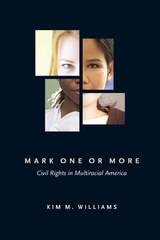
Mark One or More
Civil Rights in Multiracial AmericaKim M. Williams
University of Michigan Press, 2010
The movement to add a multiracial category to the 2000 U.S. Census provoked unprecedented debates about race. The effort made for strange bedfellows. Republicans like House Speaker Newt Gingrich and affirmative action opponent Ward Connerly took up the multiracial cause. Civil rights leaders opposed the movement on the premise that it had the potential to dilute the census count of traditional minority groups. The activists themselves—a loose confederation of organizations, many led by the white mothers of interracial children—wanted recognition. What they got was the transformation of racial politics in America.
Mark One or More is the compelling account of how this small movement sparked a big change, and a moving call to reassess the meaning of racial identity in American life.
Kim M. Williams is Associate Professor of Public Policy in Harvard's Kennedy School of Government, and an expert in racial and ethnic politics and political movements.
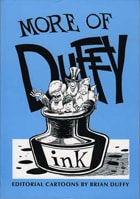
More of Duffy
Editorial Cartoons by Brian DuffyDuffy, Brian
University of Iowa Press, 1995

More on Humanism, Volume 14
Elizabeth Weed and Ellen Rooney, eds.
Duke University Press, 0
More or Less Afraid of Nearly Everything
Homeland Security, Borders, and Disasters in the Twenty-First CenturyBenjamin Rohrbaugh
University of Michigan Press, 2020
Throughout the twentieth century, the United States did not experience national security domestically; it defended its borders by conducting military, foreign policy, and intelligence operations internationally, and then separated these activities from domestic law enforcement with bright legal lines. In the twenty-first century, U.S. national security no longer occurs exclusively outside of the nation. The U.S. government is beginning to respond to this change, and the establishment of the Department of Homeland Security is merely the first step in an organizational and strategic realignment that will be a long, difficult, and mistake-filled process. More or Less Afraid of Nearly Everything is an accessible and engaging guide to homeland security, particularly migration and border security, that makes innovative arguments about the American government and keeping citizens safe, and provides practical solutions to real-world problems.
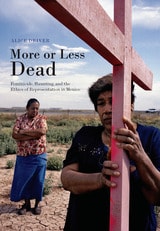
More or Less Dead
Feminicide, Haunting, and the Ethics of Representation in MexicoAlice Driver
University of Arizona Press, 2015
More or Less Dead analyzes how such violence against women has been represented in news media, books, films, photography, and art. Alice Driver argues that the various cultural reports often express anxiety or criticism about how women traverse and inhabit the geography of Ciudad Juárez and further the idea of the public female body as hypersexualized. Rather than searching for justice, the various media—art, photography, and even graffiti—often reuse victimized bodies in sensationalist, attention-grabbing ways. In order to counteract such views, local activists mark the city with graffiti and memorials that create a living memory of the violence and try to humanize the victims of these crimes.
The phrase “more or less dead” was coined by Chilean author Roberto Bolaño in his novel 2666, a penetrating fictional study of Juárez. Driver explains that victims are “more or less dead” because their bodies are never found or aren’t properly identified, leaving families with an uncertainty lasting for decades—or forever.
The author’s clear, precise journalistic style tackles the ethics of representing feminicide victims in Ciudad Juárez. Making a distinction between the words “femicide” (the murder of girls or women) and “feminicide” (murder as a gender-driven event), one of her interviewees says, “Women are killed for being women, and they are victims of masculine violence because they are women. It is a crime of hate against the female gender. These are crimes of power.”
Move, Play, Learn
Interactive Storytimes With Music, Movement, And MoreAlyssa Jewell
American Library Association, 2020
Foreword by Jamie Campbell Naidoo
Get ready to break out of your storytime routine by encouraging children’s natural instincts to move, sing, and play! Unlike traditional storytimes, where children are expected to sit quietly and just watch, music and movement storytimes encourage children to learn by getting inside stories while interacting with others. Research shows that this kind of play stimulates the senses, provides connections to all four lobes of the brain, touches on a variety of intelligences, and heightens social and emotional awareness—all while extending the early literacy practices of Every Child Ready to Read® and preparing children for school. And because there are no crafts to cut out, no snacks to pack, no scripts to memorize, and no story kits to make, it’s one of the simplest, most cost-effective storytime models to implement. Jewell’s complete guide shows the way, offering
- 20 ready-to-use storytime plans tailored to specific age groups, including babies, toddlers, preschool and all-ages programs, a real time-saver for storytime organizers and presenters;
- advice and best practices gleaned from interviews with professionals who specialize in storytimes, music making with children and families, yoga storytime, and drama education; and
- lists of recommended resources, from interactive print books to children’s music and videos available digitally, with tips on choosing the best materials.
Muchachas No More
Household Workers in Latin America and the CaribbeanElsa Chaney
Temple University Press, 1991
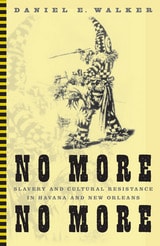
No More, No More
Slavery And Cultural Resistance In Havana And New OrleansDaniel E. Walker
University of Minnesota Press, 2004
An illuminating look at the festival performances of slaves in Havana and New Orleans
However urban slave societies might have differed from their rural counterparts, they still relied on a concerted assault on the psychological, social, and cultural identity of their African-descended inhabitants to maintain power and control. This ambitious book looks at how people of African descent in two such societies—Havana and New Orleans in the nineteenth century—created and maintained their own forms of cultural resistance to the slave regime’s assault and, in the process, put forth autonomous views of self and the social landscape.
In Havana’s annual Día de Reyes festival and in the weekly activities that took place at New Orleans’s Congo Square, author Daniel Walker identifies specific cultural beliefs and activities that Africans brought to the New World and modified in order to withstand and contest the dehumanizing effects of oppression. No More, No More crosses disciplinary boundaries as well, elucidating the economic, social, cultural, and demographic operations at work in two cities and the wide-scale efforts at cultural resistance embodied in public performances.
Open And Equitable Scholarly Communication Creating A More
Nancy Maron
Assoc of College & Research Libraries, 2019
Post-Racial No More
Race, Realities, and Resources of Ethnic Minority Families: Groves Monographs on Marriage and Family (Volume 7)Helyne Frederick
Michigan Publishing Services, 2022
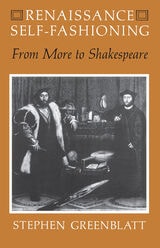
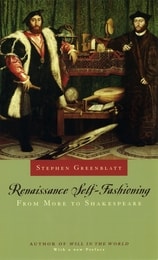
Renaissance Self-Fashioning
From More to ShakespeareStephen Greenblatt
University of Chicago Press, 1983
"No one who has read [Greenblatt's] accounts of More, Tyndale, Wyatt, and others can fail to be moved, as well as enlightened, by an interpretive mode which is as humane and sympathetic as it is analytical. These portraits are poignantly, subtly, and minutely rendered in a beautifully lucid prose alive in every sentence to the ambivalences and complexities of its subjects."—Harry Berger Jr., University of California, Santa Cruz
Renaissance Self-Fashioning
From More to ShakespeareStephen Greenblatt
University of Chicago Press, 2005
"No one who has read [Greenblatt's] accounts of More, Tyndale, Wyatt, and others can fail to be moved, as well as enlightened, by an interpretive mode which is as humane and sympathetic as it is analytical. These portraits are poignantly, subtly, and minutely rendered in a beautifully lucid prose alive in every sentence to the ambivalences and complexities of its subjects."—Harry Berger Jr., University of California, Santa Cruz
Saying I No More
Subjectivity and Consciousness in the Prose of Samuel BeckettDaniel Katz
Northwestern University Press, 1999
Separate Spheres No More
Gender Convergence in American Literature, 1830-1930Monika Elbert
University of Alabama Press, 2000
Examines the intersection of male and female spheres in American literature
Although they wrote in the same historical milieu as their male counterparts, women writers of the 19th- and early 20th-centuries have generally been "ghettoized" by critics into a separate canonical sphere. These original essays argue in favor of reconciling male and female writers, both historically and in the context of classroom teaching.
While some of the essays pair up female and male authors who write in a similar style or with similar concerns, others address social issues shared by both men and women, including class tensions, economic problems, and the Civil War experience. Rather than privileging particular genres or certain well-known writers, the contributors examine writings ranging from novels and poetry to autobiography, utopian fiction, and essays. And they consider familiar figures like Harriet Beecher Stowe, Emily Dickinson, and Ralph Waldo Emerson alongside such lesser-known writers as Melusina Fay Peirce, Susie King Taylor, and Mary Gove Nichols.
Each essay revises the binary notions that have been ascribed to males and females, such as public and private, rational and intuitive, political and domestic, violent and passive. Although they do not deny the existence of separate spheres, the contributors show the boundary between them to be much more blurred than has been assumed until now.
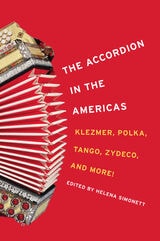
The Accordion in the Americas
Klezmer, Polka, Tango, Zydeco, and More!Edited by Helena Simonett
University of Illinois Press, 2012
This rich collection considers the accordion and its myriad forms, from the concertina, button accordion, and piano accordion familiar in European and North American music to the exotic-sounding South American bandoneon and the sanfoninha. Capturing the instrument's spread and adaptation to many different cultures in North and South America, contributors illuminate how the accordion factored into power struggles over aesthetic values between elites and working-class people who often were members of immigrant and/or marginalized ethnic communities. Specific histories and cultural contexts discussed include the accordion in Brazil, Argentine tango, accordion traditions in Colombia and the Dominican Republic, cross-border accordion culture between Mexico and Texas, Cajun and Creole identity, working-class culture near Lake Superior, the virtuoso Italian-American and Klezmer accordions, Native American dance music, and American avant-garde.
Contributors are María Susana Azzi, Egberto Bermúdez, Mark DeWitt, Joshua Horowitz, Sydney Hutchinson, Marion Jacobson, James P. Leary, Megwen Loveless, Richard March, Cathy Ragland, Helena Simonett, Jared Snyder, Janet L. Sturman, and Christine F. Zinni.

The Ecological Web
More on the Distribution and Abundance of AnimalsH. G. Andrewartha and L. C. Birch
University of Chicago Press, 1984
"The Ecological Web presents an entirely fresh look at ecology from the autecological perspective, and is a worthy successor to the authors' classic work, The Distribution and Abundance of Animals. The work is original—indeed unique—and the detailed coverage of case histories is unprecedented. The point of view will be controversial, but every ecologist will be impressed with the competence and completeness with which the arguments are mustered. A 'must' for every ecologist and environmental scientist."—Paul R. Ehrlich
"This book is the naturalist's vision of population ecology. The authors do not intend a formal description of the environment, but are seeking a way of functional analysis, a workable framework of theory within which to ask questions that will help us understand the distribution and abundance of animals in natural populations. The Ecological Web should be studied carefully by every population ecologist and should take a prominent place in the teaching of ecology. It marks a very significant period in our science as we change from one paradigm to another."—P. J. den Boer
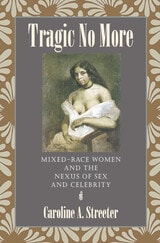
Tragic No More
Mixed-Race Women and the Nexus of Sex and CelebrityCaroline A. Streeter
University of Massachusetts Press, 2012
Streeter's subjects include concert pianist Philippa Schuyler, Dorothy West's novel The Wedding (in print and on screen), Danzy Senna's novels Caucasia and Symptomatic, and celebrity performing artists Mariah Carey, Alicia Keys, and Halle Berry. She opens with a chapter that examines the layered media response to Essie Mae Washington-Williams, Senator Strom Thurmond's biracial daughter. Throughout the book, Streeter engages the work of feminist critics and others who have written on interracial sexuality and marriage, biracial identity, the multiracial movement, and mixed race in cultural studies.

War No More
Eliminating Conflict in the Nuclear AgeRobert Hinde and Joseph Rotblat
Pluto Press, 2003
Written by Nobel Peace prize winner and former nuclear physicist Joseph Rotblat, who was involved in the creation of the first atom bomb, and biologist/ psychologist Robert Hinde, War No More provides expert insight into the nature of modern warfare - including weapons of mass destruction. Examining the key factors that contribute to conflict, the authors explain how best to approach a peaceful future.
If war is ever to be eliminated, we must address key issues such as the gap between rich and poor; have fully effective arms controls, and above all we must have better education. The authors emphasise the United Nations - as well as NGOs, religious groups, and grassroots movements - also have important parts to play.
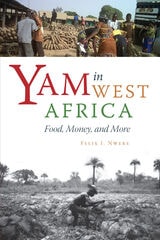
Yam in West Africa
Food, Money, and MoreFelix I. Nweke
Michigan State University Press, 2015
Yam production is concentrated in West Africa, which is responsible for more than 90 percent of the 50 million tons produced annually around the globe. Though the crop can attract high prices, too often its producers live in penury. Regional issues drive up labor costs of food crops because of dependence on obsolete technology. In addition, certain agronomic practices that are peculiar to yam production remain unchanged, and pests and diseases still ravage the crop. Yam in West Africa investigates solutions to these problems with the aim of expanding yam production, increasing sales, helping farmers, and bringing more of this staple food to those who need it. The future of the yam is bright; this book aims to make it more so.