344 books match the query 'Nationalism' and 8 start with h

cover of Hegel on Political Identity: Patriotism, Nationality, Cosmopolitanism

Hegel on Political Identity

Patriotism, Nationality, Cosmopolitanism

Lydia L. Moland

Northwestern University Press, 2012

In Hegel on Political Identity, Lydia Moland provocatively draws on Hegel's political philosophy to engage sometimes contentious contemporary issues such as patriotism, national identity, and cosmopolitanism. Moland argues that patriotism for Hegel indicates an attitude toward the state, whereas national identity is a response to culture. The two combine, Hegel claims, to enable citizens to develop concrete freedom. Moland argues that Hegel's account of political identity extends to his notorious theory of world history; she also proposes that his resistance to cosmopolitanism be reassessed in response to our globalized world. By focusing on Hegel's depiction of political identity as a central part of modern life, Moland shows the potential of Hegel's philosophy to address issues that lie at the heart of ethical and political philosophy.
[more]
cover of Hemispheric Imaginings: The Monroe Doctrine and Narratives of U.S. Empire

Hemispheric Imaginings

The Monroe Doctrine and Narratives of U.S. Empire

Gretchen Murphy

Duke University Press, 2005

In 1823, President James Monroe announced that the Western Hemisphere was closed to any future European colonization and that the United States would protect the Americas as a space destined for democracy. Over the next century, these ideas—which came to be known as the Monroe Doctrine—provided the framework through which Americans understood and articulated their military and diplomatic role in the world. Hemispheric Imaginings demonstrates that North Americans conceived and developed the Monroe Doctrine in relation to transatlantic literary narratives. Gretchen Murphy argues that fiction and journalism were crucial to popularizing and making sense of the Doctrine’s contradictions, including the fact that it both drove and concealed U.S. imperialism. Presenting fiction and popular journalism as key arenas in which such inconsistencies were challenged or obscured, Murphy highlights the major role writers played in shaping conceptions of the U.S. empire.

Murphy juxtaposes close readings of novels with analyses of nonfiction texts. From uncovering the literary inspirations for the Monroe Doctrine itself to tracing visions of hemispheric unity and transatlantic separation in novels by Lydia Maria Child, Nathaniel Hawthorne, María Amparo Ruiz de Burton, Lew Wallace, and Richard Harding Davis, she reveals the Doctrine’s forgotten cultural history. In making a vital contribution to the effort to move American Studies beyond its limited focus on the United States, Murphy questions recent proposals to reframe the discipline in hemispheric terms. She warns that to do so risks replicating the Monroe Doctrine’s proprietary claim to isolate the Americas from the rest of the world.
[more]
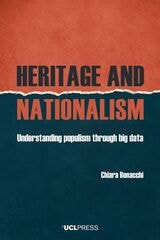
cover of Heritage and Nationalism: Understanding Populism through Big Data

Heritage and Nationalism

Understanding Populism through Big Data

Chiara Bonacchi

University College London, 2021

An empirically grounded analysis of the repurposing of ancient and medieval European history in digital-age populism.

How was the Roman Empire invoked in Brexit Britain and in the United States during  Donald Trump’s presidency, and to what purpose? And why is it critical to answer these kinds of questions? Heritage and Nationalism explores how people’s perceptions and experiences of the ancient past shape political identities in the digital age. It examines the multiple ways in which politicians, parties, and private citizens mobilize aspects of the Iron Age, Roman, and Medieval past of Britain and Europe to include or exclude others based on culture, religion, class, race, and ethnicity.
 
The book uses quantitative and qualitative methods to investigate how premodern periods are leveraged to support or oppose populist-nationalist arguments as part of social media discussions concerning Brexit, the Italian Election of 2018, and the US-Mexican border debate in the United States. Analyzing millions of tweets and Facebook posts, comments, and replies, this book is the first to use big data to answer questions about public engagement with the past and identity politics. The findings and conclusions revise and reframe the meaning of populist nationalism today and help to build a shared basis for the democratic engagement of citizens in public life in the future. The book offers a fascinating and unmissable read for anyone interested in how the past and its contemporary legacy, or heritage, influence our political thinking and feeling in a time of hyper-connectivity.

[more]
cover of Heroes and Villains: Creating National History in Contemporary Ukraine

Heroes and Villains

Creating National History in Contemporary Ukraine

David R. Marples

Central European University Press, 2007
Certain to engender debate in the media, especially in Ukraine itself, as well as the academic community. Using a wide selection of newspapers, journals, monographs, and school textbooks from different regions of the country, the book examines the sensitive issue of the changing perspectives – often shifting 180 degrees – on several events discussed in the new narratives of the Stalin years published in the Ukraine since the late Gorbachev period until 2005. These events were pivotal to Ukrainian history in the 20th century, including the Famine of 1932–33 and Ukrainian insurgency during the war years.
[more]
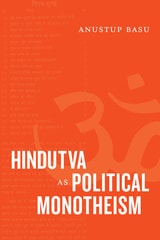
cover of Hindutva as Political Monotheism

Hindutva as Political Monotheism

Anustup Basu

Duke University Press, 2020

In Hindutva as Political Monotheism, Anustup Basu offers a genealogical study of Hindutva—Hindu right-wing nationalism—to illustrate the significance of Western anthropology and political theory to the idea of India as a Hindu nation. Connecting Nazi jurist Carl Schmitt's notion of political theology to traditional theorems of Hindu sovereignty and nationhood, Basu demonstrates how Western and Indian theorists subsumed a vast array of polytheistic, pantheistic, and henotheistic cults featuring millions of gods into a singular edifice of faith. Basu exposes the purported “Hindu Nation” as itself an orientalist vision by analyzing three crucial moments: European anthropologists’ and Indian intellectuals’ invention of a unified Hinduism during the long nineteenth century; Indian ideologues’ adoption of ethnoreligious nationalism in pursuit of a single Hindu way of life in the twentieth century; and the transformations of this project in the era of finance capital, Bollywood, and new media. Arguing that Hindutva aligns with Enlightenment notions of nationalism, Basu foregrounds its significance not just to Narendra Modi's right-wing, anti-Muslim government but also to mainstream Indian nationalism and its credo of secularism and tolerance.
[more]
cover of Historic Preservation: Collective Memory and Historic Identity

Historic Preservation

Collective Memory and Historic Identity

Barthel, Diane

Rutgers University Press, 1996
Historic preservation is a cultural movement gaining momentum and adherents throughout Europe and the United States. How do we decide what to preserve and how to preserve? Who benefits from the efforts of preservationists, curators, developers, and other "symbolic bankers" to safeguard an increasing variety of structures for future generations? Diane Barthel raises these and other questions in this important new book. Taking a comparative approach, Barthel finds that preservation in Britain has largely been an elite enterprise aimed at preserving traditional values. In the United States, by contrast, the pattern is much more dynamic and democratic, though also more permeated by commercialism. Is preservation becoming another means of consuming history, like media representations or "historic" shopping outlets? Or does it have a special significance as a very tangible means of getting in touch with our collective and individual pasts? These and other issues--including war and remembrance, agrarian and industrial preservation, and religious preservation in a secular society--demonstrate the significance of what Barthel calls "the Preservation Project" and why we all have a stake in how our history is reconstructed and interpreted.
[more]
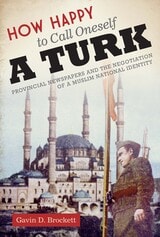
cover of How Happy to Call Oneself a Turk: Provincial Newspapers and the Negotiation of a Muslim National Identity

How Happy to Call Oneself a Turk

Provincial Newspapers and the Negotiation of a Muslim National Identity

By Gavin D. Brockett

University of Texas Press, 2011

The modern nation-state of Turkey was established in 1923, but when and how did its citizens begin to identify themselves as Turks? Mustafa Kemal Atatürk, Turkey's founding president, is almost universally credited with creating a Turkish national identity through his revolutionary program to "secularize" the former heartland of the Ottoman Empire. Yet, despite Turkey's status as the lone secular state in the Muslim Middle East, religion remains a powerful force in Turkish society, and the country today is governed by a democratically elected political party with a distinctly religious (Islamist) orientation.

In this history, Gavin D. Brockett takes a fresh look at the formation of Turkish national identity, focusing on the relationship between Islam and nationalism and the process through which a "religious national identity" emerged. Challenging the orthodoxy that Atatürk and the political elite imposed a sense of national identity from the top down, Brockett examines the social and political debates in provincial newspapers from around the country. He shows that the unprecedented expansion of print media in Turkey between 1945 and 1954, which followed the end of strict, single-party authoritarian government, created a forum in which ordinary people could inject popular religious identities into the new Turkish nationalism. Brockett makes a convincing case that it was this fruitful negotiation between secular nationalism and Islam—rather than the imposition of secularism alone—that created the modern Turkish national identity.
[more]
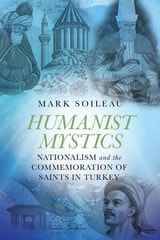
cover of Humanist Mystics: Nationalism and the Commemoration of Saints in Turkey

Humanist Mystics

Nationalism and the Commemoration of Saints in Turkey

Mark Soileau

University of Utah Press, 2018

When the Ottoman Empire met its demise in the early twentieth century, the new Republic of Turkey closed down the Sufi orders, rationalizing that they were antimodern. Yet the nascent nation, faced with defining its cultural heritage, soon began to promote the legacies of three Sufi saints: Mevlana Celaleddin Rumi, Hacı Bektaş Veli, and Yunus Emre. Their Turkish ethnicity, along with universalist themes found in their poetry and legends—of love, peace, fellowship, and tolerance—became the focus of their commemoration. With this reinterpretation of their characters—part of a broader secularist project—these saints came to be considered the great Turkish humanists. Their veneration came to play an important role in the nationalist formulation of Turkish culture, but the universalism of their humanism has exposed fissures in society over the place of religion in the nation.
 
Humanist Mystics is the first book to examine Islam and secularism within Turkish nationalist ideology through the lens of commemorated saints. Soileau surveys Anatolian and Turkish religious and political history as the context for his closer attention to the lives and influence of these three Sufi saints. By comparing premodern hagiographic and scholarly representations with twentieth-century monographs, literary works, artistic media, and commemorative ceremonies, he shows how the saints have been transformed into humanist mystics and how this change has led to debates about their character and relevance.
[more]