Results by title
754 books match the query 'Native American Studies' and 27 start with h

Han
People of the RiverCraig Mishler
University of Alaska Press, 2004
The history of the upper Yukon valley from the earliest Western contact with the Han in the 1840s has been one of continuous change. As a result of the gold rush, the Han suddenly became homeless in their own homeland. This book tells the story of that displacement and of current efforts by the Han to reclaim their lands and restore a vibrant way of life. In-depth profiles of Chief Isaac, Chief Charley, and others illustrate the critical importance of traditional leadership in stressful times.
Mishler and Simeone have carefully researched and compiled new information from historic records, adding their own, firsthand field observations and oral interviews with Elders during the 1970s, 1980s, and 1990s. They present detailed historical data on the fur trade, missionization, and the gold rush, as well as an analysis of Han social structure, settlement patterns, religion, subsistence, and expressive culture. The final chapter illustrates contemporary life in Eagle Village with two vivid ethnographic snapshots- a Christmas eve dance in 1972 and a long summer day in 1997. Appendices include a methodological essay, a historic chronology, rules for Han card games, and genealogies for many Han families. As a model of innovative ethnographic and ethnohistorical work, Han, People of the River makes an important contribution to anthropological and indigenous studies literature. As a vivid and deeply thoughtful depiction of the past, present, and future of the Han, it is meant for all Alaskans and everyone who cares about Alaska history and Alaska Native peoples.
Hand Trembling, Frenzy Witchcraft, and Moth Madness
A Study of Navajo Seizure DisordersJerrold E. Levy
University of Arizona Press, 1987
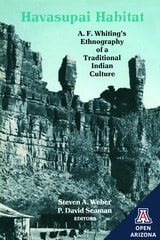
Havasupai Habitat
A. F. Whiting's Ethnography of a Traditional Indian CultureA. F. Whiting; Edited by Steven A. Weber and P. David Seaman
University of Arizona Press, 1985
Published in 1985, Havasupai Habitat offers a rich ethnography on lifeways of the Havasupai people.
Havasupai Legends
Religion and Mythology of the Havasupai Indians of the Grand CanyonRobert C Euler
University of Utah Press, 1994
Written in consultation with some of the last Havasupai shamans, this book details their religious beliefs, customs, and healing practices. A second section presents legends of the Havasupai origin, the first people, and tales of Coyote, Gila Monster, Bear, and others.

Hawai'i Is My Haven
Race and Indigeneity in the Black PacificNitasha Tamar Sharma
Duke University Press, 2021
Hawaiian Blood
Colonialism and the Politics of Sovereignty and IndigeneityJ. Kauanui Kahaulani
Duke University Press, 2008
Kauanui provides an impassioned assessment of how the arbitrary correlation of ancestry and race imposed by the U.S. government on the indigenous people of Hawai‘i has had far-reaching legal and cultural effects. With the HHCA, the federal government explicitly limited the number of Hawaiians included in land provisions, and it recast Hawaiians’ land claims in terms of colonial welfare rather than collective entitlement. Moreover, the exclusionary logic of blood quantum has profoundly affected cultural definitions of indigeneity by undermining more inclusive Kanaka Maoli notions of kinship and belonging. Kauanui also addresses the ongoing significance of the 50-percent rule: Its criteria underlie recent court decisions that have subverted the Hawaiian sovereignty movement and brought to the fore charged questions about who counts as Hawaiian.
Heartbeat of the People
Music and Dance of the Northern Pow-wowTara Browner
University of Illinois Press, 2002
Hidden Thunder
Rock Art of the Upper MidwestGeri Schrab
Wisconsin Historical Society Press, 2016
In Hidden Thunder, renowned watercolor artist Geri Schrab and archaeologist Robert "Ernie" Boszhardt give readers an up-close-and-personal look at rock art. With an eye toward preservation, Schrab and Boszhardt take you with them as they research, document, and interpret at the ancient petroglyphs and pictographs made my Native Americans in past millennia. In addition to publicly accessible sites such as Wisconsin’s Roche-a-Cri State Park and Minnesota’s Jeffers Petroglyphs, Hidden Thunder covers the artistic treasures found at several remote and inaccessible rock art sites—revealing the ancient stories through words, full-color photographs, and artistic renditions.
Offering the duo perspectives of scientist and artist, Boszhardt shares the facts that archaeologists have been able to establish about these important artifacts of our early history, while Schrab offers the artist's experience, describing her emotional and creative response upon encountering and painting these sites. Viewpoints by members of the Menominee, Ho-Chunk, Ojibwe, and other Native nations offer additional insight on the historic and cultural significance of these sites. Together these myriad voices reveal layers of meaning and cultural context that emphasize why these fragile resources—often marred by human graffiti and mishandling or damage from the elements—need to be preserved.

High Stakes
Florida Seminole Gaming and SovereigntyJessica R. Cattelino
Duke University Press, 2008
Cattelino presents a vivid ethnographic account of the history and consequences of Seminole gaming. Drawing on research conducted with tribal permission, she describes casino operations, chronicles the everyday life and history of the Seminole Tribe, and shares the insights of individual Seminoles. At the same time, she unravels the complex connections among cultural difference, economic power, and political rights. Through analyses of Seminole housing, museum and language programs, legal disputes, and everyday activities, she shows how Seminoles use gaming revenue to enact their sovereignty. They do so in part, she argues, through relations of interdependency with others. High Stakes compels rethinking of the conditions of indigeneity, the power of money, and the meaning of sovereignty.
Hinterland Households
Rural Agrarian Household Diversity in Northwest HondurasJohn G. Douglass
University Press of Colorado, 2002
Historic Native Peoples of Texas
By William C. Foster
University of Texas Press, 2008
Several hundred tribes of Native Americans were living within or hunting and trading across the present-day borders of Texas when Cabeza de Vaca and his shipwrecked companions washed up on a Gulf Coast beach in 1528. Over the next two centuries, as Spanish and French expeditions explored the state, they recorded detailed information about the locations and lifeways of Texas's Native peoples. Using recent translations of these expedition diaries and journals, along with discoveries from ongoing archaeological investigations, William C. Foster here assembles the most complete account ever published of Texas's Native peoples during the early historic period (AD 1528 to 1722).
Foster describes the historic Native peoples of Texas by geographic regions. His chronological narrative records the interactions of Native groups with European explorers and with Native trading partners across a wide network that extended into Louisiana, the Great Plains, New Mexico, and northern Mexico. Foster provides extensive ethnohistorical information about Texas's Native peoples, as well as data on the various regions' animals, plants, and climate. Accompanying each regional account is an annotated list of named Indian tribes in that region and maps that show tribal territories and European expedition routes.
This authoritative overview of Texas's historic Native peoples reveals that these groups were far more cosmopolitan than previously known. Functioning as the central link in the continent-wide circulation of trade goods and cultural elements such as religion, architecture, and lithic technology, Texas's historic Native peoples played a crucial role in connecting the Native peoples of North America from the Pacific Coast to the Southeast woodlands.

Histories of Race and Racism
The Andes and Mesoamerica from Colonial Times to the PresentLaura Gotkowitz, ed.
Duke University Press, 2012
Contributors
Rossana Barragán
Kathryn Burns
Andrés Calla
Pamela Calla
Rudi Colloredo-Mansfeld
María Elena García
Laura Gotkowitz
Charles R. Hale
Brooke Larson
Claudio Lomnitz
José Antonio Lucero
Florencia E. Mallon
Khantuta Muruchi
Deborah Poole
Seemin Qayum
Arturo Taracena Arriola
Sinclair Thomson
Esteban Ticona Alejo
History Is in the Land
Multivocal Tribal Traditions in Arizona's San Pedro ValleyT. J. Ferguson and Chip Colwell-Chanthaphonh
University of Arizona Press, 2006
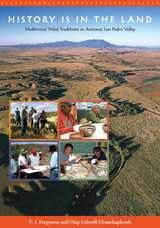
Previous research in the San Pedro Valley has focused on scientific archaeology and documentary history, with a conspicuous absence of indigenous voices, yet Native Americans maintain oral traditions that provide an anthropological context for interpreting the history and archaeology of the valley. The San Pedro Ethnohistory Project was designed to redress this situation by visiting archaeological sites, studying museum collections, and interviewing tribal members to collect traditional histories. The information it gathered is arrayed in this book along with archaeological and documentary data to interpret the histories of Native American occupation of the San Pedro Valley.
This work provides an example of the kind of interdisciplinary and politically conscious work made possible when Native Americans and archaeologists collaborate to study the past. As a methodological case study, it clearly articulates how scholars can work with Native American stakeholders to move beyond confrontations over who “owns” the past, yielding a more nuanced, multilayered, and relevant archaeology.
Hobomok and Other Writings on Indians
Karcher, Carolyn L
Rutgers University Press, 1986
Holy Wind in Navajo Philosophy
James Kale McNeley
University of Arizona Press, 1981
"An admirable volume . . . it illustrates how much we can learn about the importance of poetry as a fundamental activity by investigating the traditions of what should be acknowledged as the New World's unique classical past." —New Scholar
"This book is a fascinating analysis of what obviously is a central dimension in the traditional Navajo awareness of life." —New Mexico Historical Review
Home Before the Raven Caws
Richard Feldman
Indiana Historical Society Press, 2012
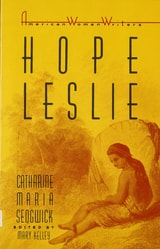
Hope Leslie
Or, Early Times in the MassachusettsSedgwick, Catherine M
Rutgers University Press, 1987
Hope Leslie (1827), set in the seventeenth-century New England, is a novel that forced readers to confront the consequences of the Puritans’ subjugation and displacement of the indigenous Indian population at a time when contemporaries were demanding still more land from the Cherokees, the Chickasaws, and the Choctaws.
"This handsome reprint ... makes available after many decades the New Englander's tale of seventeeth-century Puritans, and their relations with the indigenous Indian population." -- Nineteeth-Century Literature
" A splendidly conceived edition of Sedwick's historical romance. Highly recommended." --Choice
"Develop(s) the connections between patriarchal authority within the Puritan state and its policy of dispossessing and exterminating Indians. The different heritage it envisions explicitly link white women and Indians and elaborates a communal concept of liberty at odds with the individualistic concept which predominated in American culture." -- Legacy
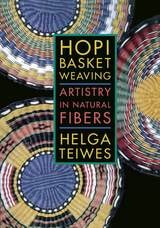
Hopi Basket Weaving
Artistry in Natural FibersHelga Teiwes
University of Arizona Press, 1996
Rising dramatically from the desert floor, Arizona's windswept mesas have been home to the Hopis for hundreds of years. A people known for protecting their privacy, these Native Americans also have a long and less known tradition of weaving baskets and plaques. Generations of Hopi weavers have passed down knowledge of techniques and materials from the plant world around them, from mother to daughter, granddaughter, or niece.
This book is filled with photographs and detailed descriptions of their beautiful baskets—the one art, above all others, that creates the strongest social bonds in Hopi life. In these pages, weavers open their lives to the outside world as a means of sharing an art form especially demanding of time and talent. The reader learns how plant materials are gathered in canyons and creek bottoms, close to home and far away. The long, painstaking process of preparation and dying is followed step by step. Then, using techniques of coiled, plaited, or wicker basketry, the weaving begins.
Underlying the stories of baskets and their weavers is a rare glimpse of what is called "the Hopi Way," a life philosophy that has strengthened and sustained the Hopi people through centuries of change. Many other glimpses of the Hopi world are also shared by author and photographer Helga Teiwes, who was warmly invited into the homes of her collaborators. Their permission and the permission of the Cultural Preservation Office of the Hopi Tribe gave her access to people and information seldom available to outsiders.
Teiwes was also granted access to some of the ceremonial observances where baskets are preeminent. Woven in brilliant reds, greens, and yellows as well as black and white, Hopi weavings, then, not only are an arresting art form but also are highly symbolic of what is most important in Hopi life. In the women's basket dance, for example, woven plaques commemorate and honor the Earth and the perpetuation of life. Other plaques play a role in the complicated web of Hopi social obligation and reciprocity.
Living in a landscape of almost surreal form and color, Hopi weavers are carrying on one of the oldest arts traditions in the world. Their stories in Hopi Basket Weaving will appeal to collectors, artists and craftspeople, and anyone with an interest in Native American studies, especially Native American arts. For the traveler or general reader, the book is an invitation to enter a little-known world and to learn more about an art form steeped in meaning and stunning in its beauty.
Hopi Cookery
Juanita Tiger Kavena
University of Arizona Press, 1980
Hopis and the Counterculture
Traditionalism, Appropriation, and the Birth of a Social FieldBrian D. Haley
University of Arizona Press, 2024
Exploring the new social field that developed to spread these ideas, Hopis and the Counterculture meticulously traces the trajectories of figures such as Ammon Hennacy, Craig Carpenter, Frank Waters, and the Firesign Theatre, among others. Drawing on insights into the interplay between primitivism, radicalism, stereotyping, and identity, Haley expands on concepts from scholars such as Roy Harvey Pearce’s notion of “isolated radicals” and Jonathan Friedman’s observations regarding the ascendancy of primitivism amid global crises. Haley scrutinizes the roles played by non-Hopi actors and the timing behind the widespread popularization of Hopi religious practices.
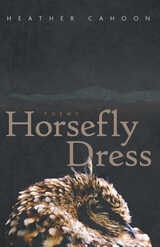
Horsefly Dress
PoemsHeather Cahoon
University of Arizona Press, 2020
Horsefly Dress is a meditation on the experience and beauty of suffering, questioning its triggers and ultimate purpose through the lens of historical and contemporary interactions and complications of Séliš, Qĺispé, and Christian beliefs. Heather Cahoon’s collection explores dark truths about the world through first-person experiences, as well as the experiences of her family and larger tribal community. As a member of the Confederated Salish and Kootenai Tribes, Cahoon crafts poems that recount traditional stories and confront Coyote’s transformation of the world, including his decision to leave certain evils present, such as cruelty, greed, hunger, and death.
By weaving together stories of Cahoon’s family and tribal community with those of Coyote and his family, especially Coyote’s daughter, Horsefly Dress, the interactions and shared experiences show the continued relevance of traditional Séliš and Qĺispé culture to contemporary life. Rich in the imagery of autumnal foliage, migrating birds, and frozen landscapes, Horsefly Dress calls forth the sensory experience of grief and transformation. As the stories and poems reveal, the transformative powers associated with the human experience of loss belong to the past, present, and future, as do the traditional Salish-Pend d’Oreille stories that create the backbone of this intricate collection.
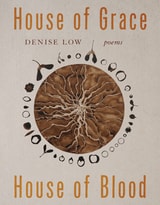
House of Grace, House of Blood
PoemsDenise Low
University of Arizona Press, 2024
In a personal poetic treatment of documents, oral tradition, and images, the author embodies the contradictions she unravels. From a haunting first-person perspective, Low’s formally inventive archival poetry combines prose and lyric, interweaving verse with historical voices in a dialogue with the source material. Each poem builds into a larger narrative on American genocide, the ways in which human loss corresponds to ecological destruction, and how intimate knowledge of the past can enact healing.
Ultimately, these poems not only reconstruct an important historical event, but they also put pressure on the gaps, silences, and violence of the archive. Low asks readers to question not only what is remembered, but how history is remembered—and who is forgotten from it. Reflecting on the injustice of the massacre, the Shawnee leader Tecumseh lamented that though “the Americans murdered all the men, women, and children, even as they prayed to Jesus . . . no American ever was punished, not one.” These poems challenge this attempted erasure.
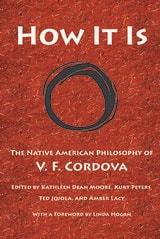
How It Is
The Native American Philosophy of V. F. CordovaV. F. Cordova; Edited by Kathleen Dean Moore, Kurt Peters, Ted Jojola, and Amber Lacy, with a Foreword by Linda Hogan
University of Arizona Press, 2007
In three parts, Cordova sets out a complete Native American philosophy. First she explains her own understanding of the nature of reality itself—the origins of the world, the relation of matter and spirit, the nature of time, and the roles of culture and language in understanding all of these. She then turns to our role as residents of the Earth, arguing that we become human as we deepen our relation to our people and to our places, and as we understand the responsibilities that grow from those relationships. In the final section, she calls for a new reverence in a world where there is no distinction between the sacred and the mundane.
Cordova clearly contrasts Native American beliefs with the traditions of the Enlightenment and Christianized Europeans (what she calls “Euroman” philosophy). By doing so, she leads her readers into a deeper understanding of both traditions and encourages us to question any view that claims a singular truth. From these essays—which are lucid, insightful, frequently funny, and occasionally angry—we receive a powerful new vision of how we can live with respect, reciprocity, and joy.
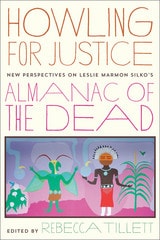
Howling for Justice
New Perspectives on Leslie Marmon Silko’s Almanac of the DeadEdited by Rebecca Tillett
University of Arizona Press, 2014
Howling for Justice actively engages with both the literary achievements and the politics of Silko’s text. It brings together essays by international scholars reacting to the novel while keeping in mind its larger concern with issues of social justice, both local and transnational. Aiming both to refocus critical attention and open the book to a broader array of readers, this collection offers fresh perspectives on its transnational vision, on its sociocultural, historical, and political ambitions, and on its continued relevance in the twenty-first century. The essays examine and explain some of the key points that readers and critics have identified as confusing, problematic, and divisive. Together, they offer new ways to approach and appreciate the text.
The book concludes with a new, never-before-published interview in which Silko reflects on the twenty years since the novel’s publication and relates the concerns of Almanac to her current work.
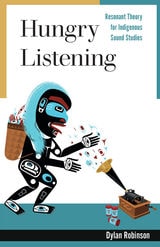
Hungry Listening
Resonant Theory for Indigenous Sound StudiesDylan Robinson
University of Minnesota Press, 2020
WInner of the Best First Book from the Native American and Indigenous Studies Association
Winner of the Labriola Center American Indian National Book Award
Winner of the Ann Saddlemyer Award from the Canadian Association for Theatre Research
Reimagining how we understand and write about the Indigenous listening experience
Hungry Listening is the first book to consider listening from both Indigenous and settler colonial perspectives. A critical response to what has been called the “whiteness of sound studies,” Dylan Robinson evaluates how decolonial practices of listening emerge from increasing awareness of our listening positionality. This, he argues, involves identifying habits of settler colonial perception and contending with settler colonialism’s “tin ear” that renders silent the epistemic foundations of Indigenous song as history, law, and medicine.
With case studies on Indigenous participation in classical music, musicals, and popular music, Hungry Listening examines structures of inclusion that reinforce Western musical values. Alongside this inquiry on the unmarked terms of inclusion in performing arts organizations and compositional practice, Hungry Listening offers examples of “doing sovereignty” in Indigenous performance art, museum exhibition, and gatherings that support an Indigenous listening resurgence.
Throughout the book, Robinson shows how decolonial and resurgent forms of listening might be affirmed by writing otherwise about musical experience. Through event scores, dialogic improvisation, and forms of poetic response and refusal, he demands a reorientation toward the act of reading as a way of listening. Indigenous relationships to the life of song are here sustained in writing that finds resonance in the intersubjective experience between listener, sound, and space.
Hunters of the Northern Forest
Designs for Survival among the Alaskan KutchinRichard K. Nelson
University of Chicago Press, 1986
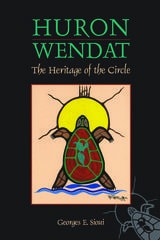
Huron Wendat
The Heritage of the CircleGeorges E. Sioui
Michigan State University Press, 1999
Wendat, or Wyandot, was the name that the five confederated nations of Wendake gave to Huronia, the Ontario territory described by the French in the 1600s. In this book, Georges Sioui, himself a Wendat, tells the history of his people by describing their social ideas and philosophy and their relevance to contemporary life. Sioui argues that for human beings there is only one way of looking at life on earth, and that is as a sacred circle of relationships among all beings. Sioui reviews the Wendats' Creation mythology and explains their origins, migrations, theology, ethics, philosophy, oral literature, and sociology, and their role in Amerindian geopolitics. He then examines archaeology and its role in bridging the gap created by negative perceptions. Finally, he describes Wendat society from an Amerindian viewpoint, concentrating on the period from 1615 to 1650 and drawing on traditional ethnographic documentation.