Results by title
72 books match the query 'Nature conservation' and 3 start with h
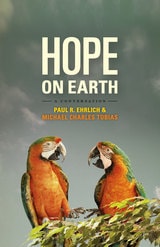
Hope on Earth
A ConversationPaul R. Ehrlich and Michael Charles Tobias
University of Chicago Press, 2014
Hope on Earth is the thought-provoking result of a lively and wide-ranging conversation between two of the world’s leading interdisciplinary environmental scientists: Paul R. Ehrlich, whose book The Population Bomb shook the world in 1968 (and continues to shake it), and Michael Charles Tobias, whose over 40 books and 150 films have been read and/or viewed throughout the world. Hope on Earth offers a rare opportunity to listen in as these deeply knowledgeable and highly creative thinkers offer their takes on the most pressing environmental concerns of the moment.
Both Ehrlich and Tobias argue that we are on the verge of environmental catastrophe, as the human population continues to grow without restraint and without significant attempts to deal with overconsumption and the vast depletion of resources and climate problems it creates. Though their views are sympathetic, they differ in their approach and in some key moral stances, giving rise to a heated and engaging dialogue that opens up dozens of new avenues of exploration. They both believe that the impact of a human society on its environment is the direct result of its population size, and through their dialogue they break down the complex social problems that are wrapped up in this idea and attempts to overcome it, hitting firmly upon many controversial topics such as circumcision, religion, reproduction, abortion, animal rights, diet, and gun control. For Ehrlich and Tobias, ethics involve not only how we treat other people directly, but how we treat them and other organisms indirectly through our effects on the environment. University of California, Berkeley professor John Harte joins the duo for part of the conversation, and his substantial expertise on energy and climate change adds a crucial perspective to the discussion of the impact of population on global warming.
This engaging and timely book invites readers into an intimate conversation with some of the most eminent voices in science as they offer a powerful and approachable argument that the ethical and scientific issues involved in solving our environmental crisis are deeply intertwined, while offering us an optimistic way forward. Hope on Earth is indeed a conversation we should all be having.
[more]
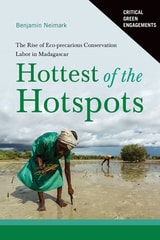
Hottest of the Hotspots
The Rise of Eco-precarious Conservation Labor in MadagascarBenjamin Neimark
University of Arizona Press, 2023
Continually recognized as one of the “hottest” of all the world’s biodiversity hotspots, the island of Madagascar has become ground zero for the most intensive market-based conservation interventions on Earth.
This book details the rollout of market conservation programs, including the finding of drugs from nature—or “bioprospecting”—biodiversity offsetting, and the selling of blue carbon credits from mangroves. It documents the tensions that exist at the local level, as many of these programs incorporate populations highly dependent on the same biodiversity now turned into global commodities for purposes of saving it. Proponents of market conservation mobilize groups of ecologically precarious workers, or the local “eco-precariat,” who do the hidden work of collecting and counting species, monitoring and enforcing the vital biodiversity used in everything from drug discovery to carbon sequestration and large mining company offsets.
Providing a voice for those community workers many times left out of environmental policy discussions, this volume proposes critiques that aim to build better conservation interventions with perspectives of the local eco-precariat.
[more]
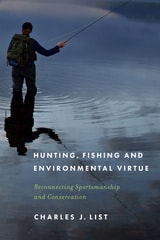
Hunting, Fishing, and Environmental Virtue
Reconnecting Sportsmanship and ConservationCharles J. List
Oregon State University Press, 2013
Do hunting and fishing lead to the development of environmental virtues? This question is at the heart of philosopher Charles List’s engaging study, which provides a defense of field sports when they are practiced and understood in an ethical manner.
In his argument, List examines the connection between certain activities and the development of virtue in the classical sources, such as Aristotle and Plato. He then explores the work of Aldo Leopold, identifying three key environmental virtues that field sports instill in practitioners in the kind of conservation advocated by Leopold and others.
After reviewing several powerful philosophical objections to his viewpoint, List considers the future of environmental sportsmanship. He suggests that, in order to incorporate a revived connection between field sports and environmental virtue, the practice of hunting and angling must undergo changes, including shifts that would impact hunter education, civic engagement, the role of firearms, our understanding of “game” animals, and alliances with other sorts of outdoor recreation.
Hunting, Fishing, and Environmental Virtue will appeal to academics interested in the ethical issues surrounding hunting and fishing, professionals in wildlife management, and hunters and anglers interested in conservation.
[more]