Results by title
65 books match the query 'Oral tradition' and 5 start with h
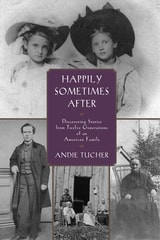
Happily Sometimes After
Discovering Stories from Twelve Generations of an American FamilyAndie Tucher
University of Massachusetts Press, 2014
A 2015 CHOICE Outstanding Academic Title
For more than four hundred years, members of the author's family have been telling stories about their American lives. They have told of impassioned elopements and heart-breaking kidnaps, of hairbreadth escapes and shocking murders, of bigamists, changelings, patriots, Indians, fires, floods, and how the great-grandmother of Chief Justice John Marshall married the pirate Blackbeard by mistake.
In this beautifully written work, Andie Tucher considers family stories as another way to look at history, neither from the top down nor the bottom up but from the inside out. She explores not just what happened—everywhere from Jamestown to Boonesborough, from the bloody field at Chickamauga to the metropolis of the Gilded Age—but also what the storytellers thought or wished or hoped or feared happened. She offers insights into what they valued, what they lost, how they judged their own lives and found meaning in them. The narrative touches on sorrow, recompense, love, pain, and the persistent tension between hope and disappointment in a nation that by making the pursuit of happiness thinkable also made unhappiness regrettable.
Based on extensive research in archives, local history societies, and family-history sources as well as conversations and correspondence, Happily Sometimes After offers an intimate and unusual perspective on how ordinary people used stories to imagine the world they wished for, and what those stories reveal about their relationships with the world they actually had.
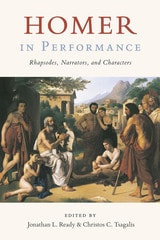
Homer in Performance
Rhapsodes, Narrators, and CharactersEdited by Jonathan L. Ready and Christos C. Tsagalis
University of Texas Press, 2018
Before they were written down, the poems attributed to Homer were performed orally, usually by rhapsodes (singers/reciters) who might have traveled from city to city or enjoyed a position in a wealthy household. Even after the Iliad and the Odyssey were committed to writing, rhapsodes performed the poems at festivals, often competing against each other. As they recited the epics, the rhapsodes spoke as both the narrator and the characters. These different acts—performing the poem and narrating and speaking in character within it—are seldom studied in tandem. Homer in Performance breaks new ground by bringing together all of the speakers involved in the performance of Homeric poetry: rhapsodes, narrators, and characters.
The first part of the book presents a detailed history of the rhapsodic performance of Homeric epic from the Archaic to the Roman Imperial periods and explores how performers might have shaped the poems. The second part investigates the Homeric narrators and characters as speakers and illuminates their interactions. The contributors include scholars versed in epigraphy, the history of art, linguistics, and performance studies, as well as those capable of working with sources from the ancient Near East and from modern Russia. This interdisciplinary approach makes the volume useful to a spectrum of readers, from undergraduates to veteran professors, in disciplines ranging from classical studies to folklore.
Homeric Questions
By Gregory Nagy
University of Texas Press, 1996
A Choice Outstanding Academic Book
The "Homeric Question" has vexed Classicists for generations. Was the author of the Iliad and the Odyssey a single individual who created the poems at a particular moment in history? Or does the name "Homer" hide the shaping influence of the epic tradition during a long period of oral composition and transmission?
In this innovative investigation, Gregory Nagy applies the insights of comparative linguistics and anthropology to offer a new historical model for understanding how, when, where, and why the Iliad and the Odyssey were ultimately preserved as written texts that could be handed down over two millennia. His model draws on the comparative evidence provided by living oral epic traditions, in which each performance of a song often involves a recomposition of the narrative.
This evidence suggests that the written texts emerged from an evolutionary process in which composition, performance, and diffusion interacted to create the epics we know as the Iliad and the Odyssey. Sure to challenge orthodox views and provoke lively debate, Nagy's book will be essential reading for all students of oral traditions.
Homeric Responses
By Gregory Nagy
University of Texas Press, 2003
The Homeric Iliad and Odyssey are among the world's foremost epics. Yet, millennia after their composition, basic questions remain about them. Who was Homer—a real or an ideal poet? When were the poems composed—at a single point in time, or over centuries of composition and performance? And how were the poems committed to writing? These uncertainties have been known as The Homeric Question, and many scholars, including Gregory Nagy, have sought to solve it.
In Homeric Responses, Nagy presents a series of essays that further elaborate his theories regarding the oral composition and evolution of the Homeric epics. Building on his previous work in Homeric Questions and Poetry as Performance: Homer and Beyond and responding to some of his critics, he examines such issues as the importance of performance and the interaction between audience and poet in shaping the poetry; the role of the rhapsode (the performer of the poems) in the composition and transmission of the poetry; the "irreversible mistakes" and cross-references in the Iliad and Odyssey as evidences of artistic creativity; and the Iliadic description of the shield of Achilles as a pointer to the world outside the poem, the polis of the audience.
Hopi Oral Tradition and the Archaeology of Identity
Wesley Bernardini
University of Arizona Press, 2005
Wesley Bernardini now draws on an unconventional source, Hopi traditional knowledge, to show how hypotheses that are developed from oral tradition can stimulate new and productive ways to think about the archaeological record. Focusing on insights that oral tradition has to offer about general processes of prehistoric migration and identity formation, he describes how each Hopi clan acquired its particular identity from the experiences it accumulated on its unique migration pathway. This pattern of “serial migration” by small social groups often saw the formation of villages by clans that briefly came together and then moved off again independently, producing considerable social diversity both within and among villages.
Using Anderson Mesa and Homol’ovi as case studies, Bernardini presents architectural and demographic data suggesting that the fourteenth century occupation of these regions was characterized by population flux and diversity consistent with the serial migration model. He offers an analysis of rock art motifs—focusing on those used as clan symbols—to evaluate the diversity of group identities, then presents a compositional analysis of Jeddito Yellow Ware pottery to evaluate the diversity of these groups’ eventual migration destinations.
Evidence supporting serial migration greatly complicates existing notions of links between ancient and modern social groups, with important implications for the implementation of the Native American Graves Protection and Repatriation Act. Bernardini’s work clearly demonstrates that studies of cultural affiliation must take into account the fluid nature of population movements and identity in the prehistoric landscape. It takes a decisive step toward better understanding the major demographic change that occurred on the Colorado Plateau from 1275 to 1400 and presents a strategy for improving the reconstruction of cultural identity in the past.