Results by title
87 books match the query 'Political Freedom' and 5 start with h

Hamas
A Beginner's GuideKhaled Hroub
Pluto Press, 2010
This beginner's guide to Hamas has been fully revised and updated. It now covers all the major events since the January 2006 elections, including the conflict with Fatah and Israel's brutal offensive in Gaza at the end of 2008.
Explaining the reasons for Hamas's popularity, leading Al-Jazeera journalist and Cambridge academic Khaled Hroub provides the key facts that are so often missing from conventional news reports. It's a one-stop guide that gives a clear overview of Hamas's history, key beliefs, and its political agenda.
This unique book provides a refreshing perspective that gets to the heart of Hamas.
Hannah Arendt
A Critical IntroductionFinn Bowring
Pluto Press, 2011
Hannah Arendt is one of the most famous political theorists of the twentieth century, yet in the social sciences her work has rarely been given the attention it deserves. This careful and comprehensive study introduces Arendt to a wider audience.
Finn Bowring shows how Arendt's writings have engaged with and influenced prominent figures in the sociological canon, and how her ideas may shed light on some of the most pressing social and political problems of today. He explores her critique of Marx, her relationship to Weber, the influence of her work on Habermas and the parallels and discrepancies between her and Foucault. This is a clearly written and scholarly text which surveys the leading debates over Arendt’s work, including discussions of totalitarianism, the public sphere and the nature of political responsibility.
This book will bring new perspectives to students and lecturers in sociology and politics.

Healing Our Divided Society
Investing in America Fifty Years after the Kerner ReportFred Harris and Alan Curtis
Temple University Press, 2018
In 1968, the Kerner Commission concluded that America was heading toward “two societies, one black, one white—separate and unequal.” Today, America’s communities are experiencing increasing racial tensions and inequality, working-class resentment over the unfulfilled American Dream, white supremacy violence, toxic inaction in Washington, and the decline of the nation’s example around the world.
In Healing Our Divided Society, Fred Harris, the last surviving member of the Kerner Commission, along with Eisenhower Foundation CEO Alan Curtis, re-examine fifty years later the work still necessary towards the goals set forth in The Kerner Report. This timely volume unites the interests of minorities and white working- and middle-class Americans to propose a strategy to reduce poverty, inequality, and racial injustice. Reflecting on America’s urban climate today, this new report sets forth evidence-based policies concerning employment, education, housing, neighborhood development, and criminal justice based on what has been proven to work—and not work.
Contributors include: Oscar Perry Abello, Elijah Anderson, Anil N.F. Aranha, Jared Bernstein, Henry G. Cisneros, Elliott Currie, Linda Darling-Hammond, Martha F. Davis, E. J. Dionne, Jr., Marian Wright Edelman, Delbert S. Elliott, Carol Emig, Jeff Faux, Ron Grzywinski, Michael P. Jeffries, Lamar K. Johnson, Celinda Lake, Marilyn Melkonian, Gary Orfield, Diane Ravitch, Laurie Robinson, Herbert C. Smitherman, Jr., Joseph Stiglitz, Dorothy Stoneman, Kevin Washburn, Valerie Wilson, Gary Younge, Julian E. Zelizer, and the editors
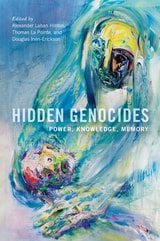
Hidden Genocides
Power, Knowledge, MemoryAlexander Laban Hinton, Thomas La Pointe, and Douglas Irvin-Erickson
Rutgers University Press, 2014
Why are some genocides prominently remembered while others are ignored, hidden, or denied? Consider the Turkish campaign denying the Armenian genocide, followed by the Armenian movement to recognize the violence. Similar movements are building to acknowledge other genocides that have long remained out of sight in the media, such as those against the Circassians, Greeks, Assyrians, the indigenous peoples in the Americas and Australia, and the violence that was the precursor to and the aftermath of the Holocaust.
The contributors to this collection look at these cases and others from a variety of perspectives. These essays cover the extent to which our biases, our ways of knowing, our patterns of definition, our assumptions about truth, and our processes of remembering and forgetting as well as the characteristics of generational transmission, the structures of power and state ideology, and diaspora have played a role in hiding some events and not others. Noteworthy among the collection’s coverage is whether the trade in African slaves was a form of genocide and a discussion not only of Hutus brutalizing Tutsi victims in Rwanda, but of the execution of moderate Hutus as well.
Hidden Genocides is a significant contribution in terms of both descriptive narratives and interpretations to the emerging subfield of critical genocide studies.
Contributors: Daniel Feierstein, Donna-Lee Frieze, Krista Hegburg, Alexander Laban Hinton, Adam Jones, A. Dirk Moses, Chris M. Nunpa, Walter Richmond, Hannibal Travis, and Elisa von Joeden-Forgey
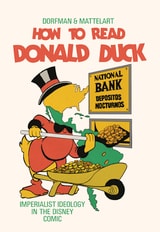
How to Read Donald Duck
Imperialist Ideology in the Disney ComicAriel Dorfman
Pluto Press, 2020
First published in 1971, How to Read Donald Duck shocked readers by revealing how capitalist ideology operates in our most beloved cartoons. Having survived bonfires, impounding and being dumped into the ocean by the Chilean army, this controversial book is once again back on our shelves.
Written and published during the blossoming of Salvador Allende's revolutionary socialism in Chile, the book examines how Disney products reflect capitalist ideology, and are active agents working in this ideology’s favor. Focusing on the hapless mice and ducks of Disney, curiously parentless, marginalized and always short of cash, Ariel Dorfman and Armand Mattelart expose how these characters established hegemonic ideas about capital, race, gender and the relationship between developed countries and the Third World.
A devastating indictment of a media giant, a document of twentieth-century political upheaval, and a reminder of the dark undercurrent of pop culture, How to Read Donald Duck is once again available, together with a new introduction by Ariel Dorfman in which he writes.
"It is that joy in liberation, that alegria, that spirit of resistance, that I wish to share with America, as the book that Pinochet’s soldiers could not liquidate or Disney’s lawyers stop from entering the United States finally finds its way to its new home, deep into the land that invented Donald Duck and Donald Trump. Is the same country that gave me such a warm welcome as a child, and perhaps may now equally greet with open arms this critique of oppression and it certainty that we don’t have to leave the world as it was when we first encountered it."