Results by title
753 books match the query 'Race' and 15 start with h

Hawai'i Is My Haven
Race and Indigeneity in the Black PacificNitasha Tamar Sharma
Duke University Press, 2021
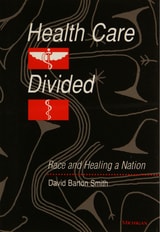
Health Care Divided
Race and Healing a NationDavid Barton Smith
University of Michigan Press, 1999
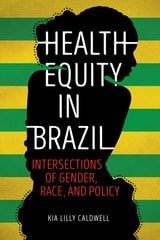
Health Equity in Brazil
Intersections of Gender, Race, and PolicyKia Lilly Caldwell
University of Illinois Press, 2017
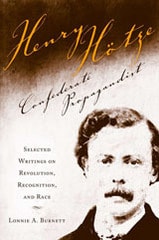
Henry Hotze, Confederate Propagandist
Selected Writings on Revolution, Recognition, and RaceLonnie A. Burnett
University of Alabama Press, 2008
Among the arguments Hotze employed were adaptations of the scientific racism of the period, which attempted to establish a rational basis for assumptions of racial difference. After the collapse of the Confederacy in 1865, Hötze remained in Europe, where he became an active partisan and promoter of the ideas of Arthur de Gobineau (1816–1882) whose work Essai sur L’inégalité des Races Humaines was a founding document in racism’s struggle for intellectual respectability.
This work consists of a biographical essay on Hotze; his contributions to Mobile newspapers during his military service in 1861; his correspondence with Confederate officials during his service in London; articles he published in London to influence British and European opinion; and his correspondence with, and published work in support of, Gobineau.
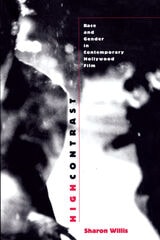
High Contrast
Race and Gender in Contemporary Hollywood FilmsSharon Willis
Duke University Press, 1997
Capturing the political complexity of these films, Willis argues that race, gender, and sexuality, as they are figured in the fantasy of popular film, do not function separately, but rather inform and determine each other’s meaning. She demonstrates how collective anxieties regarding social difference are mapped onto big budget movies like the Die Hard and Lethal Weapon series, Basic Instinct, Fatal Attraction, Thelma and Louise, Terminator 2, and others. Analyzing the artistic styles of directors Lynch, Tarantino, and Lee, in such films as Wild at Heart, Pulp Fiction, and Do the Right Thing, she investigates how these interactions of difference are linked to the production of specific authorial styles, and how race functions for each of these directors, particularly in relation to gender identity, erotics, and fantasy.
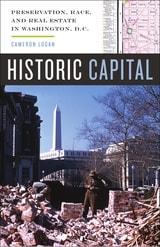
Historic Capital
Preservation, Race, and Real Estate in Washington, D.C.Cameron Logan
University of Minnesota Press, 2017
Washington, D.C. has long been known as a frustrating and sometimes confusing city for its residents to call home. The monumental core of federal office buildings, museums, and the National Mall dominates the city’s surrounding neighborhoods and urban fabric. For much of the postwar era, Washingtonians battled to make the city their own, fighting the federal government over the basic question of home rule, the right of the city’s residents to govern their local affairs.
In Historic Capital, urban historian Cameron Logan examines how the historic preservation movement played an integral role in Washingtonians’ claiming the city as their own. Going back to the earliest days of the local historic preservation movement in the 1920s, Logan shows how Washington, D.C.’s historic buildings and neighborhoods have been a site of contestation between local interests and the expansion of the federal government’s footprint. He carefully analyzes the long history of fights over the right to name and define historic districts in Georgetown, Dupont Circle, and Capitol Hill and documents a series of high-profile conflicts surrounding the fate of Lafayette Square, Rhodes Tavern, and Capitol Park, SW before discussing D.C. today.
Diving deep into the racial fault lines of D.C., Historic Capital also explores how the historic preservation movement affected poor and African American residents in Anacostia and the U Street and Shaw neighborhoods and changed the social and cultural fabric of the nation’s capital. Broadening his inquiry to the United States as a whole, Logan ultimately makes the provocative and compelling case that historic preservation has had as great an impact on the physical fabric of U.S. cities as any other private or public sector initiative in the twentieth century.
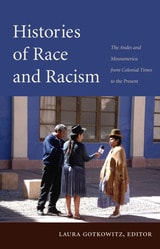
Histories of Race and Racism
The Andes and Mesoamerica from Colonial Times to the PresentLaura Gotkowitz, ed.
Duke University Press, 2012
Contributors
Rossana Barragán
Kathryn Burns
Andrés Calla
Pamela Calla
Rudi Colloredo-Mansfeld
María Elena García
Laura Gotkowitz
Charles R. Hale
Brooke Larson
Claudio Lomnitz
José Antonio Lucero
Florencia E. Mallon
Khantuta Muruchi
Deborah Poole
Seemin Qayum
Arturo Taracena Arriola
Sinclair Thomson
Esteban Ticona Alejo
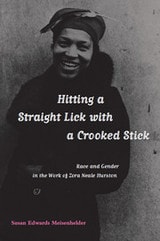
Hitting A Straight Lick with a Crooked Stick
Race and Gender in the Work of Zora Neale HurstonSusan E Meisenhelder
University of Alabama Press, 2001
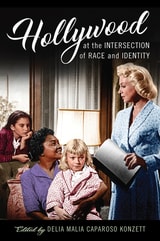
Hollywood at the Intersection of Race and Identity
Delia Malia Caparoso Konzett
Rutgers University Press, 2020
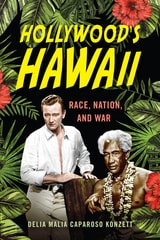
Hollywood's Hawaii
Race, Nation, and WarDelia Malia Caparoso Konzett
Rutgers University Press, 2017
Delia Malia Caparoso Konzett highlights films that mirror the cultural and political climate of the country over more than a century—from the era of U.S. imperialism on through Jim Crow racial segregation, the attack on Pearl Harbor and WWII, the civil rights movement, the contemporary articulation of consumer and leisure culture, as well as the buildup of the modern military industrial complex. Focusing on important cultural questions pertaining to race, nationhood, and war, Konzett offers a unique view of Hollywood film history produced about the national periphery for mainland U.S. audiences. Hollywood’s Hawaii presents a history of cinema that examines Hawaii and the Pacific and its representations in film in the context of colonialism, war, Orientalism, occupation, military buildup, and entertainment.
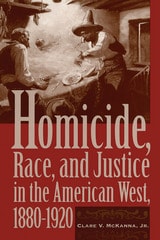
Homicide, Race, and Justice in the American West, 1880-1920
Clare V. McKanna
University of Arizona Press, 1997
This scenario dramatically brings home to the viewer what historians have long debated and hundreds of other films and books suggest: the turn-of-the-century West was a violent time and place. Ranchers, miners, deputy sheriffs, teenagers and old men, occasionally even housewives and mothers found themselves at the business end of a shotgun or a .38 revolver. Yet, since western historians tend to portray violence as essentially episodic--frontier gunfights, range wars, vigilante movements, and the like--solid data has been hard to come by.
As a beginning point for actually measuring lethal violence and assessing the administration of justice, here at last is a detailed and well-documented study of homicide in the American West. Comparing data from representative areas--Douglas County, Nebraska; Las Animas County, Colorado; and Gila County, Arizona--this book reveals a level of violence far greater than many historians have believed, even surpassing eastern cities like New York and Boston.
Clashing cultures and transient populations, a boomtown mentality, easy availability of alcohol and firearms: these and many other factors come under scrutiny as catalysts in the violence that permeated the region. By comparing homicide data, including coroner's inquests, indictments, plea bargains, and sentences across both racial and regional lines, the book also offers persuasive evidence that criminal justice systems of the Old West were weighted heavily in favor of defendants who were white and against those who were African American, Native American, or Mexican.
Packed with information, this is a book for students and scholars of western history, social history, criminology, and justice studies. Western history buffs will be captivated by colorful anecdotes about the real West, where guns could and did blaze over anything from love trysts to vendettas to too much foam on the beer. From whatever perspective, all readers are sure to find here a well-constructed framework for understanding the West as it was and for interpreting the region as it moves into the future.
Honor Bound
Race and Shame in AmericaLeverenz, David
Rutgers University Press, 2012
To make his argument, Leverenz casts an unusually wide net, from ancient and modern cultures of honor to social, political, and military history to American literature and popular culture.
He highlights the convergence of whiteness and honor in the United States from the antebellum period to the present. The Civil War, the civil rights movement, and the election of Barack Obama represent racial progress; the Tea Party movement represents the latest recoil.
From exploring African American narratives to examining a 2009 episode of Hardball—in which two white commentators restore their honor by mocking U.S. Attorney General Eric Holder after he called Americans “cowards” for not talking more about race—Leverenz illustrates how white honor has prompted racial shaming and humiliation. The United States became a nation-state in which light-skinned people declared themselves white. The fear masked by white honor surfaces in such classics of American literature as The Scarlet Letter and Adventures of Huckleberry Finn and in the U.S. wars against the Barbary pirates from 1783 to 1815 and the Iraqi insurgents from 2003 to the present. John McCain’s Faith of My Fathers is used to frame the 2008 presidential campaign as white honor’s last national stand.
Honor Bound concludes by probing the endless attempts in 2009 and 2010 to preserve white honor through racial shaming, from the “birthers” and Tea Party protests to Joe Wilson’s “You lie!” in Congress and the arrest of Henry Louis Gates Jr. at the front door of his own home. Leverenz is optimistic that, in the twenty-first century, racial shaming is itself becoming shameful.

Hope Draped in Black
Race, Melancholy, and the Agony of ProgressJoseph R. Winters
Duke University Press, 2016
Hormones, Heredity, and Race
Spectacular Failure in Interwar ViennaCheryl A. Logan
Rutgers University Press, 2013
Paul Kammerer had spent years gathering zoological evidence on whether environmental change could alter heredity, using his research as the scientific foundation for a new kind of eugenics—one that challenged the racism growing in mainstream eugenics. By 1918, he drew on the pioneering research of two colleagues who studied how secretions shaped sexual attributes to argue that hormones could alter genes. After 1920, Julius Tandler employed a similar concept to restore the health and well-being of Vienna's war-weary citizens. Both men rejected the rigidly acting genes of the new genetics and instead crafted a biology of flexible heredity to justify eugenic reforms that respected human rights. But the interplay of science and personality with the social and political rise of fascism and with antisemitism undermined their ideas, leading to their spectacular failure.

HumAnimal
Race, Law, LanguageKalpana Rahita Seshadri
University of Minnesota Press, 2012
HumAnimal explores the experience of dehumanization as the privation of speech. Taking up the figure of silence as the space between human and animal, it traces the potential for an alternate political and ethical way of life beyond law. Employing the resources offered by deconstruction as well as an ontological critique of biopower, Kalpana Rahita Seshadri suggests that humAnimal, as the site of impropriety opened by racism and manifested by silence, can be political and hazardous to power.
Through the lens of such works as Coetzee’s Foe, Chesnutt’s “The Dumb Witness,” Dr. Itard’s “wild child,” and aerialist Philippe Petit’s Man on Wire, Seshadri lucidly brings Derrida’s concept of the trace and his theory of sovereignty into conversation with Agamben’s investigation of the analytics of power. The task is twofold: on the one hand, to question the logocentric presumption that determines the separation between human and animal, and on the other to examine the conflation of this separation as an instrument of power in the practice of racism. Thus HumAnimal details the differences and intersections between Derrida and Agamben in their respective approaches to power, claiming that to think simultaneously within the registers of deconstruction (which conceives of power as a symptom of the metaphysics of presence) and biopolitics (which conceives of power as the operation of difference) entails a specification of the political and ethical consequences that attends the two perspectives.
When considered as the potential of language to refuse the law of signification and semantics, silence can neutralize the exercise of power through language, and Seshadri’s inquiry discloses a counterpower that does not so much oppose or destroy the politics of the subject but rather neutralizes it and renders it ineffective.