Results by title
50 books match the query 'Realism' and 2 start with h

Higher Ground
From Utopianism to Realism in American Feminist Thought and TheorySally L. Kitch
University of Chicago Press, 2000
Many feminists love a utopia—the idea of restarting humanity from scratch or transforming human nature in order to achieve a prescribed future based on feminist visions. Some scholars argue that feminist utopian fiction can be used as a template for creating such a future. However, Sally L. Kitch argues that associating feminist thought with utopianism is a mistake.
Drawing on the history of utopian thought, as well as on her own research on utopian communities, Kitch defines utopian thinking, explores the pitfalls of pursuing social change based on utopian ideas, and argues for a "higher ground" —a contrasting approach she calls realism. Replacing utopianism with realism helps to eliminate self-defeating notions in feminist theory, such as false generalization, idealization, and unnecessary dichotomies. Realistic thought, however, allows feminist theory to respond to changing circumstances, acknowledge sameness as well as difference, value the past and the present, and respect ideological give-and-take.
An important critique of feminist thought, Kitch concludes with a clear, exciting vision for a feminist future without utopia.
[more]
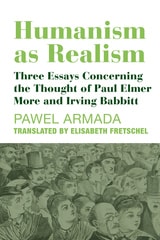
Humanism as Realism
Three Essays Concerning the Thought of Paul Elmer More and Irving BabbittLisa Fretschel
St. Augustine's Press, 2023
Originally published in Polish in 2019 by The Lethe Foundation, this book demonstrates the relevance and important of Paul Elmer More (1864–1937) and Irving Babbitt (1865–1933). Their collective legacy is one of responsible and truly thoughtful living. Their treatment of Humanists and their diagnosis of modernity is an important theme in this work, and the indication of the political consequences of humanism.
"This is a protreptic book. Its main goal is to encourage people to undertake independent studies or more generally, simply to think independently. If we want to think for ourselves, and not like preprogrammed humanoids, we can’t do so in a vacuum. We have to lean on something. In the Author’s view, the more than century-old writings of Paul Elmer More and Irving Babbitt are perfectly suited to the role of such a support for us, living in the here and now. They make it possible for us to dig ourselves out from underneath the heaps of opinions, “principles” or “theories” that allegedly can’t be rejected, that we’re obliged to follow, but that have a paralyzing and dumbing-down effect on us, making our lives from the
outset seems like the dream of a childish old man."
––Taken from the Preface by Pawel Armada
[more]