346 books match the query 'Relations' and 7 start with h
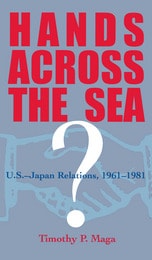
cover of Hands Across the Sea?: U.S.-Japan Relations, 1961–1981

Hands Across the Sea?

U.S.-Japan Relations, 1961–1981

Timothy P. Maga

Ohio University Press, 1997

In 1961, the U.S. economy and military remained unassailable in the eyes of the world. Within twenty years, America faced defeat in Vietnam and its economy had been shaken. Japan was now considered the great economic superpower, while the U.S. and Japan reversed roles as surplus and debtor nations. Hands across the Sea? examines this reversal of roles, determining how and why America and Japan became the post-World War II era’s most argumentative allies.

Through extensive research in a number of presidential libraries and author interviews with both American and Japanese policy-makers, Professor Maga finds a U.S.-Japan relationship forever troubled by cultural misunderstanding, America’s Cold War obsession, Japanese pride, and strangely conflicting goals in both trade and defense. Given the intensity of the arguments over some of these issues, it is remarkable that Washington and Tokyo continued a working dialogue during this critical time.

Hands across the Sea? represents the first in-depth study of the modern U.S.-Japan relationship. It especially discovers how serious the U.S.-Japan disagreements over trade, defense, the direction of the Cold War, nuclear policy, and the environment had become.

Whereas American observers of U.S.-Japan relations are quick to point out their fellow countrymen’s ignorance of other cultures and Japan’s brilliance in analyzing American policy and life, the evidence suggests otherwise. Steering far away from anyone’s political correctness, this book’s bottom line involves hard-hitting investigation and analysis.

[more]
cover of Hemispheric Imaginations: North American Fictions of Latin America

Hemispheric Imaginations

North American Fictions of Latin America

Helmbrecht Breinig

Dartmouth College Press, 2016
What image of Latin America have North American fiction writers created, found, or echoed, and how has the prevailing discourse about the region shaped their work? How have their writings contributed to the discursive construction of our southern neighbors, and how has the literature undermined this construction and added layers of complexity that subvert any approach based on stereotypes? Combining American Studies, Canadian Studies, Latin American Studies, and Cultural Theory, Breinig relies on long scholarly experience to answer these and other questions. Hemispheric Imaginations, an ambitious interdisciplinary study of literary representations of Latin America as encounters with the other, is among the most extensive such studies to date. It will appeal to a broad range of scholars of American Studies.
[more]
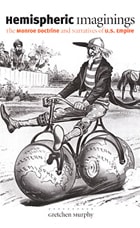
cover of Hemispheric Imaginings: The Monroe Doctrine and Narratives of U.S. Empire

Hemispheric Imaginings

The Monroe Doctrine and Narratives of U.S. Empire

Gretchen Murphy

Duke University Press, 2005

In 1823, President James Monroe announced that the Western Hemisphere was closed to any future European colonization and that the United States would protect the Americas as a space destined for democracy. Over the next century, these ideas—which came to be known as the Monroe Doctrine—provided the framework through which Americans understood and articulated their military and diplomatic role in the world. Hemispheric Imaginings demonstrates that North Americans conceived and developed the Monroe Doctrine in relation to transatlantic literary narratives. Gretchen Murphy argues that fiction and journalism were crucial to popularizing and making sense of the Doctrine’s contradictions, including the fact that it both drove and concealed U.S. imperialism. Presenting fiction and popular journalism as key arenas in which such inconsistencies were challenged or obscured, Murphy highlights the major role writers played in shaping conceptions of the U.S. empire.

Murphy juxtaposes close readings of novels with analyses of nonfiction texts. From uncovering the literary inspirations for the Monroe Doctrine itself to tracing visions of hemispheric unity and transatlantic separation in novels by Lydia Maria Child, Nathaniel Hawthorne, María Amparo Ruiz de Burton, Lew Wallace, and Richard Harding Davis, she reveals the Doctrine’s forgotten cultural history. In making a vital contribution to the effort to move American Studies beyond its limited focus on the United States, Murphy questions recent proposals to reframe the discipline in hemispheric terms. She warns that to do so risks replicating the Monroe Doctrine’s proprietary claim to isolate the Americas from the rest of the world.
[more]
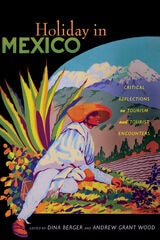
cover of Holiday in Mexico: Critical Reflections on Tourism and Tourist Encounters

Holiday in Mexico

Critical Reflections on Tourism and Tourist Encounters

Dina Berger and Andrew Grant Wood, eds.

Duke University Press, 2009

With its archaeological sites, colonial architecture, pristine beaches, and alluring cities, Mexico has long been an attractive destination for travelers. The tourist industry ranks third in contributions to Mexico’s gross domestic product and provides more than 5 percent of total employment nationwide. Holiday in Mexico takes a broad historical and geographical look at Mexico, covering tourist destinations from Tijuana to Acapulco and the development of tourism from the 1840s to the present day. Scholars in a variety of fields offer a complex and critical view of tourism in Mexico by examining its origins, promoters, and participants.

Essays feature research on prototourist American soldiers of the mid-nineteenth century, archaeologists who excavated Teotihuacán, business owners who marketed Carnival in Veracruz during the 1920s, American tourists in Mexico City who promoted goodwill during the Second World War, American retirees who settled San Miguel de Allende, restaurateurs who created an “authentic” cuisine of Central Mexico, indigenous market vendors of Oaxaca who shaped the local tourist identity, Mayan service workers who migrated to work in Cancun hotels, and local officials who vied to develop the next “it” spot in Tijuana and Cabo San Lucas. Including insightful studies on food, labor, art, diplomacy, business, and politics, this collection illuminates the many processes and individuals that constitute the tourism industry. Holiday in Mexico shows tourism to be a complicated set of interactions and outcomes that reveal much about the nature of economic, social, cultural, and environmental change in Greater Mexico over the past two centuries.

Contributors. Dina Berger, Andrea Boardman, Christina Bueno, M. Bianet Castellanos, Mary K. Coffey, Lisa Pinley Covert, Barbara Kastelein, Jeffrey Pilcher, Andrew Sackett, Alex Saragoza, Eric M. Schantz, Andrew Grant Wood
[more]
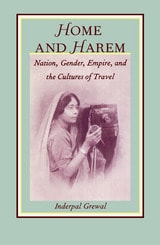
cover of Home and Harem: Nation, Gender, Empire and the Cultures of Travel

Home and Harem

Nation, Gender, Empire and the Cultures of Travel

Inderpal Grewal

Duke University Press, 1996

Moving across academic disciplines, geographical boundaries, and literary genres, Home and Harem examines how travel shaped ideas about culture and nation in nineteenth-century imperialist England and colonial India. Inderpal Grewal’s study of the narratives and discourses of travel reveals the ways in which the colonial encounter created linked yet distinct constructs of nation and gender and explores the impact of this encounter on both English and Indian men and women. Reworking colonial discourse studies to include both sides of the colonial divide, this work is also the first to discuss Indian women traveling West as well as English women touring the East.

In her look at England, Grewal draws on nineteenth-century aesthetics, landscape art, and debates about women’s suffrage and working-class education to show how all social classes, not only the privileged, were educated and influenced by imperialist travel narratives. By examining diverse forms of Indian travel to the West and its colonies and focusing on forms of modernity offered by colonial notions of travel, she explores how Indian men and women adopted and appropriated aspects of European travel discourse, particularly the set of oppositions between self and other, East and West, home and abroad.

Rather than being simply comparative, Home and Harem is a transnational cultural study of the interaction of ideas between two cultures. Addressing theoretical and methodological developments across a wide range of fields, this highly interdisciplinary work will interest scholars in the fields of postcolonial and cultural studies, feminist studies, English literature, South Asian studies, and comparative literature.


[more]
cover of Hotel Trópico: Brazil and the Challenge of African Decolonization, 1950–1980

Hotel Trópico

Brazil and the Challenge of African Decolonization, 1950–1980

Jerry Dávila

Duke University Press, 2010
In the wake of African decolonization, Brazil attempted to forge connections with newly independent countries. In the early 1960s it launched an effort to establish diplomatic ties with Africa; in the 1970s it undertook trade campaigns to open African markets to Brazilian technology. Hotel Trópico reveals the perceptions, particularly regarding race, of the diplomats and intellectuals who traveled to Africa on Brazil’s behalf. Jerry Dávila analyzes how their actions were shaped by ideas of Brazil as an emerging world power, ready to expand its sphere of influence; of Africa as the natural place to assert that influence, given its historical slave-trade ties to Brazil; and of twentieth-century Brazil as a “racial democracy,” a uniquely harmonious mix of races and cultures. While the experiences of Brazilian policymakers and diplomats in Africa reflected the logic of racial democracy, they also exposed ruptures in this interpretation of Brazilian identity. Did Brazil share a “lusotropical” identity with Portugal and its African colonies, so that it was bound to support Portuguese colonialism at the expense of Brazil’s ties with African nations? Or was Brazil a country of “Africans of every color,” compelled to support decolonization in its role as a natural leader in the South Atlantic? Drawing on interviews with retired Brazilian diplomats and intellectuals, Dávila shows the Brazilian belief in racial democracy to be about not only race but also Portuguese ethnicity.
[more]
cover of Hungarian Culture and Politics in the Habsburg Monarchy 1711-1848

Hungarian Culture and Politics in the Habsburg Monarchy 1711-1848

Gábor Vermes

Central European University Press, 2014

This book describes and analyzes the critical period of 1711-1848 within Hungary from novel points of view, including close analyses of the proceedings of Hungarian diets. Contrary to conventional interpretations, the study, stressing the strong continuity of traditionalism in Hungarian thought, society, and politics, argues that Hungarian liberalism did not begin to flower in any substantial way until the 1830s and 1840s. Hungarian Culture and Politics in the Habsburg Monarchy also traces and evaluates the complex relationship between Austria and Hungary over this span of time. Past interpretations have, with only a few exceptions, tilted heavily towards the Austrian role within the Monarchy, both because its center was in Vienna and because few non-Hungarian scholars can read Hungarian. This analysis redresses this balance through the use of both Austrian and Hungarian sources, demonstrating the deep cultural differences between the two halves of the Monarchy, which were nevertheless closely linked by economic and administrative ties and by a mutual recognition that co-existence was preferable to any major rupture.
[more]