Results by title
89 books match the query 'Religion & Science' and 5 start with h
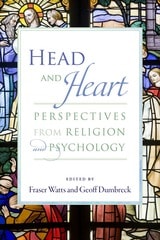
Head and Heart
Perspectives from Religion and PsychologyFraser Watts
Templeton Press, 2013
The fact that this distinction has been so persistent makes it an important area of study. Head and Heart: Perspectives from Religion and Psychology takes an inter-disciplinary approach, linking the thinking of theologians and philosophers with theory and research in present-day psychology. The tradition of using framing questions that have been developed in theology and philosophy can now be brought into dialogue with scientific approaches developed within cognitive psychology and neuroscience. Though these scientific approaches have not generally used the terms “head” and “heart,” they have arrived at a similar distinction in other ways. There is a notable convergence upon the realization that humans have two modes of cognition at their disposal that correspond to “head” and “heart.” The time is therefore ripe to bring the approaches of theology and science in to dialogue—an important dialogue that has been heretofore neglected.
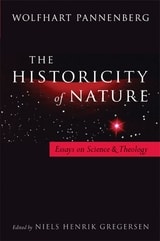
Historicity of Nature
Essays on Science and TheologyWolfhart Pannenberg
Templeton Press, 2008
Known as one of the most outstanding theologians of the twentieth century, Wolfhart Pannenberg is also considered a great interdisciplinary thinker. Now, essays and articles on science and theology that are central to understanding Pannenberg's theories have been collected into one volume.
Niels Henrik Gregersen, a former student of Pannenberg and now professor of systematic theology at Copenhagen University, has compiled the writings in four sections: Methodology, Creation and Nature's Historicity, Religion and Anthropology, and Meaning and Metaphysics. Included in this volume are:
•Translations of Pannenberg's principled argument for the consonance between science and religion, including contingency and laws of nature, field theories and space-time, and divine action•Translations of Pannenberg's theory of theology as a rational hypothetical science, including his discussions with leading British and American scholars such as A. N. Whitehead, John Cobb, and Langdon Gilkey
•Previously unpublished articles on the problems between science and theology in the course of modern history, explaining why chance may be more important for theology than design
•Translations of seminal articles that articulate Pannenberg's understanding of the role of religion in human nature
•One of the few theological articles on aggression as a psychological and social phenomenon
With this collection, the essays of this important contemporary theologian and his illuminating views are presented in one convenient volume.
Horizons of Cosmology
Joseph Silk
Templeton Press, 2009
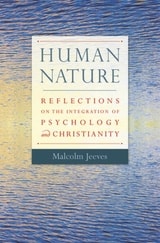
Human Nature
Reflections on the Integration of Psychology and ChristianityMalcolm Jeeves
Templeton Press, 2006
College and university professors have been demanding that this book, out of print for several years, be made available again, as it is unique in its field. This new edition, which includes a new preface and guidance to current literature, offers a balanced study of the implications of scientific developments in psychology and neuroscience for traditional Christian beliefs.
Malcolm Jeeves, former editor-in-chief of Neuropsychologia, a leading international scientific journal in behavioral and cognitive neuroscience, explores the intersection of science and faith in defining what it means to be human. He reports on recent scientific research on consciousness and the link between mind, brain, and behavior. He examines issues such as determinism by indicating the possible relevance of chaos theory to enduring concerns about freedom and responsibility. He looks at similarities and differences between human nature and animal nature. He reexamines traditional dualist views of soul and body in the light of contemporary research on mind and brain and argues for a wholistic model. This leads to addressing questions such as: does spiritual awareness depend on the intactness of our brains or does spirituality stand apart from our biological substrate?
Jeeves' insightful analysis of the ways recent findings in psychology relate to certain Christian beliefs about people expands the global science religion dialogue.
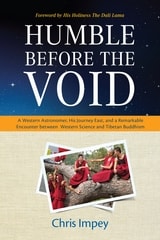
Humble before the Void
A Western Astronomer, his Journey East, and a Remarkable Encounter Between Western Science and Tibetan BuddhismChris Impey
Templeton Press, 2014
“This book will provide readers with a greater awareness of the spirit of curiosity and inquiry that lies at the heart of the Buddhist tradition, as well as the fruitfulness of maintaining active communication between the Buddhist and scientific communities.” —from the Foreword by His Holiness the Dalai Lama
In Humble before the Void, Impey, a noted astronomer, educator, and author gives us a thoroughly absorbing and engaging account of his journey to Northern India to teach in the first-ever “Science for Monks” leadership program. The program was initiated by His Holiness the Dalai Lama to introduce science into the Tibetan Buddhist monastic tradition.
In a vivid and compelling narrative, Impey introduces us to a group of exiled Tibetan monks whose charm, tenacity and unbridled enthusiasm for learning is infectious. Impey marvels not only at their enthusiasm, but at their tireless diligence that allows the monks to painstakingly build intricate sand mandalas—that can be swept away in an instant. He observes them as they meticulously count galaxies and notes how their enthusiasm and diligence stands in contrast to many American students who are frequently turned off by science’s inability to deliver easy, immediate payoffs. Because the Buddhist monks have had a limited science education, Impey must devise creative pedagogy. His new students immediately take to his inspired teaching methods, whether it’s the use of balloons to demonstrate the Hubble expansion or donning an Einstein mask to explain the theory of relativity.
Humble before the Void also recounts Impey’s experiences outside the classroom, from the monks’ eagerness to engage in pick-up basketball games and stream episodes of hip American sitcoms to the effects on his relationship with the teenage son who makes the trip with him. Moments of profound serenity and beauty in the Himalayas are contrasted with the sorrow of learning that other monks have set themselves on fire to protest the Chinese oppression in Tibet.
At the end of the three week program, both the monks and Impey have gained a valuable education. While the monks have a greater understanding and appreciation of science, Impey has acquired greater self- knowledge and a deeper understanding of the nature of learning and teaching in the East and West. This understanding leads to a renewed enthusiasm for making his topic come alive for others.