Results by title
598 books match the query 'Religious' and 21 start with h

Hagar Poems
Mohja Kahf
University of Arkansas Press, 2016
“Mohja Kahf ’s Hagar Poems is brilliantly original in its conception, thrillingly artful in its execution. Its range is immense, its spiritual depth is profound, it negotiates its shifts between archaic and the contemporary with utmost skill. There’s lyricism, there’s satire, there’s comedy, there’s theology of a high order in this book.”
—Alicia Ostriker, author of For the Love of God: The Bible as an Open Book
“Hagar/ Hajar the immigrant/exile/outcast/refugee mother of a people is given multiple voices and significance in Mohja Kahf’s new book of dramatic monologues, which also reinvents Pharaoh’s daughter, Zuleika, Aïsha, and Mary in poems that are at once lively and learned, agnostic and devout. The sequence on an American mosque, and the poet’s ambivalent love for what it represents, is unique in American poetry.”
—Marilyn Hacker, author of A Stranger’s Mirror
“‘Where have all the goddesses gone,’ writes Mohja Kahf, ‘I tracked down Isis / incognito on Cyprus. /She told me Ishtar / lived under the radar / in southern Iraq. . . .’ In Hagar Poems, Mohja Kahf’s hallmark qualities—irreverence, imagination, wit, poignancy—are all exuberantly in evidence. A wonderful read.”
—Leila Ahmed, author of A Quiet Revolution: The Veil’s Resurgence, from the Middle East to America
“This brilliant collection captures all the ‘patient threading of relationship’ between Hagar and Sarah as between women, and then between women and men, between human and God. . . . At every turn of the page [Kahf] refuses complacency and circumstance but opts instead for exposing the tenuousness of threads that tie and bind and then come loose before our eyes.”
—From the foreword by Amina Wadud
The central matter of this daring new collection is the story of Hagar, Abraham, and Sarah—the ancestral feuding family of Judaism, Christianity, and Islam.
These poems delve into the Hajar story in Islam. They explore other figures from the Near Eastern heritage, such as Mary and Moses, and touch on figures from early Islam, such as Fatima and Aisha. Throughout, there is artful reconfiguring. Readers will find sequels and prequels to the traditional narratives, along with modernized figures claimed for contemporary conflicts.
Hagar Poems is a compelling shakeup of not only Hagar’s story but also of current roles of all kinds of women in all kinds of relationships.
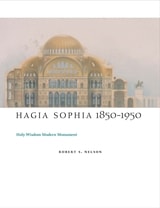
Hagia Sophia, 1850-1950
Holy Wisdom Modern MonumentRobert S. Nelson
University of Chicago Press, 2004
Built from 532 to 537 as the Cathedral of Constantinople, Hagia Sophia was little studied and seldom recognized as a great monument of world art until the nineteenth century, and Nelson examines the causes and consequences of the building's newly elevated status during that time. He chronicles the grand dome's modern history through a vibrant cast of characters—emperors, sultans, critics, poets, archaeologists, architects, philanthropists, and religious congregations—some of whom spent years studying it, others never visiting the building. But as Nelson shows, they all had a hand in the recreation of Hagia Sophia as a modern architectural icon. By many means and for its own purposes, the West has conceptually transformed Hagia Sophia into the international symbol that it is today.
While other books have covered the architectural history of the structure, this is the first study to address its status as a modern monument. With his narrative of the building's rebirth, Nelson captures its importance for the diverse communities that shape and find meaning in Hagia Sophia. His book will resonate with cultural, architectural, and art historians as well as with those seeking to acquaint themselves with the modern life of an inspired and inspiring building.

Haim Nahum
A Sephardic Chief Rabbi in Politics, 1892-1923Esther Benbassa
University of Alabama Press, 1995
A collection of rare writings and correspondence by a rabbi and diplomat active at the end of the Ottoman Empire
Rabbi, diplomat, linguist, fixer of delicate problems, Haim Nahum moved through the last years of the Ottoman world and the birth of the modern Middle East with uncommon dexterity. He left behind a rich trove of letters and writing, the best of which are collected in this volume. For contemporary readers, his story feels surprisingly current. He inhabited an age crowded with competing identities, clashing nationalisms, and endless political improvisations. In other words, he would feel perfectly at home today.
The most intriguing feature of Nahum is not that he occupied important positions, but that he seemed constitutionally incapable of belonging to only one world. Equally at ease among statesmen, clerics, scholars, and bureaucrats, he functioned as a human connecting flight between cultures. In this fascinating biography first edited and published in French in 1990, Esther Benbassa captures this cosmopolitan figure without embalming him in reverence, allowing readers to encounter a subtle, resourceful, and occasionally elusive man whose métier was negotiation and whose natural habitat was complexity.
This book will delight readers of Ottoman history, Jewish history, Middle Eastern affairs, diplomatic history, biography, religious studies, and Mediterranean culture. It will also appeal to polyglots, antiquarians, devotees of vanished empires, and anyone attracted to those liminal figures who stand at the crossroads of civilizations, translating not merely languages but entire ways of seeing the world.

Handmaid of the Holy Spirit
Dame Eleanor Davies, Never Soe Mad a LadieEsther S. Cope
University of Michigan Press, 1993
Harmonic Function in Chromatic Music
A Renewed Dualist Theory and an Account of Its PrecedentsDaniel Harrison
University of Chicago Press, 1994
One of Harrison's central innovations is his reconstruction of the notion of harmony. Harrison understands harmonic power to flow not from chords as such but from the constituents of chords, reckoned for the most part as scale degrees of a key. This insight proves especially useful in analyzing the unusual progressions and key relations that characterize chromatic music.
Complementing the theoretical ideas is a critical history of nineteenth-century German harmonic theory in which Harrison traces the development of Hugo Riemann's ideas on dualism and harmonic function and examines aspects of Riemannian theory in the work of later theorists. Combining theoretical innovations with a sound historical understanding of those innovations, Harmonic Function in Chromatic Music will aid anyone studying this pivotal period of Western music history.
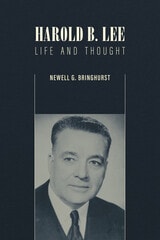
Harold B. Lee
Life and ThoughtNewell G. Bringhurst
Signature Books, 2021

Hawksmoor's London Churches
Architecture and TheologyPierre de la Ruffinière du Prey
University of Chicago Press, 2000
Hegel on Hamann
G. W. F. Hegel
Northwestern University Press, 2008
In 1828, G. W. F. Hegel published a critical review of Johann George Hamann, a retrospective of the life and works of one of Germany's most enigmatic and challenging thinkers and writers. While Hegel's review had enjoyed a central place in Hamann studies since its appearance, Hegel on Hamann is the first English translation of the important work. Philosophers, theologians, and literary critics welcome Anderson's stunning translation since Hamann is gaining renewed attention, not only as a key figure of German intellectual history, but also as an early forerunner of postmodern thought. Relationships between Enlightenment, Counter Enlightenment, and Idealism come to the fore as Hegel reflects on Hamann's critiques of his contemporaries Immanuel Kant, Moses Mendelssohn, J. G. Herder, and F. H. Jacobi. Hegel on Hamann also includes an introduction to Hegel's review, as well as an essay on the role of friendship in Hamann's life, in Hegel's thought, and in German intellectual culture more broadly. Rounding out the volume are its extensive annotations and bibliography, which facilitate further study of eighteenth- and nineteenth-century philosophy in English and German. This book is essential both for readers of Hegel or Hamann and for those interested in the history of German thought, the philosophy of religion, language and hermeneutics, or friendship as a philosophical category.
Heidegger's Confessions
The Remains of Saint Augustine in "Being and Time" and BeyondRyan Coyne
University of Chicago Press, 2015
Coyne first examines the role of Augustine in Heidegger’s early period and the development of his magnum opus, Being and Time. He then goes on to show that Heidegger owed an abiding debt to Augustine even following his own rise as a secular philosopher, tracing his early encounters with theological texts through to his late thoughts and writings. Bringing a fresh and unexpected perspective to bear on Heidegger’s profoundly influential critique of modern metaphysics, Coyne traces a larger lineage between religious and theological discourse and continental philosophy.
Heir to the Crescent Moon
Abdur-Rahman, Sufiya
University of Iowa Press, 2021
In Heir to the Crescent Moon, Abdur-Rahman’s longing to comprehend her father’s complicated relationship with Islam leads her first to recount her own history, and then delves into her father’s past. She journeys from the Christian righteousness of Adam Clayton Powell Jr.’s 1950s Harlem, through the Malcolm X–inspired college activism of the late 1960s, to the unfulfilled potential of the early 1970s Black American Muslim movement. Told at times with lighthearted humor or heartbreaking candor, Abdur-Rahman’s story of adolescent Arabic lessons, fasting, and Muslim mosque, funeral, and Eid services speaks to the challenges of bridging generational and cultural divides and what it takes to maintain family amidst personal and societal upheaval. She weaves a vital tale about a family: Black, Muslim, and distinctly American.

Hell and the Mercy of God
Adrian J. Reimers
Catholic University of America Press, 2017
Catholic philosopher Adrian Reimers takes on these challenges in Hell and the Mercy of God, drawing on relevant sources from Aristotle to Aquinas, from Dante to Tolkien, from Wagner to John Paul II, along with Billie Holliday, The Godfather, and the music of George Gershwin. He presents a philosophical theology, grounded in Scripture, of the nature of goodness and evil, exploring various types of pain, the seven capital sins, the resurrection of the body, the meaning of mammon, the core meaning of idolatry, the psychology of Satan and those who choose his path, and the moral responsibility of the human person.
These reflections illuminate the intelligibility of orthodox Catholic teachings on the goodness of God and the reality of hell. Hell is not an arbitrary imposition set up for human rule-breakers but a continuation of a freely chosen way of life manifest even in this world. Examples from history, art, and contemporary culture lead the author to conclude that anyone who does not believe in the reality of hell is not paying enough attention. And yet, mercy and hope remain triumphant, because, just as Christ offers entrance into paradise to the “good thief” Dismas on the cross, God continues to offer repentance and salvation to all who live.
Hermann Cohen
Writings on Neo-Kantianism and Jewish PhilosophyEdited by Samuel Moyn and Robert Schine
Brandeis University Press, 2021
Hermann Cohen (1842–1918) was among the most accomplished Jewish philosophers of modern times—if not the single most significant. But his work has not yet received the attention it deserves. This newly translated collection of his writings—most of which are appearing in English for the first time—illuminates his achievements for student readers and rectifies lapses in his intellectual reception by prior generations. It presents chapters from Cohen’s Ethics of Pure Will, conflicting interpretations of Cohen by Franz Rosenzweig and Alexander Altmann, and finally the eulogy to Cohen delivered at graveside by Ernst Cassirer. Containing full annotations and selections that concentrate both on the philosophical core of Cohen’s writings and the politics of interpretation of his work at the time of his death and after, Hermann Cohen truly brings to light all of Cohen’s accomplishments.
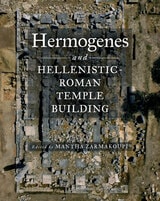
Hermogenes and Hellenistic-Roman Temple Building
Edited by Mantha Zarmakoupi
University of Wisconsin Press, 2026
Hermogenes remains one of the most influential and famous designers of the Hellenistic world, although he is known primarily via the first-century BCE Roman architect Vitruvius, who credited his Greek predecessor with major accomplishments. Despite his comparative fame, the paucity of sources has nevertheless obscured Hermogenes’ legacy. This volume updates the evidence, reevaluates this highly significant figure, and reintroduces crucial innovations in the ancient Greek world—innovations that continue to be influential today.
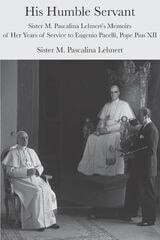
His Humble Servant
Sister M. Pascalina Lehnert's Memoirs of Her Years of Service to Eugenio Pacelli, Pope Pius XIIM. Pascalina Lehnert
St. Augustine's Press, 2012
This is a personal and insightful portrait of Pope Pius XII, the memories of Sister M. Pascalina Lehnert, who served as his housekeeper for forty years. Her book, most of it written just a few months after the Pope’s death, shares insights into the person, the life, and the thinking of Pius XII, from his time as Nuncio in Munich until his death. Much of Sister’s motivation in writing this work was to correct the many distortions of fact and interpretation regarding this great pope.
This book was a best seller in the original German, as well as in the Italian and French translations. This is the first edition in English.
These reminiscences were written down at the instructions of Sister’s Superior General, but were not made known to the public until 1982, when it was published in German at the express wishes of Pope John Paul II to publish the work without any changes. So the work remained a lively, flowing account of memories and anecdotes in a simple, spontaneous style. It is a powerful and insightful account of Pius’s daily life, his treatment of those around him, and his concern for the upholding of the traditional teaching of the Church in the face of his awesome burden to lead the Church during World War II.
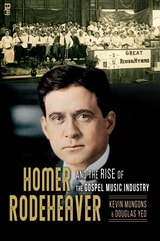
Homer Rodeheaver and the Rise of the Gospel Music Industry
Kevin Mungons and Douglas Yeo
University of Illinois Press, 2021
Homer Rodeheaver merged evangelical hymns and African American spirituals with popular music to create a potent gospel style. Kevin Mungons and Douglas Yeo examine his enormous influence on gospel music against the backdrop of Christian music history and Rodeheaver's impact as a cultural and business figure. Rodeheaver rose to fame as the trombone-playing song leader for evangelist Billy Sunday. As revivalism declined after World War I, Rodeheaver leveraged his place in America's newborn celebrity culture to start the first gospel record label and launch a nationwide radio program. His groundbreaking combination of hymnal publishing and recording technology helped define the early Christian music industry. In his later years, he influenced figures like Billy Graham and witnessed the music's split into southern gospel and black gospel.
Clear-eyed and revealing, Homer Rodeheaver and the Rise of the Gospel Music Industry is an overdue consideration of a pioneering figure in American music.
Homo Viator
Introduction to the Metaphysic of HopeGabriel Marcel
St. Augustine's Press, 2010
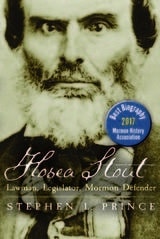
Hosea Stout
Lawman, Legislator, Mormon DefenderStephen L. Prince
Utah State University Press, 2016
Stout joined the Mormons in Missouri in 1838 and followed them to Nauvoo, where he rose quickly to become a top leader in the Nauvoo Legion and chief of police, a position he also held at Winter Quarters. He became the first attorney general for the Territory of Utah, was elected to the Utah Territorial Legislature, and served as regent for the University of Deseret (which later became the University of Utah) and as judge advocate of the Nauvoo Legion in Utah. In 1862, Stout was appointed US attorney for the Territory of Utah by President Abraham Lincoln. In 1867, he became city attorney of Salt Lake City and he was elected to the Utah House of Representatives in 1881.
But Stout’s history also had its troubled moments. Known as a violent man and aggressive enforcer, he was often at the center of controversy during his days on the police force and was accused of having a connection with deaths in Nauvoo and Utah. Ultimately, however, none of these allegations ever found traction, and the leaders of the LDS community, especially Brigham Young, saw to it that Stout was promoted to roles of increasing responsibility throughout his life. When he died in 1889, Hosea Stout left a complicated legacy of service to his state, his church, and the members of his faith community.
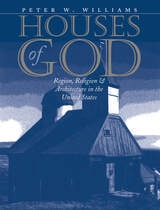
Houses of God
Region, Religion, and Architecture in the United StatesPeter W. Williams
University of Illinois Press, 1997

Hugh Nibley
A Mormon ScholarJoseph M. Spencer
University of Illinois Press, 2027
Joseph M. Spencer examines Nibley’s theology, social criticism, and thought. Nibley’s elite academic training led to a long career at Brigham Young University. There he used ancient texts and comparative history to support his religious claims and confront modern culture and values. Spencer reveals Nibley as a serious thinker whose theology of grace buttressed the whole of his work. As he shows, readers misinterpret Nibley by seeing his scholarship as separate from his theology and social criticism, rather than as a unified project that emerged from the many streams of his wide-ranging thought.
Clear-eyed and accessible, Hugh Nibley provides a much-needed guide to the work of an important yet misunderstood theologian and intellectual.
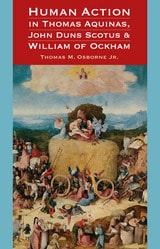
Human Action in Thomas Aquinas, John Duns Scotus, and William of Ockham
Thomas M. Osborne Jr.
Catholic University of America Press, 2014

Hymns / Inni
Giuseppe Verdi
University of Chicago Press, 2007
This newest volume in The Works of Giuseppe Verdi series comprises his only two surviving secular choral works: Inno popolare, or Hymn of the People, for unaccompanied male chorus, and Inno delle nazioni, or Hymn of the Nations, for tenor solo, chorus, and orchestra.
Verdi wrote the brief Inno popolare in 1848 at the behest of the Italian philosopher and patriot Giuseppe Mazzini, intending that it become an anthem for Italy at a time when the country had just driven away its Austrian overlords. He wrote no more independent patriotic pieces until he was asked in 1861 to represent his country with a patriotic composition at a musical jubilee during London’s International Exhibition of 1862. The resulting piece was Inno delle nazioni, the critical edition of which is based on Verdi’s autograph score, preserved at the British Library. Other important sources include the composer's musical sketches, recently discovered in the Verdi family villa, and the performing parts Toscanini used for a BBC broadcast in 1943.