Results by title
123 books match the query 'Religious life' and 5 start with h
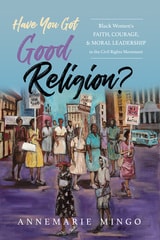
Have You Got Good Religion?
Black Women's Faith, Courage, and Moral Leadership in the Civil Rights MovementAnneMarie Mingo
University of Illinois Press, 2024
What compels a person to risk her life to change deeply rooted systems of injustice in ways that may not benefit her? The thousands of Black Churchwomen who took part in civil rights protests drew on faith, courage, and moral imagination to acquire the lived experiences at the heart of the answers to that question. AnneMarie Mingo brings these forgotten witnesses into the historical narrative to explore the moral and ethical world of a generation of Black Churchwomen and the extraordinary liberation theology they created. These women acted out of belief that what they did was bigger than themselves. Taking as their goal nothing less than the moral transformation of American society, they joined the movement because it was something they had to do. Their personal accounts of a lived religion enacted in the world provide powerful insights into how faith steels human beings to face threats, jail, violence, and seemingly implacable hatred. Throughout, Mingo draws on their experiences to construct an ethical model meant to guide contemporary activists in the ongoing pursuit of justice.
A depiction of moral imagination that resonates today, Have You Got Good Religion? reveals how Black Churchwomen’s understanding of God became action and transformed a nation.
[more]
Healing Ableism
Stories About Disability and Religious LifeDarla Schumm
Rutgers University Press, 2026
Most people encounter disability at some point in their lives, either in their own bodies or through a friend or loved one. Faith leaders, sacred texts, and members of religious communities frequently offer religious teachings and metaphors as explanation for the presence of disability, but rarely do we hear the voices of people living with disabilities reflecting on their experiences of God, faith, or religious life. In Healing Ableism: Stories about Disability and Religious Life, Darla Schumm explores the extraordinary stories of people with disabilities who struggle with the ordinary human challenges of faith and doubt, exclusion and inclusion, and injustice and justice. Blending candid story-telling, cultural critique, and theory, Schumm invites readers to reflect on the experiences of people with disabilities in religious communities and organizations. Schumm argues that it’s not disability that needs healing, it’s ableism that needs healing. In the final chapter, Schumm offers accessible love as one avenue for healing ableism.
[more]
Heartwood
The First Generation of Theravada Buddhism in AmericaWendy Cadge
University of Chicago Press, 2004
Theravada is one of the three main branches of Buddhism. In Asia it is practiced widely in Thailand, Laos, Burma, Sri Lanka, and Cambodia. This fascinating ethnography opens a window onto two communities of Theravada Buddhists in contemporary America: one outside Philadelphia that is composed largely of Thai immigrants and one outside Boston that consists mainly of white converts.
Wendy Cadge first provides a historical overview of Theravada Buddhism and considers its specific origins here in the United States. She then brings her findings to bear on issues of personal identity, immigration, cultural assimilation, and the nature of religion in everyday life. Her work is the first systematic comparison of the ways in which immigrant and convert Buddhists understand, practice, and adapt the Buddhist tradition in America. The men and women whom Cadge meets and observes speak directly to us in this work, both in their personal testimonials and as they meditate, pray, and practice Buddhism.
Creative and insightful, Heartwood will be of enormous value to sociologists of religion and anyone wishing to understand the rise of Buddhism in the Western world.
[more]
Heaven's Kitchen
Living Religion at God's Love We DeliverCourtney Bender
University of Chicago Press, 2003
How do people practice religion in their everyday lives? How do our daily encounters with people who hold different religious beliefs shape the way we understand our own moral and spiritual selves? In Heaven's Kitchen, Courtney Bender takes a highly original approach to answering these questions. For more than a year she worked in New York City as a volunteer for a nonprofit, nonreligious organization called God's Love We Deliver, helping to prepare home-cooked meals for people with AIDS. Paying close attention to what was said and not said, Bender traces how the volunteers gave voice to their moral positions and religious values. She also examines how they invested their conversations, and mundane activities such as cooking, with personal meaning that in turn affected how they saw their own spiritual lives. Filled with vibrant storytelling and rich theoretical insights, Heaven's Kitchen shows faith as a living practice, reshaping our understanding of the role of religion in contemporary American life.
[more]
Hillel at Michigan, 1926/27-1945
Struggles of Jewish Identity in a Pivotal EraAndrei S. Markovits and Kenneth Garner
Michigan Publishing Services, 2016
This book provides the very first in-depth analysis of the founding decades of a major Hillel chapter in the United States. Hillel at the University of Michigan was founded in 1926 as the fourth such chapter in the United States following its establishment at three other public universities in the Midwest: Illinois (1923); Wisconsin (1924); Ohio State (1925).
The study analyzes Hillel's challenges as a big-tent, catch-all institution trying to represent all Jewish students on campus regardless of their religious orientation, cultural preferences, and ideological predilections. It looks at Hillel's interactions with the then powerful Jewish fraternities and sororities that provided the main locus of Jewish life on campus at the time, as well as its relations with the University's leadership and many of its cultural and political constituencies. Most of these activities occurred at a time when anti-Semitism was rife in the United States, particularly in the larger Detroit area, home to Henry Ford and Father Charles Edward Coughlin.
The study analyzes Hillel's challenges as a big-tent, catch-all institution trying to represent all Jewish students on campus regardless of their religious orientation, cultural preferences, and ideological predilections. It looks at Hillel's interactions with the then powerful Jewish fraternities and sororities that provided the main locus of Jewish life on campus at the time, as well as its relations with the University's leadership and many of its cultural and political constituencies. Most of these activities occurred at a time when anti-Semitism was rife in the United States, particularly in the larger Detroit area, home to Henry Ford and Father Charles Edward Coughlin.
[more]