Results by title
51 books match the query 'Rights' and 2 start with h
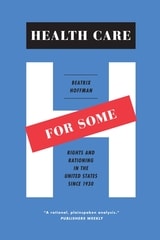
Health Care for Some
Rights and Rationing in the United States since 1930Beatrix Hoffman
University of Chicago Press, 2012
In Health Care for Some, Beatrix Hoffman offers an engaging and in-depth look at America’s long tradition of unequal access to health care. She argues that two main features have characterized the US health system: a refusal to adopt a right to care and a particularly American approach to the rationing of care. Health Care for Some shows that the haphazard way the US system allocates medical services—using income, race, region, insurance coverage, and many other factors—is a disorganized, illogical, and powerful form of rationing. And unlike rationing in most countries, which is intended to keep costs down, rationing in the United States has actually led to increased costs, resulting in the most expensive health care system in the world.
While most histories of US health care emphasize failed policy reforms, Health Care for Some looks at the system from the ground up in order to examine how rationing is experienced by ordinary Americans and how experiences of rationing have led to claims for a right to health care. By taking this approach, Hoffman puts a much-needed human face on a topic that is too often dominated by talking heads.
[more]
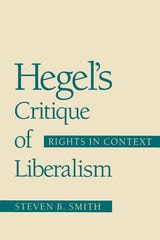
Hegel's Critique of Liberalism
Rights in ContextSteven B. Smith
University of Chicago Press, 1989
In Hegel's Critique of Liberalism, Steven B. Smith examines Hegel's critique of rights-based liberalism and its relevance to contemporary political concerns. Smith argues that Hegel reformulated classic liberalism, preserving what was of value while rendering it more attentive to the dynamics of human history and the developmental structure of the moral personality. Hegel's goal, Smith suggests, was to find a way of incorporating both the ancient emphasis on the dignity and even architectonic character of political life with the modern concern for freedom, rights, and mutual recognition. Smith's insightful analysis reveals Hegel's relevance not only to contemporary political philosophers concerned with normative issues of liberal theory but also to political scientists who have urged a revival of the state as a central concept of political inquiry.
[more]