Results by title
117 books match the query 'Rural conditions' and 3 start with h

Hapa Girl
A MemoirMay-lee Chai
Temple University Press, 2008
In the mid-1960s, Winberg Chai, a young academic and the son of Chinese immigrants, married an Irish-American artist. In Hapa Girl ("hapa" is Hawaiian for "mixed") their daughter tells the story of this loving family as they moved from Southern California to New York to a South Dakota farm by the 1980s. In their new Midwestern home, the family finds itself the object of unwelcome attention, which swiftly escalates to violence. The Chais are suddenly socially isolated and barely able to cope with the tension that arises from daily incidents of racial animosity, including random acts of cruelty.
May-lee Chai's memoir ends in China, where she arrives just in time to witness a riot and demonstrations. Here she realizes that the rural Americans' "fears of change, of economic uncertainty, of racial anxiety, of the unknowable future compared to the known past were the same as China's. And I realized finally that it had not been my fault."
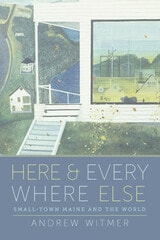
Here and Everywhere Else
Small-Town Maine and the WorldAndrew Witmer
University of Massachusetts Press, 2022
Winner of the 2023 New England Society Book Award in the Historical Nonfiction category
Winner of an Award of Excellence, American Association for State and Local History (AASLH)
In 1822, settlers pushed north from Massachusetts and other parts of New England into Monson, Maine. On land taken from the Penobscot people, they established prosperous farms and businesses. Focusing on the microhistory of this village, Andrew Witmer reveals the sometimes surprising ways that this small New England town engaged with the wider world across the nineteenth and twentieth centuries. Townspeople fought and died in distant wars, transformed the economy and landscape with quarries and mills, and used railroads, highways, print, and new technologies to forge connections with the rest of the nation.
Here and Everywhere Else starts with Monson’s incorporation in the early nineteenth century, when central Maine was considered the northern frontier and over 90 percent of Americans still lived in rural areas; it ends with present-day attempts to revive this declining Maine town into an artists’ colony. Engagingly written, with colorful portraits of local characters and landmarks, this study illustrates how the residents of this remote place have remade their town by integrating (and resisting) external influences.

Hot Towns
The Future of the Fastest Growing Communities in AmericaWolf, Peter
Rutgers University Press, 1999
Hot Towns is about the vast, current national relocation of one million Americans a year. Successful, accomplished, and well-financed people of all ages are moving to communities they view as choice—places distinguished by fine climate, physical beauty, abundant natural recreation resources, and minimal social problems and low crime. Towns in this elite roster include Santa Fe, Aspen, Boulder, Bozeman, Chapel Hill, East Hampton, and many others.
These American boom towns, Peter Wolf writes, have grown in jobs and population at two to three times the national average. But warning signs of deterioration are already evident: overbuilding, failing natural resources, rising taxes, and traffic congestion are all taking a toll on these communities. Rapid migration can enhance or swamp America’s fastest growing and most desirable communities
Wolf examines the choices that people in these areas can make to both effectively accommodate growth and yet ensure their economic futures. A wise town undergoing growth will realize that what must be preserved is not the growth in-and-for itself, but the qualities which attract people in the first place. Wolf demonstrates how it is possible—even during a town’s rapid expansion—to enhance the quality of residents’ lives, to incorporate aesthetics and design into town evolution, to protect what is precious in nature, and to preserve the best that has already been built.
Wolf concludes with a practical checklist for the residents of hot towns, allowing them to evaluate how their communities are coping with growth.