Results by title
137 books match the query 'Science & Technology' and 7 start with h
Hardy Cross
American EngineerLeonard K. Eaton
University of Illinois Press, 2006
Helmholtz
A Life in ScienceDavid Cahan
University of Chicago Press, 2018
Utilizing all of Helmholtz’s scientific and philosophical writings, as well as previously unknown letters, this book reveals the forces that drove his life—a passion to unite the sciences, vigilant attention to the sources and methods of knowledge, and a deep appreciation of the ways in which the arts and sciences could benefit each other. By placing the overall structure and development of his scientific work and philosophy within the greater context of nineteenth-century Germany, Helmholtz also serves as cultural biography of the construction of the scientific community: its laboratories, institutes, journals, disciplinary organizations, and national and international meetings. Helmholtz’s life is a shining example of what can happen when the sciences and the humanities become interwoven in the life of one highly motivated, energetic, and gifted person.
Henry Darwin Rogers, 1808–1866
American GeologistPatsy Gerstner
University of Alabama Press, 1994
The life and legacy of a pioneer who helped shape American geology.
Henry Darwin Rogers, 1808–1866: American Geologist is the first comprehensive biography of Henry Darwin Rogers, one of the pioneering figures who helped establish geology as a professional scientific discipline in the United States. Written by historian Patsy Gerstner, this meticulously researched study traces Rogers's life from his early education and scientific interests to his leadership of the groundbreaking geological surveys of New Jersey and Pennsylvania.
At a time when American science was still in its formative stages, Rogers distinguished himself through extensive fieldwork, influential publications, and innovative theories about the formation of mountain systems. His investigations of Pennsylvania's Appalachian region led to one of the first distinctly American theories of mountain elevation and helped advance understanding of the earth's geological structure. Gerstner places these achievements within the broader context of nineteenth-century scientific institutions, professional rivalries, and the growing importance of state-sponsored research
More than a scientific biography, the book offers a compelling account of the emergence of American geology and the individuals who transformed natural history into a rigorous scientific enterprise. It is an indispensable resource for understanding the history of science, the development of geological thought, and the evolution of scientific professionalism in the United States.
Henry William Ravenel, 1814-1887
South Carolina Scientist in the Civil War EraTamara Miner Haygood
University of Alabama Press, 1987
The life of a pioneering Southern scientist in an era of war, change, and discovery.
Henry William Ravenel, 1814–1887: South Carolina Scientist in the Civil War Era is a compelling biography of one of nineteenth-century America's most accomplished yet largely overlooked natural scientists. Through meticulous archival research, Tamara Miner Haygood brings to life the story of Henry William Ravenel, a South Carolina planter, botanist, and pioneering mycologist whose work earned international recognition while he lived far from the major scientific centers of the United States.
Born into the Lowcountry planter class, Ravenel developed a lifelong fascination with the natural world and became a leading authority on the study of fungi and plants. Despite limited formal scientific training, he built an extensive network of correspondents that included some of the most prominent botanists in America and Europe. His collections, publications, and exchanges of specimens contributed significantly to the advancement of botanical science and established his reputation as one of the foremost naturalists of his generation.
Haygood places Ravenel's scientific achievements within the broader context of Southern society, demonstrating how intellectual pursuits flourished in unexpected ways within a region often overlooked in histories of American science. At the same time, the biography confronts the realities of slavery, plantation life, religion, and regional identity that shaped Ravenel's world. His experience challenges long-held assumptions about the relationship between Southern culture and scientific inquiry.
The Civil War and its aftermath transformed Ravenel's life, disrupting his finances, professional networks, and daily routines. Yet he remained committed to scientific work, continuing to collect, study, and publish despite enormous challenges. More than a biography, this volume offers a fascinating exploration of science, society, and survival during one of the most turbulent periods in American history. Essential reading for historians of science, Civil War scholars, environmental historians, botanists, and students of Southern culture.
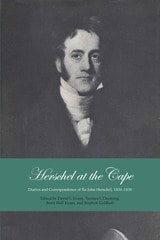
Herschel at the Cape
Diaries and Correspondence of Sir John Herschel, 1834-1838Edited by David S. Evans, Terence J. Deeming, Betty Hall Evans, and Stephen Goldfarb
University of Texas Press, 1969
Sir John Herschel, one of the founders of Southern Hemisphere astronomy, was a man of extraordinarily wide interests. He made contributions to botany, geology, and ornithology, as well as to astronomy, chemistry, and mathematics. Throughout his scientific career he kept a diary, recording his public and private life. The diaries from 1834 to 1838, years he spent making astronomical observations at the Cape of Good Hope, are reproduced in this book and prove to be much more than an ordinary scientist’s logbook. They present personal and social history, literary commentaries, the results of close observations of nature and numerous scientific experiments, the excitement of travel, political intrigues, gossip, and philosophical reflections—all interpreted through an alert and versatile mind. In the present transcription, the material has been enriched with selected correspondence of Sir John and his wife Lady Herschel (née Margaret Brodie Stewart).
Sir John devoted his working time at the Cape primarily to a systematic observation of the southern sky, complementing his earlier “sweeping” of the northern sky at Slough, England. He later became one of the founders of photography, but at the Cape he used a simple optical device, the camera lucida, in the production of numerous landscape drawings. Many of these, along with reproductions of sketches contained in the diaries and botanical drawings made by Sir John and Lady Herschel, are used to illustrate this book. Sir John was also a leading figure in the foundation of the educational system of the Cape and a supporter of exploratory expeditions into the interior.
As the son of Sir William Herschel, in his day the most famous British astronomer and the discoverer of the planet Uranus, Sir John was already celebrated when he arrived from England. Every individual of note, resident at the Cape or visiting, went to see him. He was supported in his work by his wife, who ran an enormous establishment and bore a huge family, but who nevertheless found time to travel in the country around the western Cape with him and to assist in his observations.
The diaries and letters are supplemented by especially valuable editorial notes that provide much needed and highly interesting information concerning persons and events mentioned and described by Sir John. All the original manuscript material used in this volume is archived at the Harry Ransom Center at the University of Texas at Austin. Sir John’s camera lucida drawings are from the South African Public Library in Cape Town.
Hostages of Each Other
The Transformation of Nuclear Safety since Three Mile IslandJoseph V. Rees
University of Chicago Press, 1996
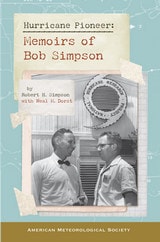
Hurricane Pioneer
Memoirs of Bob SimpsonRobert H. Simpson with Neal M. Dorst
American Meteorological Society, 2014
For Simpson this was just one of his many pioneering explorations of hurricanes and extreme storms. Over his decades-long career his research led to great leaps in our understanding of tropical meteorology and our approach to hurricane safety. He was the first director of the National Hurricane Research Project and the second director of the National Hurricane Center, though he may be best known as co-creator of the widely used Saffir-Simpson Hurricane Scale, familiar to anyone who has heard a reporter use the words “category five.”
Simpson’s memoirs take readers from his experience with the Corpus Christi hurricane of 1919 to his travels to study weather across the globe. Along the way he crosses paths with other weather greats, including his trailblazing wife, meteorologist Joanne Simpson. Hurricane Pioneer is a riveting first-hand account at a revolutionary time in meteorology.